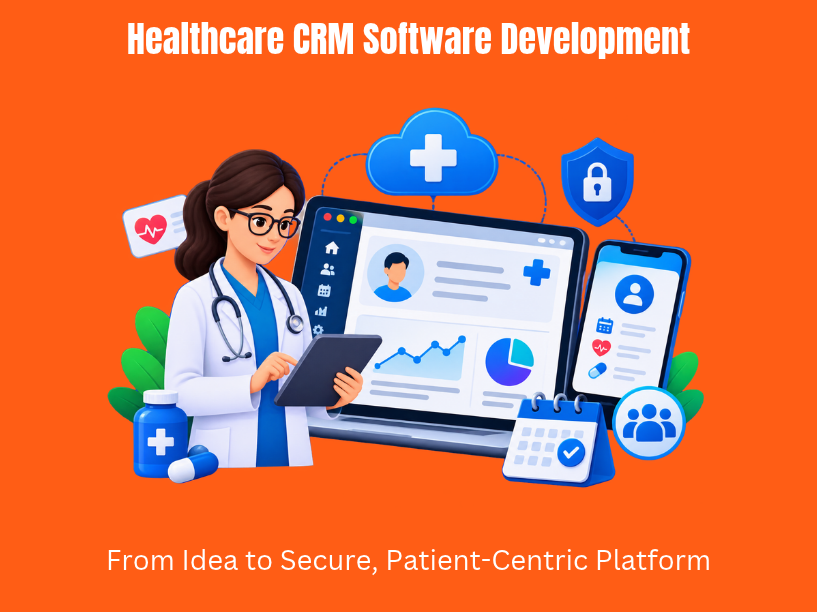

Healthcare organizations today face a widening gap between what patients expect and what legacy systems deliver. Patients want seamless digital interactions similar to what they experience in banking or retail. Providers need visibility into every touchpoint that happens before, between, and after clinical visits. That gap is exactly where healthcare CRM software development comes in, and getting it right has become a strategic priority rather than a nice-to-have.
This guide walks through everything involved in planning, building, and maintaining a healthcare CRM platform: architecture decisions, must-have features, compliance requirements, AI capabilities, integration strategies, and phased rollout planning for healthcare providers and healthtech companies alike.
Healthcare CRM software development addresses a specific challenge: managing patient relationships across every non-clinical interaction, from intake and referrals to follow-ups and long-term retention. Unlike an EHR, which serves as the clinical system of record, a healthcare CRM acts as the system of engagement. And unlike a generic CRM built for sales pipelines, a healthcare CRM must handle consent management, care-gap tracking, regulatory compliance, and deep integration with clinical systems. The 2024–2026 window represents a tipping point, driven by aging populations, normalized telehealth, and the shift to value-based care contracts that reward engagement over volume.
A well-built healthcare CRM delivers measurable outcomes: higher patient retention, stronger patient engagement through personalized communication, fewer no-shows, and clearer visibility into patient interactions across channels. CRM systems enhance operational efficiency by centralizing patient data into a single, actionable view. TVL IT Solutions builds secure, interoperable healthcare CRM solutions that integrate with EHRs, billing systems, and patient portals without disrupting clinical workflows. The sections that follow cover architecture, features, compliance, tech stack, and a step-by-step development process for organizations ready to move from idea to production.
A healthcare CRM is a system designed for managing patient relationships across non-clinical touchpoints: intake forms, appointment scheduling, reminders, referral tracking, satisfaction surveys, recall campaigns, and post-visit communication. It does not replace the EHR. Instead, it complements it.
Here is how the three systems differ:
A healthcare CRM stores specific data objects: patient and household profiles, referring provider records, appointment and no-show history, engagement data from campaigns, care-gap or recall flags, and communication preference records. Healthcare CRM software should consolidate patient demographics and communication logs into a unified view.
Consider a chronic care example: a patient with diabetes receives a referral, completes intake forms, gets appointment reminders, and then the CRM identifies a missed lab (care gap) and triggers outreach. After the visit, satisfaction surveys and wellness program invitations follow. The EHR handles the clinical side. The CRM handles the relationship.
The global healthcare CRM market was valued at approximately USD 17.9 billion in 2023 and is projected to grow at a compound annual growth rate of roughly 11.6%, reaching an estimated USD 47.7 billion by 2032. That trajectory reflects several converging forces.
First, connected devices and remote monitoring generate new patient data streams that demand coordinated outreach. Second, telehealth has become a permanent fixture, expanding the surface area of patient communication that CRM systems need to manage. Third, regulatory expectations around secure communication and data management continue to tighten globally. Fourth, patients now expect seamless digital experiences shaped by their interactions with banking, retail, and travel platforms.
Regional dynamics add complexity. In the US, HIPAA and HITECH set the compliance baseline, while ONC and CMS interoperability rules push for standardized FHIR-based APIs. In the EU, GDPR drives consent workflows and data minimization requirements. In parts of APAC, data-localization rules require in-country storage and integration with legacy hospital information systems. Data-driven insights from CRM improve decision-making in healthcare, but those insights must flow within the regulatory boundaries of each market.
This rapid growth means more off-the-shelf options exist than ever, but it also increases the need for differentiated, custom healthcare CRM solutions tailored to each provider’s specific workflows and regional requirements.
A well-implemented healthcare CRM touches clinical, operational, and financial outcomes without replacing clinical systems. It acts as the connective tissue between patient-facing interactions and back-office processes.
Here are the core benefits:
An important caveat: these benefits depend heavily on change management, staff training, and integration quality. A CRM alone is not a magic bullet. Without clean data and engaged users, even the best platform will underdeliver.
Most real-world healthcare CRM platforms blend multiple CRM types, but separating them conceptually helps architects and stakeholders align on design priorities and phasing.
Operational CRM automates day-to-day workflows. Operational CRM automates administrative tasks like scheduling and billing. Think appointment reminders, call center scripts, intake form routing, and billing-adjacent follow-ups. Patient Relationship Management CRM focuses on personalized patient care at this operational layer.
Analytical CRM aggregates data from EHR feeds, claims, campaigns, and patient interactions to surface trends. Analytical CRM provides insights into patient behavior and treatment outcomes. It answers questions like: which service lines have rising no-show rates? Where is referral leakage highest? Which outreach campaigns actually drive appointments?
Collaborative CRM enables shared visibility across multi-clinic networks, integrated delivery systems, and cross-disciplinary care teams. Collaborative CRM improves communication across healthcare teams by ensuring that when a care coordinator updates a patient record, the referring provider and the specialist both see the change.
Customer Service CRM enhances patient support and satisfaction by routing inquiries, tracking resolution times, and surfacing patient history during calls. Marketing CRM targets patient engagement through personalized campaigns, segmenting populations by condition, demographics, or care-gap status.
Scenario: A mid-sized hospital network uses operational automations (appointment reminders, intake routing) that feed analytical dashboards (no-show trends by clinic, referral conversion rates). Those analytics drive new collaborative workflows where care coordinators proactively reach out to high-risk patients identified by the data.
When planning a custom healthcare CRM, the following modules form the functional backbone. Each can be prioritized and phased based on organizational readiness.
TVL IT Solutions often starts with a minimal module set, such as patient profiles, reminders, and basic analytics, and iteratively adds modules once adoption is proven and feedback is collected.
Regardless of whether you configure an enterprise platform or build from scratch, certain features are non-negotiable for any healthcare CRM in 2025–2026.
User adoption can be improved through minimalist and role-specific dashboard designs. When a front-desk staffer can reschedule a flagged no-show risk in one click, the CRM earns its place in the daily workflow rather than becoming another ignored tab.
AI and machine learning move healthcare CRM from reactive record-keeping to proactive engagement, identifying which patients need attention before problems escalate.
Specific use cases include:
Healthcare CRMs should leverage modular architecture for scalability so that AI capabilities can be layered onto the platform without re-architecting the core system. TVL IT Solutions integrates AI/ML models into CRM workflows with governance guardrails: no unsupervised model access to full clinical notes, explainability requirements for clinical-facing recommendations, and regular model retraining based on outcome feedback.
A healthcare CRM is only as valuable as the quality and completeness of data flowing into it. Without reliable integrations, staff resort to manual data entry and “swivel chair” workflows that erode both accuracy and trust.
Typical integration endpoints include:
Standards matter. EHR/EMR interoperability uses standards like HL7 FHIR-compliant API connectors. Older systems may expose HL7 v2 or proprietary interfaces. DICOM handles imaging data, and X12 covers claims. Standardized healthcare interoperability protocols facilitate data syncing and help avoid brittle point-to-point interfaces. Healthcare CRM should integrate seamlessly with existing EHR or EMR systems to deliver a complete patient view.
Integration approaches range from direct EHR APIs, to integration engines like Mirth or Cloverleaf, to middleware platforms. Each approach carries trade-offs in speed, maintainability, and control. Seamless EHR integration reduces data duplication across healthcare systems, which directly improves data reliability for outreach and analytics.
Master data management is critical. Organizations must enforce a “golden record” policy per patient, reconciling identifiers (MRN, national IDs) across systems, deduplicating contact records, and resolving demographic conflicts. Without this discipline, segmentation breaks down and patients receive duplicate or contradictory communications.
Healthcare CRMs manage sensitive personal health information (PHI), which makes security a foundational design concern rather than a late-stage checkbox.
Key regulatory frameworks:
Healthcare CRM supports compliance with HIPAA and GDPR regulations through a layered set of safeguards:
Business Associate Agreements (BAAs) are required in the US when any vendor handles PHI. Cloud providers, SMS gateways, and analytics tools all need BAA coverage.
Developing a healthcare CRM requires balancing commercial efficiency with data privacy regulations. TVL IT Solutions implements secure coding practices, regular security testing (penetration tests, vulnerability scans), and configuration hardening as part of its standard delivery approach.
Adoption determines whether a healthcare CRM delivers value or gathers dust. And adoption hinges on UX designed for each user group’s actual daily workflow.
Clinical and care-coordination staff need quick access to context: reason for last contact, upcoming appointments, open tasks, and care-gap alerts. Every additional click is a barrier. Interfaces should support one-click rescheduling, quick note entry, and at-a-glance patient summaries.
Administrative and marketing teams need intuitive segmentation tools, drag-and-drop campaign builders, and performance dashboards that do not require SQL skills or IT support for every report. Filters should feel familiar, similar to the search and sort patterns they already use in consumer apps.
Patient-facing portals or mobile views must prioritize clarity, accessibility (meeting WCAG standards), and local language support. Patients should understand what they can and cannot do through the CRM channel, with clear messaging that CRM communication is not for emergencies.
Continuous testing with end users helps improve usability in healthcare CRM development. TVL IT Solutions follows participatory design practices: conducting design workshops with actual clinicians and staff, building interactive prototypes for early feedback, and running iterative usability testing throughout development rather than only at the end.
TVL IT Solutions follows a structured lifecycle for custom healthcare CRM development that balances thoroughness with agility.
Phase 1 – Discovery The development process includes requirement discovery and stakeholder alignment. This means interviewing clinicians, front desk staff, marketing teams, IT, and compliance officers. Workflows are mapped, existing healthcare systems are documented, and use cases are prioritized. A common starting point: appointment reminders and simple patient outreach campaigns.
Phase 2 – Design Information architecture, data models, security models, and UI/UX wireframes are defined. Every design decision is validated against regulatory requirements and interoperability needs. Consent workflows, access controls, and audit structures are designed alongside the user interface, not after.
Phase 3 – Development Agile iterations with continuous integration allow incremental feature releases. Each sprint produces working software that pilot teams can validate. Extensive testing is crucial for validating security controls and compliance at every increment, not just before launch.
Phase 4 – Integration EHR, billing, scheduling, and communication systems are connected using the appropriate standards and middleware. Integration complexity affects the scope and timeline of any healthcare CRM project.
Phase 5 – Go-Live and Beyond Deployment strategies focus on system stability and user onboarding. Staff training covers both the “how” and the “why” of new workflows. Ongoing maintenance is necessary to address compliance updates and technical issues as regulations evolve, EHR vendors update APIs, and organizational needs shift.
Healthcare organizations face two main paths: configuring an existing platform (such as Salesforce Health Cloud or Microsoft Dynamics 365) or building a fully custom healthcare CRM.
Platform configuration advantages:
Custom CRM advantages:
Decision factors include:
When generic CRM platforms are stretched through excessive custom fields and manual workarounds, the result is often poor reporting, operational friction, and compliance exposure. The Salesforce vs Custom CRM decision guide from TVL IT Solutions explores this trade-off in greater detail.
TVL IT Solutions can work both ways: implementing and extending enterprise platforms or building from scratch with a modern web and mobile stack, depending on what the organization actually needs.
TVL IT Solutions selects technology stacks based on client requirements, existing ecosystems, and compliance constraints rather than applying a one-size-fits-all formula.
Front-end options:
Back-end options:
Data storage:
Cloud considerations:
The tech stack should support the regulatory and interoperability demands outlined earlier while remaining maintainable by the client’s team or an ongoing support partner.
The following scenarios illustrate how healthcare CRM development plays out in practice. These are realistic, composite examples drawn from common implementation patterns.
Example 1: Pediatric No-Show Reduction Across a 5-Clinic Network
A primary care network with five clinics struggled with a pediatric no-show rate exceeding 20%. They implemented a CRM module focused on appointment reminders, vaccination recall campaigns, and no-show risk scoring. The system integrated with their existing EHR to pull appointment data and patient demographics, then used predictive analytics to flag high-risk appointments for additional phone outreach. The result was a noticeable reduction in manual reminder calls and measurably improved appointment adherence, consistent with published research showing AI models achieving 83% accuracy in no-show prediction.
Example 2: Oncology Referral Coordination
An oncology center built a custom healthcare CRM to manage inbound referrals, second-opinion requests, and survivorship follow-ups. The CRM integrated with their EHR and imaging systems to provide care coordinators with a unified view of each patient’s referral status, clinical context, and communication history. Referral conversion tracking replaced manual spreadsheets, and automated follow-up sequences ensured survivorship patients stayed connected post-treatment.
Example 3: Telehealth-First Provider in a Growing Market
A telehealth provider operating across multiple cities used CRM for patient onboarding, identity verification, appointment flows, and post-consultation care plans across mobile and web. The CRM handled omnichannel patient communication in multiple languages and tracked treatment plans alongside engagement data to identify patients falling off their care pathways.
In each case, TVL IT Solutions’ expertise in web, mobile, and enterprise integrations enabled secure, scalable delivery aligned to the organization’s specific workflows.
Many healthcare CRM projects fail not because of technology, but because of misaligned expectations, poor data, and neglected change management. Here are the most common pitfalls and practical mitigations.
Treating CRM as a pure IT project. Without clinical and operations sponsors, the CRM becomes disconnected from actual workflows. Mitigation: Assign a clinical champion and an operations lead from day one. Their input shapes requirements and drives adoption.
Underestimating data cleaning and migration. Dirty data, duplicates, and inconsistent identifiers undermine every CRM function. Mitigation: Define data governance policies early. Run deduplication and standardization before migration, not after.
Over-customizing on day one. Trying to build every feature upfront leads to bloated timelines and delayed value. Mitigation: Start with a focused pilot, prove adoption, then expand. TVL IT Solutions typically recommends launching with two to three core modules and iterating.
Ignoring training and user feedback. A system that staff do not understand or trust will be bypassed. Mitigation: Invest in hands-on training, create role-specific quick-start guides, and establish regular feedback loops with frontline users.
Weak integration planning. Assuming EHR integration will be straightforward often leads to surprises. Legacy systems may have limited APIs, rate limits, or proprietary data models. Mitigation: Map all integration endpoints during discovery. Budget time for testing, error handling, and data reconciliation. Review the 10 questions to ask before hiring a healthcare software company to stress-test vendor readiness.
Realistic scoping and incremental delivery consistently outperform attempts to deploy everything at once.
Beyond security, healthcare organizations must establish clear governance: who owns what data, how long it is retained, and how quality is maintained across systems.
Data quality practices include:
Consent and preference management is particularly important. Healthcare CRM development requires compliance with HIPAA and GDPR, both of which mandate careful handling of patient consent. A well-designed CRM should:
Example: During a call, a front-desk staffer updates a patient’s preference from SMS to email-only. That change propagates immediately to all active campaigns and future automated sequences. No manual campaign edits required.
TVL IT Solutions designs data models and workflows to make consent management visible and auditable, reducing compliance risk for healthcare providers and building patient trust in the process.
Healthcare CRM is an ongoing program, not a one-time deployment. Organizations that measure, review, and refine continuously are the ones that extract lasting value.
Typical KPI categories include:
| Category | Example Metrics |
| Engagement | Open/click rates, portal logins, channel usage |
| Operational | No-show rates, call handling times, slot fill rates |
| Clinical-adjacent | Follow-up adherence, care-gap closure rates |
| Experience | Patient satisfaction scores, complaint resolution time |
Analytics should be presented in role-specific dashboards. Executives need high-level trend lines. Operations leads need queue performance and bottleneck visibility. Marketing teams need campaign cohort analysis and attribution data.
TVL IT Solutions implements feedback loops that connect measurement to action:
The goal is not to promise specific percentage improvements but to build the capability to measure, learn, and improve systematically over time.
Flexibility matters because healthcare organizations sit at different stages of digital transformation. TVL IT Solutions offers several engagement approaches to match.
Dedicated team model: A long-term, integrated squad of developers, QA engineers, business analysts, and UX designers working as an extension of the client’s team. This model suits evolving CRM roadmaps where requirements shift as the organization learns from early adoption.
Fixed-scope projects: Suitable for well-defined CRM modules or pilots, such as a first version focusing on patient engagement for a single service line. Clear deliverables, defined timelines, and structured handoff.
Time and material or hybrid arrangements: Useful when requirements are likely to change based on regulatory shifts, organizational restructuring, or early user feedback. Provides flexibility without sacrificing accountability.
Regardless of model, TVL IT Solutions maintains a security-first, compliance-aware software development process and transparent communication. The engagement model is a delivery mechanism; the commitment to data security, regulatory compliance, and quality remains constant across all of them.
Besides fully custom builds, TVL IT Solutions configures and extends enterprise CRM platforms widely used across the healthcare industry: Salesforce (including Salesforce Health Cloud) and Microsoft Dynamics 365.
Salesforce Health Cloud work typically includes:
Microsoft Dynamics 365 healthcare scenarios include:
The team’s cross-platform experience enables balanced recommendations. When an organization’s workflows align well with a platform’s native healthcare modules and the licensing model fits, platform configuration is the faster path. When workflows are highly specialized, data ownership is a priority, or integration demands exceed what platform connectors support, a custom healthcare CRM is the more sustainable choice.
This is capability description, not a one-size recommendation. The right answer depends on the organization’s long-term data ownership needs, integration landscape, and operational complexity.
Turning a healthcare CRM vision into reality works best as a phased roadmap rather than a single monolithic deployment. A 12–24 month horizon with clear phase gates lets organizations build confidence, prove adoption, and manage risk.
Phase 1 (Months 1–6): Foundation Focus on core patient data management, simple appointment reminders, basic analytics dashboards, and limited EHR read access for clinical context. This phase establishes the data model, security architecture, and initial integrations. It is the minimum viable platform that staff can start using and providing feedback on.
Phase 2 (Months 6–12): Expansion Add deeper segmentation, more complex workflow automation (multi-step care journeys, referral tracking), and extended integrations with billing systems, labs, and telehealth platforms. This phase is where the CRM begins to touch more operational processes and deliver cross-departmental value.
Phase 3 (Months 12–24): Intelligence Layer on AI/ML capabilities such as no-show prediction and risk stratification, advanced reporting for leadership, and patient-facing enhancements like richer portal interactions or mobile app integration.
Industry benchmarks suggest healthcare CRM development costs start around $40,000 for MVPs, while advanced healthcare CRM platforms can exceed $200,000 to $400,000 depending on scope. Customization significantly increases the overall development cost, as does integration complexity, which affects the final scope of any build. Ongoing maintenance costs are typically about 15-20% of the initial build annually, covering compliance updates, infrastructure, and iterative improvements.
TVL IT Solutions offers a structured discovery workshop where stakeholders align on priorities, risks, and technical approach, creating a roadmap grounded in organizational readiness rather than wishful thinking.
Effective healthcare CRM software development is about designing secure, interoperable systems that make it easier for patients to stay engaged and for healthcare professionals to coordinate care across every touchpoint. It is not about replacing electronic health records or clinical workflows. It is about filling the engagement gap that existing healthcare systems leave open.
The themes that run through every successful healthcare CRM implementation are consistent: clear separation yet deep integration between CRM and EHR, unwavering attention to data security and regulatory compliance, pragmatic phasing that proves value before scaling, and a commitment to continuous improvement driven by real usage data.
TVL IT Solutions combines custom software engineering, AI/ML expertise, and enterprise platform skills to help healthcare organizations build or modernize healthcare CRM solutions aligned with their long-term goals. Whether the path forward involves configuring Salesforce Health Cloud, extending Microsoft Dynamics 365, or building a fully custom healthcare CRM platform from scratch, the foundation is the same: patient-centric design, secure architecture, and a development partner that understands the stakes.
If your organization is evaluating its healthcare CRM options, consider scheduling a discovery call or technical assessment with TVL IT Solutions to explore the approach that fits your workflows, compliance landscape, and growth trajectory.
Healthcare CRM software development involves building a platform to manage patient relationships, appointment reminders, referrals, communication preferences, follow-ups, and patient engagement. It complements an EHR system rather than replacing it.
Essential features include unified patient profiles, omnichannel communication, appointment and follow-up automation, referral management, care-gap tracking, patient consent management, analytics dashboards, role-based access controls, and audit logging.
Healthcare CRM platforms can integrate with EHR systems through APIs, middleware, and healthcare interoperability standards such as HL7 FHIR. These integrations help synchronize patient information, appointment details, and relevant clinical context while reducing duplicate data entry.
Healthcare CRM platforms must address applicable regulations, such as HIPAA and HITECH in the United States and GDPR in the European Union. Important safeguards include data encryption, role-based access controls, audit logs, secure backups, incident response procedures, and appropriate vendor agreements.
According to the article, healthcare CRM development costs may start at approximately $40,000 for a minimum viable product (MVP), while advanced platforms can exceed $200,000–$400,000. Actual costs depend on features, integrations, customization, compliance requirements, and ongoing maintenance.
At TVL IT Solutions, we specialize in delivering scalable, secure, and custom software development services tailored to your unique business needs. Whether you’re a startup or an enterprise, our team is ready to turn your vision into reality.
Get Started Now