Lorem ipsum dolor sit amet consectetur adipisicing elit. Optio iste eveniet earum assumenda expedita labore, commodi dicta incidunt, nobis sunt minus officiis! Sequi rem tempora tempore ea corrupti eveniet harum.
If you run a logistics fleet, a courier service, or any business that moves goods or people, this guide is for you. Transportation mobile app development has become the operational backbone of modern mobility and logistics companies, and this article breaks down exactly what it takes to build one that works. TVL IT Solutions, a transportation software development company based in India, specializes in custom logistics and transportation mobile app development – from fleet tracking dashboards to driver management apps and everything in between.
Meta & SEO Essentials for Transportation Mobile App Development
Recommended Title Tag: Transportation Mobile App Development Services | TVL IT Solutions
Recommended Meta Description: “TVL IT Solutions delivers transportation mobile app development with real time tracking, route optimization, driver management, and supply chain integration. Build your custom transportation app today.”
Place the primary keyword “transportation mobile app development” in the H1, first paragraph, and at least two H2 subheadings.
Use keyword variations such as “transportation app development,” “logistics mobile app development,” and “transport app development services” in H2–H4 headings naturally.
Optimize image alt text with descriptive names (e.g., transportation-mobile-app-development-dashboard.png).
Include internal links to TVL IT Solutions’ mobile app development and logistics software development pages where contextually relevant.
What Is Transportation Mobile App Development?
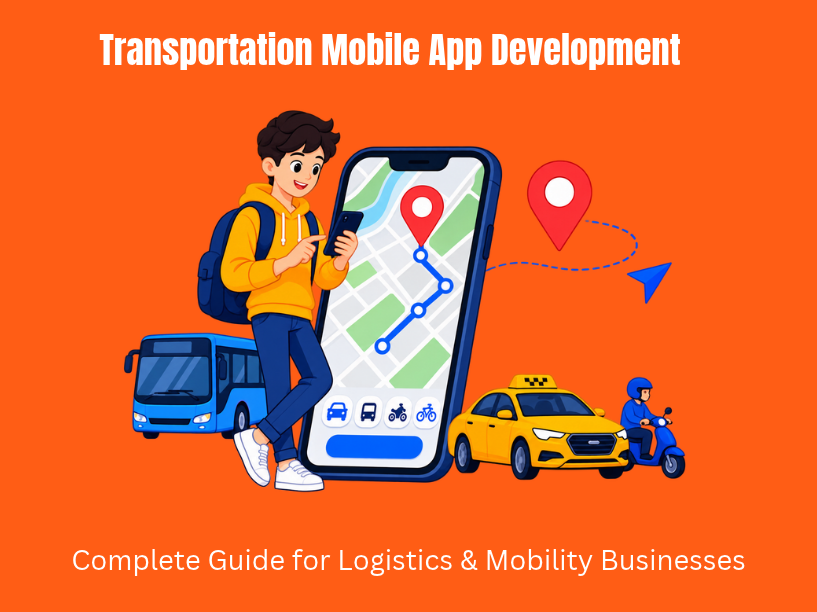
Transportation mobile app development is the process of designing, building, and deploying Android, iOS, and cross-platform applications that manage the movement of vehicles, goods, and passengers. These apps replace manual calls, spreadsheets, and paper manifests with features like real time tracking, route optimization, automated dispatch, and digital proof of delivery.
Passenger mobility apps cover ride-hailing, corporate shuttle services, and employee transport – where rider experience, seat booking, and payment flows are priorities.
Logistics and transportation apps serve freight, courier, last-mile, and distribution operations – where load matching, SLA compliance, capacity planning, and supply chain operations take center stage.
GPS tracking is essential for accurate location data in transportation applications, and real-time tracking is essential for transportation apps across both categories. Here is where the app types branch out:
Fleet management apps help companies manage vehicles and drivers across regional or national networks.
Warehouse management apps track products and streamline orders at the facility level.
On-demand delivery apps connect users with couriers for fast deliveries.
Supply chain management apps handle all steps of product delivery from origin to destination.
Logistics and freight management apps manage the entire shipping process, including documentation and carrier coordination.
Order management apps simplify handling customer orders and linking them to dispatch workflows.
TVL IT Solutions focuses oncustom mobile app development aligned to each client’s transportation management workflows, rather than offering rigid, one-size-fits-all products. For example, a mid-sized Indian logistics company operating a 150-vehicle fleet can digitize its entire dispatch-to-delivery cycle to improve on-time deliveries and reduce operational costs.
Why Transportation & Logistics Businesses Need a Mobile App Now
The post-2024 landscape has shifted permanently. E-commerce growth, urban congestion, and customer expectations for same-day or scheduled deliveries with real time tracking have made digital tools non-negotiable for any serious transportation business. The digital logistics market was estimated at USD 49.37 billion in 2025 and is projected to reach approximately USD 165.22 billion by 2032, growing at roughly 18.8% CAGR.
Key pain points without a transportation mobile app:
Delayed communication between dispatchers, drivers, and customers
No live visibility of vehicles or shipments in transit
High operational costs from inefficient routing and idle time
Frequent billing disputes due to missing documentation
Poor driver management leading to schedule overruns and safety gaps
Direct outcomes a transportation management app delivers:
Higher asset utilization and fewer empty runs
Faster dispute resolution through digital proof of delivery
Improved customer satisfaction with live tracking and accurate ETAs
Real-time tracking improves supply chain transparency significantly, and allows users to monitor shipments anytime
Custom logistics software enhances operational efficiency by 30%, and custom software can reduce delivery times by up to 25%
TVL IT Solutions has supported clients moving from phone-based dispatching to app-based systems, helping them cut missed deliveries and eliminate hours of daily manual coordination.
Types of Transportation Mobile Apps (And Which One You Need)
Choosing the right app type is the first strategic decision before any development services begin. The transportation and logistics sector includes a wide range of applications, each serving different stakeholders and solving different problems.
Fleet management and driver management apps for trucking and bus operators – primary users: fleet managers, drivers. Core outcomes: vehicle tracking, maintenance scheduling, compliance logging.
Last-mile and courier delivery apps for e-commerce, groceries, and pharma – primary users: riders, customers, operations teams. Core outcomes: real time tracking, route optimization, proof of delivery.
Ride-hailing and taxi apps for city cabs, shuttles, and employee transport – primary users: passengers, drivers, admins. Core outcomes: booking, fare calculation, live ETAs.
Rental and vehicle-sharing apps for cars, bikes, EVs, and micro-mobility – primary users: renters, fleet owners. Core outcomes: availability, pricing, geofenced pickup/drop zones.
Warehouse and yard operations companion apps – primary users: yard managers, dock workers. Core outcomes: gate check-in, trailer location, dock assignment.
Before approaching any app development company for estimates, map your specific use case and identify the user roles involved. This clarity saves weeks during the development process.
Core User Roles in a Transportation Mobile App
Almost every transportation management app revolves around at least three roles: Admin/Dispatcher, Driver, and Customer (or Shipper/Passenger). User interfaces should be designed separately for drivers and passengers to cater to their unique needs, because developing a mobile app for transportation services requires balancing real-time performance and user experience.
Admin / Dispatcher: Needs a control panel with live maps, route planning tools, exception alerts, reporting tools, and advanced analytics for operational decisions. Typically accesses a web-based admin panel.
Driver: Needs simple, distraction-free flows – start trip, navigate, capture proof of delivery. Requires offline support for poor-coverage zones and in-app communication with dispatch.
Customer / Shipper / Passenger: Needs frictionless booking, real time tracking, ETA notifications, and access to digital documents (invoices, e-PODs, receipts).
Extended roles that mature platforms add:
Finance / Accounts: Billing reconciliation, POD document access, seamless integration with accounting or ERP systems.
Management: KPI dashboards showing profitability by route, customer, or lane – enabling real time data-driven decisions.
TVL IT Solutions typically designs separate panels (mobile and web) per role for clarity, security, and usability. This role-based separation through dedicated interfaces is something the team builds into architecture from the start.
Must-Have Features for Transportation Mobile App Development
These are the essential features most logistics and transportation apps cannot ship without. Each one directly affects usability, safety, and business operations.
Real time tracking with GPS, live map view, and breadcrumb history. Core technologies for transportation apps include GPS tracking and secure payment integration.
Route optimization that factors in traffic, delivery windows, vehicle capacity, and driver hours. Route optimization helps reduce fuel costs and delivery times, and suggests the best paths for drivers through efficient route optimization algorithms.
Automated dispatch and load assignment based on configurable rules – zone, capacity, driver skill, and priority. Automated dispatching assigns tasks based on driver availability.
Digital proof of delivery: e-signatures, photo capture, and barcode/QR scan to eliminate paperwork disputes.
Fare/charge and distance calculation configured per business logic – per kilometer, per zone, per load type, or with surcharges.
In-app chat and automated messaging (SMS, push notifications) between customer, driver, and dispatcher for seamless communication.
Secure payment gateway integration and wallet support. In-app payments enhance user convenience in logistics apps and enable secure transactions within the app. Supporting multiple payment gateways requires compliance with PCI-DSS standards.
Role-based access control and audit logs for compliance. End-to-end encryption and compliance with privacy regulations are critical for user trust in transportation apps.
Multi-language and multi-currency support for cross-border operations or diverse driver workforces.
Geofencing that alerts users when vehicles enter or leave designated areas – useful for hubs, customer sites, and restricted zones.
TVL IT Solutions typically helps clients choose a “Phase 1” subset for an MVP and reserves advanced capabilities for later iterations, keeping the initial logistics app development project focused and deliverable.
Advanced Capabilities to Differentiate Your Transportation App
Beyond the basics, advanced features help reduce operational costs and create lasting competitive advantage. These are the modules that separate a custom transportation app from a generic off-the-shelf tool.
AI-based ETA prediction using live traffic, historical route data, and driver behavior patterns. Transportation apps often incorporate AI for features like demand forecasting and route optimization. AI/ML enables smart automation in logistics apps.
Dynamic route optimization for multi-stop and multi-vehicle scenarios, including re-optimization mid-route as new orders arrive or conditions change. AI integration in logistics software optimizes route planning effectively.
Predictive maintenance alerts based on vehicle telemetry, mileage, and service history – preventing breakdowns before they happen.
Driver scoring and gamification to encourage safe, fuel-efficient driving with measurable feedback loops.
Capacity matching in freight marketplaces – matching loads to carriers by lane, vehicle type, and compliance requirements to reduce empty runs.
Cold chain and IoT sensor integration (temperature, humidity, door-open events) for sensitive cargo like pharmaceuticals and perishables. IoT connects devices for real-time monitoring in logistics.
Analytics dashboards showing on-time performance, utilization, fuel metrics, and exception trends. Big data analytics enhances decision-making in logistics operations. AI and ML improve predictive analytics in logistics applications.
Blockchain-based visibility for high-value or regulated goods. Blockchain technology provides transparency in supply chains.
TVL IT Solutions’ backend andAI/ML development teams design these capabilities as modular services that connect to existing CRMs, ERPs, and warehouse management systems – so clients don’t need to rip and replace what already works.
Technology Stack & Architecture for Transportation Mobile Apps
Transportation apps must be scalable, secure, and resilient. Real time tracking and location-heavy workloads demand careful technology stack decisions that affect performance for years after launch. Transportation apps need to manage high user traffic and concurrency effectively.
Client-side technologies:
Native Android (Kotlin/Java) and iOS (Swift) for performance-critical driver apps that require tight GPS integration, navigation, and background location services.
Cross-platform frameworks likeFlutter andReact Native can utilize a single codebase for deployment on both platforms – ideal for customer-facing and admin apps where speed of delivery matters.
Offline-first design for areas with unstable networks, using local storage, cached map tiles, and sync queues so drivers can operate even without connectivity.
Backend and infrastructure:
Backend services using Node.js, .NET, Java, or Go with REST or GraphQL APIs, structured as microservices for independent scaling.
Real-time communication technologies such as WebSockets are crucial for immediate status updates in transportation apps – pushing live location, dispatch alerts, and chat messages.
Cloud deployment on AWS, Azure, or GCP with auto-scaling, containerization (Docker, Kubernetes), and managed databases. Cloud computing ensures scalable logistics app solutions and scalable logistics solutions with real-time data access. Cloud computing ensures scalable and secure logistics software. Cloud infrastructure is necessary to scale app functionalities as user demand increases.
Maps, data, and security:
Real-time tracking relies heavily on robust mapping tools like Google Maps or Mapbox, with geofencing APIs for auto check-in/check-out.
Relational databases (PostgreSQL, MySQL) for transactional data; NoSQL or time-series databases for telemetry and location streams.
Security layers: TLS in transit, AES encryption at rest, OAuth2 authentication, multi-factor auth, and role-based access control.
TVL IT Solutions designs microservices-based architecture so that components like the route optimization engine or pricing module can be evolved independently without disrupting the rest of the platform.
Step-by-Step Transportation Mobile App Development Process at TVL IT Solutions
Here is how TVL IT Solutions typically delivers transportation management app development from an initial app idea through to launch and beyond.
Phase 1: Discovery and Process Mapping Stakeholder interviews, ride-alongs or operations observations, and detailed mapping of current dispatch, billing, and driver workflows. This phase surfaces the real bottlenecks – not just the ones listed in a requirements document.
Phase 2: Product Strategy Defining user stories, prioritizing features against business goals, and aligning the roadmap with KPIs like on-time delivery rate or fleet utilization. This is where the team decides the MVP scope.
Phase 3: UX/UI Design Low-fidelity wireframes, clickable prototypes, and separate flows for driver, dispatcher, and customer. The admin panel gets its own design track to ensure dispatchers can make decisions at a glance.
Phase 4: Architecture and Tech Stack Selection Based on scale requirements, integration needs, and the client’s internal IT capabilities. The team selects frameworks, cloud providers, and data strategies that match the five-year vision.
Phase 5: Agile Development Sprints with regular demos to operations teams for feedback. Each sprint delivers working software, not just slide decks.
Phase 6: Integration Connecting with existing systems – ERP, TMS, WMS, telematics devices, CRM – via APIs. This step is often underestimated and is where domain expertise matters.
Phase 7: QA and Field Testing Pilot with a limited fleet. Testing should cover GPS accuracy, network conditions, and payment flows in transportation apps. Effective performance optimization is necessary to enhance user experiences in transportation apps. Transportation apps must comply with local transportation laws and data privacy regulations.
Phase 8: Go-Live and Training Phased rollout, dispatcher and driver training sessions, playbooks, and SOP documents. No “big bang” launches – controlled scaling.
Phase 9: Post Launch Support and Iteration Ongoing maintenance, monitoring, and iterative feature releases based on real-world usage data. Post launch support and maintenance services keep the app aligned with evolving business needs.
TVL IT Solutions offers flexibleengagement models – dedicated team, fixed scope, time and material, or hybrid – depending on client maturity and roadmap complexity.
Key Considerations Before Choosing a Transportation App Development Company
Transport and logistics app development projects fail more often from process mismatch than from pure technical gaps.Choosing the right partner requires looking beyond portfolios.
Domain expertise:
Look for demonstrated case studies in logistics and transportation, not just generic mobile app development.
The team should understand transportation management concepts: SLAs, lane economics, demurrage, detention, hours-of-service regulations, and compliance frameworks.
Technical capability:
Ability to provide end-to-end development services – discovery, UX, backend, mobile, DevOps, and long-term support – under one roof.
Security-first development practices: data encryption, secure authentication, role-based access, and audit trails.
Soft factors:
Communication practices for offshore teams: overlapping working hours, clear status updates, and a single point of contact.
Willingness to do a small pilot or PoC before a larger rollout. A transport app development company that insists on building everything at once is a red flag.
TVL IT Solutions operates as a long-term technology partner with experience supporting startups, SMEs, and enterprises in logistics-heavy industries throughcustom software development engagements tailored to each organization’s growth trajectory.
How Transportation Apps Impact Operational Costs and Efficiency
This section focuses on qualitative cost and efficiency impacts – the operational levers that a well-built transportation app activates.
Routing and utilization:
Better route optimization reduces unnecessary kilometers driven and improves vehicle utilization. Organizations using optimized routing have reported 10–30% reductions in transportation spend.
Fewer empty return trips through intelligent load matching and backhaul planning.
Communication and visibility:
Real time tracking and automated alerts decrease manual follow-up calls and the time dispatchers spend locating drivers.
Tracking metrics such as daily active users and booking rates is vital for assessing success post-launch and measuring adoption.
Driver and schedule management:
Driver management improvements – shift adherence, fewer idle periods, safer driving habits – lead to more predictable schedules and lower insurance exposure.
Documentation and billing:
Reduced paperwork and faster billing cycles through digital proof of delivery and automated invoicing workflows.
Service quality and retention:
Fewer service failures and missed deliveries improve SLA adherence, customer satisfaction, and long-term retention.
Data-driven decisions reveal which routes to keep, which contracts to renegotiate, and where to add or remove capacity.
Before vs. After: A dispatcher who spent three hours each morning building routes on spreadsheets now reviews an algorithmically generated plan in under five minutes. Drivers receive assignments on their phones instead of waiting for callbacks. Customers track their shipments in real time instead of calling a helpline.
Case Study Snapshots: Transportation Mobile Apps in Action
Real-world experience matters more than feature lists. Below are representative scenarios that illustrate how transportation mobile app development translates into measurable operational gains.
Regional Fleet Operator – India A mid-market trucking company with 200+ vehicles across 12 hubs digitized trip planning, driver logs, and proof of delivery through a custom Android app and web dashboard. The tech stack included Go for backend services, React Native for driver-facing screens, PostgreSQL, and AWS. Outcomes included approximately 40% reduction in operational delays, fully digital dispatch, and elimination of paper-based reconciliation. On demand logistics capabilities were added in a later phase to handle spot-market loads.
Last-Mile Delivery Startup – Urban Market A startup launched an on demand logistics app with customer, rider, and admin panels for dense urban routes. The platform supported batching of orders, efficient route optimization for multi-stop runs, and real time tracking. The system scaled to handle over 1,000 daily rides using a Node.js backend, MongoDB, and containerized cloud infrastructure. On demand solutions like this demonstrate how quickly logistics mobile apps can reach scale with the right architecture.
Employee Transport Management – Enterprise An enterprise employee shuttle solution featured route planning, seat reservation, driver verification, and security check-in via geofencing. The app improved employee safety, delivered predictable arrival times, and replaced hours of manual roster management. The logistics mobile app development project used Flutter for cross-platform delivery and integrated with the company’s existing HR and access control systems.
Future Trends in Transportation Mobile App Development
Transportation mobile app development is evolving rapidly between now and the early 2030s. Here are the trends shaping what gets built next.
Wider AI/ML integration for predictive ETAs, demand forecasting, intelligent driver assignment, and autonomous dispatch. Research using Transformer and Graph Neural Network architectures has shown 15% reductions in travel distance and 20% speed improvements in smart logistics routing.
EV fleet management requiring apps that handle charging schedules, range-aware routing, battery state monitoring, and energy analytics – a growing segment as fleets electrify.
Multi-modal transport planning within a single app, combining trucks, rail, air, and last-mile delivery legs into unified shipment visibility.
Increased IoT sensor adoption in trailers, containers, and warehouses, feeding real time data into transportation management apps for cold chain compliance, security, and condition monitoring.
Blockchain pilots for freight document verification, chain-of-custody tracking, and regulatory compliance in cross-border supply chain operations.
Tighter integration with B2B SaaS platforms (TMS, WMS, ERP) through standardized APIs, reducing the “integration tax” that slows down adoption of new logistics software.
TVL IT Solutions actively builds with cloud-native, API-driven architectures, so clients can adopt these latest technologies incrementally without rewriting their entire software solutions stack.
How to Get Started with TVL IT Solutions for Transportation App Development
Moving from research to action doesn’t require a massive upfront commitment. The most successful logistics app development services engagements start small and scale deliberately.
Recommended first steps:
Map two to three critical workflows you want to digitize first – dispatch-to-delivery, returns handling, or driver onboarding are common starting points.
Prepare a short requirements note describing user roles, locations served, existing systems in place, and your top business goals.
Collaborating with TVL IT Solutions:
Schedule a discovery workshop with TVL IT Solutions to validate use cases and define an initial MVP scope. The team will recommend a technology stack, timeline, and engagement model that fits.
Decide on an engagement model – dedicated team, fixed scope, or hybrid – based on your internal capabilities and timelines.
TVL IT Solutions can start with a pilot fleet or region and then scale to nationwide or multi-country deployments as the platform proves itself.
Plan the long-term roadmap from the outset: analytics modules, third-party integrations, advanced optimization, and ongoing maintenance should all be on the horizon even if they ship later.
The gap between logistics companies that digitize transportation operations and those that don’t is widening every quarter. A focused MVP, a reliablelogistics software development partner, and a willingness to iterate based on real field data – that combination consistently delivers results.
Ready to build your transportation mobile app?Contact TVL IT Solutions to schedule your discovery workshop and take the first step toward a smarter, faster, and more transparent transportation process.
Frequently Asked Question
What is transportation mobile app development?
Transportation mobile app development is the process of designing and building mobile applications to manage vehicles, drivers, goods, and passengers. These apps include features such as GPS tracking, route optimization, automated dispatch, and digital proof of delivery.
What are the essential features of a transportation mobile app?
Essential features include real-time GPS tracking, route optimization, automated dispatch, driver management, digital proof of delivery, in-app communication, secure payments, geofencing, and role-based access controls.
How does a transportation mobile app improve logistics operations?
A transportation mobile app improves logistics operations by optimizing routes, reducing empty trips, automating dispatch, providing real-time shipment visibility, and minimizing manual coordination. It also helps businesses improve vehicle utilization and delivery efficiency.
Which technologies are used for transportation mobile app development?
Common technologies include Kotlin and Swift for native apps, Flutter and React Native for cross-platform development, and Node.js, .NET, Java, or Go for backend services. GPS, Google Maps, Mapbox, cloud infrastructure, WebSockets, and databases such as PostgreSQL are also used.
How long does it take to develop a transportation mobile app?
The article does not specify a fixed development timeline. The duration depends on the app’s features, user roles, integrations, architecture, and project scope. A phased MVP approach can help businesses launch essential functionality first and add advanced features later.
Transform Your Ideas Into Powerful Software Solutions
At TVL IT Solutions, we specialize in delivering scalable, secure, and custom software development services tailored to your unique business needs. Whether you’re a startup or an enterprise, our team is ready to turn your vision into reality.