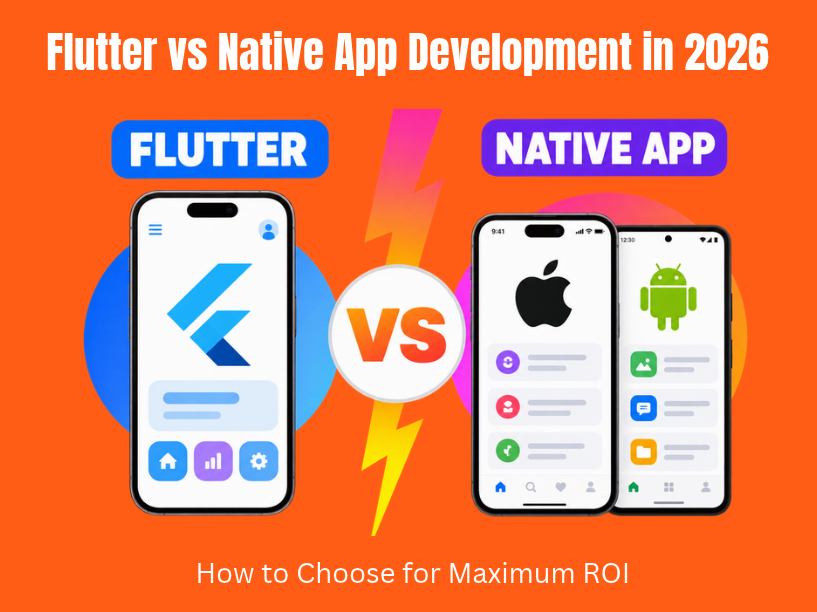
Choosing between flutter vs native app development shapes your product’s speed, quality, and long-term flexibility. This guide breaks down both approaches with real data so you can make a confident decision.
Here is the short version before the deep dive.
Choose Flutter when you need:
Choose native development when you need:
For roughly 80–90% of business app ideas we see at TVL IT Solutions, Flutter delivers better speed and ROI than building two separate codebases. We recommend going native only when hardware-level performance or bleeding-edge OS features are your primary differentiator.
Both flutter and native development can produce high-quality mobile apps, but they prioritize different aspects. Flutter can accelerate time-to-market by 1.5x compared to native, which matters enormously for startups and SMEs racing to validate ideas.
TVL IT Solutions actively builds and maintains both Flutter and native apps, so this advice is technology-agnostic and based on project fit. The sections below break down performance, development time, maintenance, and real-world case studies.
Flutter is an open-source UI software development kit created by Google for building multiplatform applications. Released in stable form in 2018, it uses the dart programming language, compiles to native code via AOT (Ahead-of-Time) compilation, and ships with its own rendering engine called Impeller.
Flutter works from a single codebase for Android, iOS, web, and desktop. Instead of wrapping native ui components, it controls every pixel through its rendering engine, giving you consistent visuals across different platforms. Apps built with Flutter can run on multiple platforms including mobile, web, and desktop with minimal code adjustments.
Flutter includes a rich library of customizable widgets, enhancing UI development for forms, animations, and navigation. The hot reload feature lets mobile developers see UI and logic changes almost instantly. Dart’s strong null safety reduces runtime crashes and simplifies refactoring.
Production credibility speaks volumes. BMW uses Flutter in its My BMW app. Google Pay India runs Flutter extensively. Nubank serves 90+ million customers with Flutter-powered flows. Alibaba deploys Flutter across commerce features. As of 2024, roughly 30% of new free iOS apps are built with Flutter.
The ecosystem keeps maturing. Recent Flutter 3.x releases have improved Impeller performance, expanded desktop support, and strengthened DevTools. Flutter offers consistent UI across platforms using its own rendering engine, and it allows building apps from a single codebase for both platforms.
Native app development involves building applications for a single platform using specific programming languages and tools. For Android, that means Kotlin or Java with android studio. For iOS, it means Swift or Objective C with Xcode on macOS.
Native app development requires using platform-specific languages such as Swift, Kotlin, or Java, and native frameworks tied to each operating system. Native applications consistently match the design guidelines of their respective platforms, ensuring the best user experience. Native apps provide a smoother user interface and UX because they use platform-specific UI components for better user experience.
Why native remains essential in certain scenarios:
The trade-offs are real:
TVL IT Solutions recommends native for real-time video editing apps, high-fidelity 3D or AR experiences using ARKit/ARCore, and performance-critical fintech trading platforms requiring ultra-low latency.
For startups and SMEs planning MVPs, development time directly affects how fast you can validate your business model and reach users.
Flutter development is 20-50% faster than creating two native apps. A single codebase means features, screens, and business logic are implemented once for both ios platforms. Flutter’s hot reload feature speeds up debugging and development by shrinking the feedback loop between design and engineering. One team can build for both iOS and Android using Flutter, and flutter allows for simultaneous updates across platforms, saving time.
Native mobile app development doubles the effort. Every screen, every flow, every bug fix must happen in two separate codebases with separate review cycles. Native development requires separate teams for iOS and Android, adding coordination overhead. Dependencies on two platform release cycles and app store review processes stretch timelines further.
The learning curve also differs. Dart is a programming language designed to feel familiar to developers with JavaScript, Java, or C# backgrounds. Flutter’s widget tree paradigm is well-documented and approachable. Native requires specialized expertise for each specific platform and native languages, making cross-training slower.
Consider this real-world parallel: Whirlpool’s “Compra Certa” app achieved 92% shared codebase with Flutter, delivered its first version in 30 days, and reported 35% faster development speed. Flutter apps can be developed 20-50% faster than native apps, making it ideal for rapid prototyping and mobile app development for startups.
Native apps still hold the performance edge in raw benchmarks, but Flutter has narrowed the gap significantly for most mobile application development scenarios.
CPU, memory, and animation smoothness:
Native apps have lower CPU usage, about 50% less than Flutter apps in heavy workloads. Flutter apps can take twice the memory compared to native apps. However, Flutter’s Impeller engine and AOT compilation deliver near native performance at 60 FPS or higher for typical business UIs. Benchmarks show Impeller reduced dropped frames from about 12% (under Skia) to roughly 1.5% during complex animations. Flutter apps may have larger file sizes due to included libraries bundled in the binary.
Hardware and OS feature access:
Native apps offer better integration with device hardware features and talk directly to platform apis for ARKit, advanced camera controls, and background services. Flutter relies on plugins or custom platform channels to reach these APIs, which may lag briefly after new OS releases. Native apps use platform specific features for superior performance in hardware-intensive tasks.
User experience differences:
Native apps use platform-specific UI components that auto-adapt to system conventions, dark mode, and accessibility settings. Flutter mimics platform look-and-feel with Cupertino and Material widgets but uses its own rendering engine, delivering more consistent visuals across devices. Flutter’s UI design may lack pixel-perfect accuracy compared to native apps in edge cases.
The practical guidance:
Flutter can achieve near-native performance in most typical apps like dashboards, e commerce platforms, social apps, and internal tools. Native apps provide better performance for hardware-intensive tasks involving GPU-heavy graphics, low-level sensors, or niche OS features. For the majority of mobile app development projects, the performance difference is negligible.
Long-term maintenance often consumes more time and budget than initial development, especially for products on multi-year roadmaps.
Flutter’s single codebase simplifies maintenance and reduces costs across the entire product lifecycle. Bug fixes, refactors, and feature rollouts happen once and deploy to both platforms. Centralized business logic reduces platform drift, where iOS and Android behave differently. Structured state management patterns like Bloc, Riverpod, and Provider help keep complex flutter projects manageable at scale.
Native maintenance means two app stores, two codebases, and two sets of device quirks. Apple mandated in 2026 that new app submissions must use the iOS 26 SDK, forcing toolchain upgrades and deprecation handling. Each operating system update can require separate upgrade work and regression testing on native mobile apps. Teams must ensure feature parity, design alignment, and security updates across both platforms simultaneously.
Flutter’s plugin ecosystem is mature for common needs like payments, GPS, and sensors. Very niche hardware integration may require custom native bridging through platform channels. Native has longer-standing libraries but also legacy code and deprecated APIs to manage. Flutter apps may have larger file sizes due to included libraries, which is worth considering for low-end device targets.
For multi-year roadmaps and global rollouts, Flutter’s advantage in synchronized updates and unified bug fixes makes it the simpler choice for most cross platform apps.
No explicit pricing here, only structural comparisons to help you plan.
Native development often incurs higher costs because it requires hiring two distinct development teams for different platforms. Native app development typically incurs higher costs due to separate codebases, separate QA pipelines, and duplicate design work. Using Flutter eliminates the need for two separate developer teams. Flutter reduces development cost by up to 45%, and flutter development can save up to 45% on overall costs by consolidating effort into one cross-functional team.
Flutter is ideal for projects needing rapid development and cost efficiency, particularly multi-platform launches. Native may be justified when product strategy demands top-tier native performance or deep hardware integration, even if it requires broader engineering capacity.
TVL IT Solutions offers flexible engagement models. A dedicated team works for long-term flutter development or native mobile development. Fixed scope projects fit clearly defined MVPs. Time and material or hybrid models suit evolving products where priorities shift. You can also explore how to reduce mobile app development costs through smart architecture decisions.
Offshore collaboration from India gives access to experienced flutter developers and native engineers, QA specialists, and DevOps in time-zone-aligned pods. Teams can extend in-house capabilities with specialized skills, including integrating mobile frontends with enterprise systems.
The real question is not just “flutter vs native costs” but which approach delivers better lifetime value for your product roadmap.
Both cross platform technologies and native technologies succeed in production across industries. The right choice depends on your use case.
Flutter-friendly scenarios:
Retail, e commerce, and marketplace apps benefit from quick cross platform compatibility and faster development cycles. Banking and fintech portals focusing on dashboards, transactions, and secure authentication get consistency and speed from a single code base. Corporate and field-force apps for inventory tracking, inspections, or sales enablement prioritize consistent UX and faster releases.
Consider a logistics management flutter app where a team unifies driver, dispatcher, and customer views. Building shared screens once for tracking, notifications, and status updates and deploying to android and ios platforms cuts release time dramatically. Similarly, an education platform delivered with Flutter can support mobile, web, and desktop from a single shared core, covering quizzes, grading, and video playback.
Native-first scenarios:
High-end mobile games using Unity or Unreal with native launchers and deep GPU optimization need native code access. Health and wellness apps relying on platform health APIs, wearables, or specialized sensors benefit from native sdks. Camera-centric apps with advanced filters, low-level image processing, and background recording demand the direct hardware integration that native components provide.
Both approaches have clear lanes. Mobile app developers should match the technology to the product requirements, not to popularity.
TVL IT Solutions is a custom software development company in India focused on secure, scalable web and mobile products for startups, SMEs, and enterprises.
The discovery process starts by clarifying business goals, user journeys, and non-functional requirements like performance, security, and compliance. The team evaluates existing systems, APIs, and enterprise platforms the app must integrate with. Roadmap length, expected traffic patterns, and mobile project complexity all factor in.
The decision framework maps criteria: performance needs, hardware integration depth, time-to-market pressure, team capabilities, and long-term maintenance strategy. Sometimes a hybrid approach works best, using Flutter for most UI while dropping into native modules for critical features like react native or platform-specific sensors.
TVL IT Solutions also brings backend and frontend engineering, AI/ML capabilities, and game development expertise that complement both flutter and native frontends. Engagement models include dedicated teams, fixed-scope delivery, and hybrid cooperation with in-house mobile developers.
We treat every mobile application decision as a strategic partnership conversation, not a technology pitch.
Ready to validate whether Flutter, native, or a combined approach fits your specific project? Reach out to TVL IT Solutions for a tailored recommendation.
Flutter is the best fit for most cross platform business apps needing faster development, unified experience, and streamlined maintenance. Native remains essential for performance-critical, hardware-intensive, or platform-first innovation where native performance and native features are non-negotiable.
There is no one-size-fits-all answer. The right choice comes from aligning technology with product strategy, roadmap, and user needs. Avoid choosing purely on trends like “everyone is using Flutter” or “native is always better.” Instead, map your requirements to the criteria discussed: performance, maintenance, learning curve, development cost, and long-term scalability.
TVL IT Solutions brings hands-on experience in both flutter app development and native mobile app development, along with backend, AI/ML, and enterprise integrations, helping de-risk the decision for clients across industries.
Consider a discovery workshop to validate the right approach for your mobile application development goals in 2026 and beyond. The best mobile project starts with the right technology choice, and that choice starts with an honest conversation.
Flutter uses a single Dart codebase to build apps for multiple platforms, while native development uses platform-specific technologies such as Kotlin for Android and Swift for iOS.
Flutter can be a strong choice for business apps that prioritize faster development, shared code, and streamlined maintenance. Native development is more suitable for performance-intensive and hardware-focused applications.
Flutter can reduce development effort because one codebase serves both Android and iOS. The article states that Flutter development can be 20–50% faster than creating two separate native applications.
Native apps generally have an advantage in raw performance, hardware access, and platform-specific optimization. Flutter can provide near-native performance for many typical business applications.
Native development is better suited to applications requiring advanced camera controls, AR/VR, GPU-intensive graphics, specialized sensors, ultra-low latency, or immediate access to new platform APIs.
At TVL IT Solutions, we specialize in delivering scalable, secure, and custom software development services tailored to your unique business needs. Whether you’re a startup or an enterprise, our team is ready to turn your vision into reality.
Get Started Now