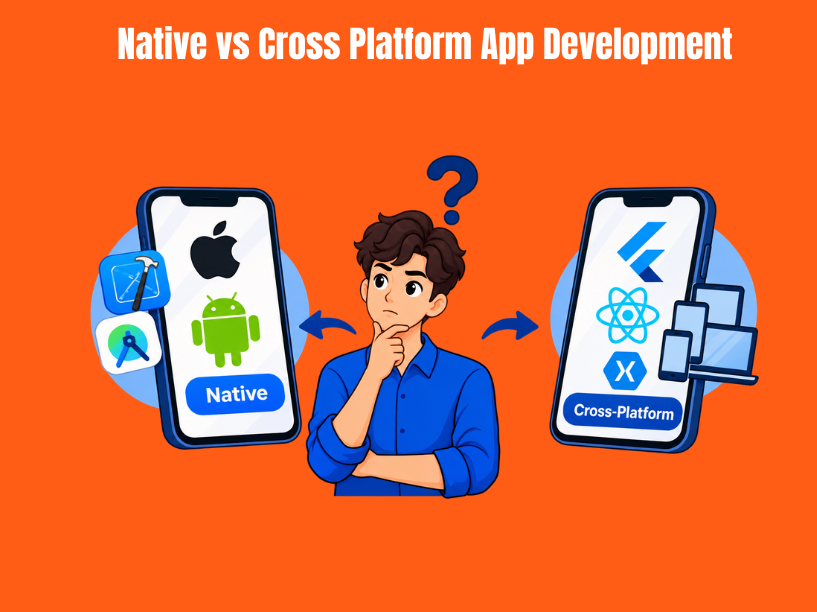

Choosing between native vs cross platform app development is one of the most consequential technical decisions a product team makes. Get it right, and you ship faster, spend smarter, and keep users engaged for years. Get it wrong, and you burn runway fixing performance issues or rewriting codebases.
This guide breaks down exactly when native development wins, when cross platform development makes more sense, and how TVL IT Solutions helps clients navigate the decision with hard data instead of guesswork.
For most startups and SMEs in 2025–2026, cross platform app development is the practical default unless your product depends on specialized hardware, extreme graphics, or strict regulatory compliance. Enterprises with mission-critical applications or deep operating system integrations still lean native.
Choose native app development when:
Choose cross platform when:
Quick comparison:
TVL IT Solutions builds both native and cross platform apps. During a 1–2 week discovery phase, the team assesses performance needs, hardware dependencies, user growth expectations, and risk to recommend the right path forward.
Native app development means building separate apps for each operating system using that platform’s officially supported languages and SDKs. You write one app for iOS and a completely different app for Android. Native apps are built for specific operating systems, compiling directly to machine code that allows tight integration with OS-level services like push notifications, in-app purchases, and biometric authentication.
Modern native tech stacks include:
Native apps are built using platform specific languages like Swift and Kotlin, and native development allows access to all device features and APIs on day one. Well-known examples include Snapchat’s original clients, WhatsApp’s early mobile builds, and most AAA mobile games that leverage advanced GPU rendering.
TVL IT Solutions uses native mobile app development when projects demand advanced graphics, robust offline capabilities, or strict compliance with mobile platform guidelines. If you are building an iOS app using Swift, for instance, native gives you earliest access to Apple’s newest hardware and software capabilities.
Cross platform app development means using a single codebase to ship mobile applications to multiple platforms, typically iOS and Android, and sometimes web and desktop. Cross platform apps use a single codebase for multiple platforms, sharing business logic, data models, and networking code while rendering a native or native-like UI layer.
The most popular cross platform frameworks in 2026 include:
Cross platform frameworks allow sharing much of the application code between iOS and Android. Real-world examples include Alibaba (Flutter), Facebook Groups (React Native), and Google Pay (Flutter). Cross platform apps can be built from a single codebase, making cross platform development a strong fit for teams that need simultaneous coverage.
TVL IT Solutions often recommends cross platform app development for MVPs, internal tools, and B2B platforms where rapid iteration across both iOS and Android is critical.
This high-level native vs cross platform comparison covers the dimensions that matter most for initial decision-making.
In 2026, the performance gap is significantly smaller than it was in 2016. Advances in Flutter’s Impeller engine and React Native’s New Architecture have closed much of the distance. But high-end graphics, specialized hardware integrations, and platform specific programming languages still favor native.
Despite the maturity of modern cross platform frameworks, native mobile app development remains the right call for projects where performance, compliance, or hardware depth are non-negotiable.
While native is powerful, it is not always the most efficient choice for every mobile app development project. The technical advantages come with real operational trade-offs.
TVL IT Solutions helps clients avoid over-engineering by validating early whether they truly need full native stacks for both platforms, or whether a leaner approach fits their custom software development goals.
By 2026, cross platform mobile development has become the default starting point for many startups and SaaS product teams. The frameworks are mature, the plugin ecosystems are deep, and the performance trade-offs are minimal for most business applications.
Cross platform is powerful, but it is not a one-size-fits-all choice for mobile development. Understanding where it falls short helps you plan around the gaps.
This decision framework helps product owners and CTOs cut through the noise. Scan the bullets below and identify which factors weigh heaviest for your project.
TVL IT Solutions normally runs a structured discovery and architecture workshop to map these factors and recommend native, cross platform, or a mixed strategy. This prevents costly mid-project pivots.
Performance, UX, and access to native features are often the tiebreakers in native vs cross platform discussions. Here is where the data stands in 2026.
Performance benchmarks (mid-range devices):
Native app development provides superior performance for complex applications that push rendering, memory, or sensor limits. Cross platform frameworks like Flutter deliver near-native performance for the vast majority of business mobile applications, but animations on very complex screens may still need custom native modules.
UX differences: Native apps follow each platform’s conventions perfectly. iOS users get expected navigation bars, swipe gestures, and San Francisco typography. Android users get Material Design patterns and predictable back navigation. Cross platform app development often favors a unified but slightly less platform-idiomatic design. Flutter renders its own UI (high consistency, less platform-native feel), while React Native uses actual native UI components (more platform-authentic feel).
Access to native features: Biometric authentication, contactless payments, CarPlay, Android Auto, and platform-specific widgets arrive first for native. Cross platform reaches them via plugins and bridges that may appear weeks or months later.
Mini-example: A banking app in 2026 wants biometric authentication via FaceID/TouchID, device binding, secure enclave cryptographic operations, and offline transaction caching. A native iOS and Android build leverages Apple’s Secure Enclave and Android’s hardware-backed keystore directly for different app versions. A cross platform build could handle most of this via plugins but would await framework support for the newest biometric capabilities and may need native bridge modules for cryptographic operations.
Many teams underestimate long-term maintenance and security when choosing between native and cross platform. These factors compound over years and can shift the total cost equation dramatically.
Security: Native apps integrate directly with platform security capabilities: Keychain, Keystore, hardware-backed crypto, and secure storage APIs. This simplifies compliance with frameworks like PCI DSS and healthcare regulations. Cross platform apps can reach similar security standards if developers correctly use platform-specific security APIs through plugins and keep dependencies updated. But this adds architectural discipline and auditing overhead. Both approaches benefit from built in security features when properly implemented.
Scalability: Both native and cross platform scale well on the client side. Native apps utilize efficient memory management for scalability, especially for apps handling large datasets or complex state. The primary scaling concern is usually backend architecture (APIs, cloud infrastructure), which TVL IT Solutions designs with security-first and scalable patterns regardless of mobile stack.
Maintenance: Native tracks OS releases directly but doubles work across two codebases. Cross platform simplifies code sharing but introduces dependency on framework health. Real-world data from production apps shows that after two years, technical debt in cross platform projects can add roughly 30–40% more maintenance cost than initially anticipated, driven by dependency upgrades, plugin compatibility, and version mismatches.
CI/CD and testing: TVL IT Solutions sets up automated testing pipelines for both native and cross platform projects. Native apps need device-specific testing across iOS simulators and Android device variants with separate pipelines. Cross platform allows more shared unit and integration tests, but platform-specific and device-specific validation remains necessary to keep regression risk low as the same app evolves across multiple operating systems.
These scenarios reflect the kinds of decisions TVL IT Solutions navigates with clients across India, Europe, and North America.
Scenario 1 – Healthcare / Telemedicine: A telemedicine client needs offline data capture in rural areas with limited connectivity, encrypted storage complying with HIPAA, and integration with Bluetooth medical devices. The app must handle complex on-device data sync and hardware-level biometric auth. TVL recommends native mobile applications for both iOS and Android, leveraging each platform’s SDKs for BLE and security. Native development offers better performance for complex applications in regulated, hardware-dependent environments.
Scenario 2 – B2B SaaS Startup: A startup building a dashboard-style app for sales teams across regions needs forms, scheduling, reports, simple camera integration, and push notifications. They value rapid iteration and want to build mobile apps that ship every two weeks. TVL selects cross platform (Flutter) with a shared codebase and modular native modules for camera and barcode scanning. Cross platform development can save up to 30% in costs while still reaching android users and iOS users simultaneously. The development effort stays focused on a single development team.
Scenario 3 – Retail / Logistics Enterprise: A large enterprise modernizing legacy field force apps needs barcode scanning, wearable device support, and offline maps. TVL uses a mixed approach: cross platform mobile applications for main user flows (inventory lookups, user workflows, reporting) and small native modules for advanced device integrations like barcode scanning hardware and warehouse wearables. This balances user engagement across multiple platforms with the specialized hardware access that only native modules provide.
These decisions are grounded in measurable criteria: expected user base growth, performance requirements, regulatory risk, internal IT capabilities, and integration with existing web and enterprise systems.
TVL IT Solutions is a custom software development company based in India that delivers secure, scalable, business-ready mobile and web solutions for global clients. The team does not default to one approach. Every recommendation is earned through structured analysis.
How TVL supports your decision:
TVL’s experience spans mobile app development, web backends, game development, and enterprise platforms including AI and ML, Microsoft Dynamics, and Salesforce. This breadth enables end-to-end digital transformation rather than isolated app builds.
Engagement models (without locking you into a single structure): dedicated team for ongoing product development, fixed-scope projects for well-defined hybrid apps, time and material for evolving requirements, and hybrid setups for long-term partnerships.
The right choice between native or cross platform is never about framework loyalty. It is about matching technology to your product’s unique requirements, your team’s strengths, and your market’s demands.
Ready to validate your next platform app? Contact TVL IT Solutions for a transparent, data-driven recommendation on whether your app should be native, cross platform, or a strategic combination of both.
Native app development involves building separate applications for iOS and Android using platform-specific technologies. Cross platform development uses a shared codebase to build applications for multiple platforms.
Native development is better for apps requiring advanced performance, specialized hardware access, and deep OS integration. Cross platform is suitable for MVPs, startups, dashboards, and business applications that need faster development and broader reach.
Popular frameworks include Flutter, React Native, .NET MAUI, and Kotlin Multiplatform. Each offers different approaches to code sharing and user interface development.
Yes. Cross platform development can reduce development costs by up to 30% compared with building separate native applications, according to the article. It also allows teams to maintain a shared codebase.
Modern cross platform frameworks can deliver approximately 90–95% of native performance in typical business scenarios. However, native development remains preferable for graphics-intensive applications, AR/VR, and specialized hardware integrations.
At TVL IT Solutions, we specialize in delivering scalable, secure, and custom software development services tailored to your unique business needs. Whether you’re a startup or an enterprise, our team is ready to turn your vision into reality.
Get Started Now