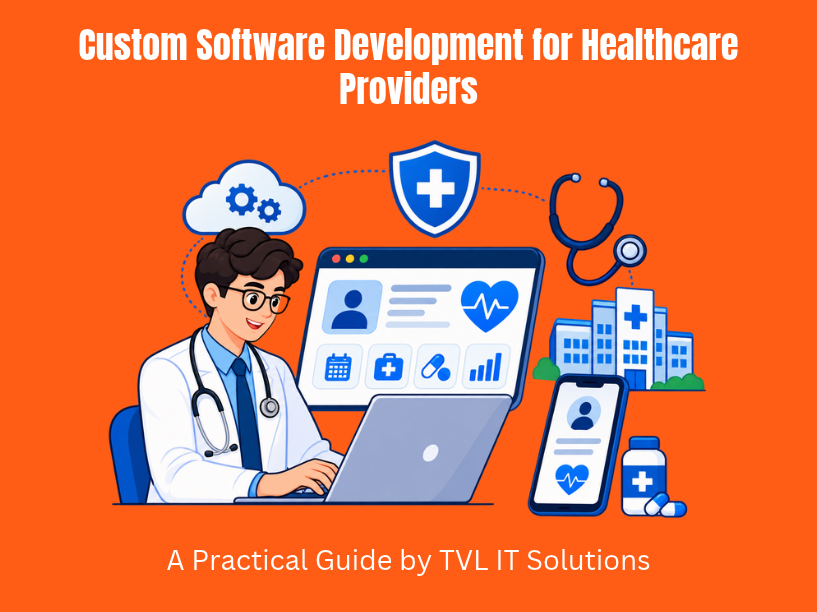

Healthcare providers face a growing gap between what generic software offers and what clinical teams actually need. Fragmented EHR systems, slow medical billing cycles, underused patient portals, and disconnected medical devices create daily friction for hospitals, clinics, and telehealth practices. Custom software development for healthcare providers bridges that gap by aligning technology to real clinical and administrative workflows – not the other way around.
This guide is written from the perspective of TVL IT Solutions, an India-based custom software development company that partners with healthcare providers, ISVs, and digital health startups to build secure, scalable healthcare software solutions. We cover the full landscape: clinical workflows, administration, interoperability, medical devices, data security, and ongoing support.
The healthcare industry is digitizing faster than most sectors. The healthcare IT market is expected to grow at 17.9% CAGR until 2030, and the broader digital health market – valued at approximately USD 347.4 billion in 2025 – is forecast to reach USD 1,830.4 billion by 2033. These numbers reflect real demand: providers need software that works for their specific operations, not software they must work around.
Telemedicine adoption increased by over 3,000% in 2020. While utilization has stabilized, about 22% of adults reported using telehealth services in recent surveys. This shift forced healthcare organizations to rethink everything – scheduling, billing, remote consultations, and how patient data moves between systems. Off-the-shelf tools often could not keep up.
Today, 60% of users expect to manage their health information online. That expectation drives demand for custom patient portals, mobile apps, remote patient monitoring systems, and digital front doors that connect patients to their care teams. Healthcare organizations are increasingly adopting cloud-based solutions for scalability, making it possible to serve thousands of concurrent users without performance loss.
At TVL IT Solutions, we see the same patterns across our healthcare software projects: providers and healthtech firms come to us because their existing medical systems cannot support the workflows, integrations, or security requirements they need. The rest of this article covers what custom healthcare software development actually involves, where it delivers value, and how to approach it practically.
A generic EHR or standalone billing package works for basic record-keeping. But the moment a cardiology clinic needs specialty-specific templates, or a multi-specialty hospital requires deep integration between its lab information system and patient portals, the limitations surface quickly. Understanding why businesses switch to custom software development helps frame this decision.
Off-the-shelf healthcare software typically fails in predictable areas. Rigid workflows force clinicians to adapt to the software rather than the software adapting to clinical workflows. Integration with medical devices – ECG machines, infusion pumps, imaging scanners – is often limited to what the vendor decides to support. The UX tends to be designed for “average” use, meaning it is optimized for nobody in particular. Analytics and reporting are confined to what the vendor ships.
Custom healthcare software development flips this. Care pathways become configurable to the provider’s protocols. Specialty-specific templates reduce data entry errors and speed up documentation. Custom dashboards surface clinical and financial KPIs that matter to the organization, not generic benchmarks. Integration with existing medical systems – including legacy systems – is designed from the start, not bolted on.
Custom healthcare software enhances patient engagement and operational efficiency because every screen, workflow, and data exchange is built around the provider’s actual processes. Custom software can improve patient care by streamlining record-keeping and reducing the friction that leads to misdiagnosis and unnecessary procedures. Healthcare software can reduce misdiagnosis and unnecessary procedures when clinical decision support tools are tuned to the provider’s specialty and patient population.
TVL IT Solutions regularly works with healthcare providers and healthtech firms on several categories of modern healthcare software development. Here are the most requested.
Custom EHR and EMR Modules. Rather than replacing an entire electronic health records system, many providers need custom modules layered on top – specialty documentation templates, clinical decision support alerts, or automated referral tracking. Outpatient clinics, mental health facilities, and multi-hospital systems each need different configurations.
Telehealth and Digital Health Platforms. Telemedicine platforms that combine video, audio, chat, and asynchronous messaging, integrated with scheduling, billing, and EHR systems. These are especially critical for telehealth-first practices and chronic disease management programs.
Patient Portals and Patient Engagement Tools. Custom patient portals let patients view lab results, schedule appointments, message providers, and manage payments. Over 60% of users expect to manage health information online, making these portals essential for patient engagement.
Medical Billing Software and Revenue Cycle Management. Medical billing software and revenue cycle management systems that automate claim submission, denial management, and payment posting. Custom solutions connect billing to clinical workflows so charges are captured accurately at the point of care.
Hospital and Practice Management Software. Hospital management software and practice management systems that handle scheduling, resource allocation, staff management, and operational reporting. Practice management software is particularly important for single-physician clinics and small group practices that need streamlined, specialty-tuned operations.
Remote Patient Monitoring Software. Remote patient monitoring software that ingests data from connected medical devices – blood pressure cuffs, glucometers, pulse oximeters – and presents it on clinician dashboards with threshold-based alerts. Remote patient monitoring systems are central to chronic disease and post-surgical care programs.
Medical Device Software and Companion Apps. Medical device software, including Software as a Medical Device (SaMD) and companion mobile apps for medical device manufacturers. These require regulatory-grade development practices, including compliance with IEC 62304 and relevant FDA or EU MDR requirements.
Medical Imaging Software. Medical imaging software that connects PACS, RIS, and DICOM-based devices to reporting dashboards, enabling radiologists and referring physicians to access images and reports faster.
Pharmacy Management Software. Pharmacy management software that integrates with EHR systems for e-prescribing, formulary checks, and inventory management across single or multi-location pharmacies.
Different healthcare providers have distinct priorities, and custom software patterns vary accordingly. Custom solutions can be tailored to specific workflows in healthcare regardless of organization size.
Large Hospitals and Health Systems. Enterprise-scale healthcare organizations often need to consolidate dozens – sometimes hundreds – of legacy systems into unified platforms. Mayo Clinic, for example, merged 287 legacy systems into a single EHR and revenue cycle management solution, defining over 1,400 future-state workflows and involving 51,000 end users. Typical projects include OR scheduling optimization, supply chain visibility, bed capacity predictive analytics, and enterprise-wide reporting. Custom reporting tools can track patient outcomes and clinical data across departments and campuses.
Specialty and Single-Physician Clinics. Smaller medical practices need lightweight but deeply specialized tools – referral and prior authorization tracking, specialty-specific documentation templates, scheduling and reminder systems, and patient survey tools. A dermatology clinic’s workflow differs fundamentally from a mental health practice, and custom healthcare software adapts to those differences instead of forcing workarounds.
Diagnostic and Imaging Centers. Labs and imaging centers require lab information systems (LIS), PACS/RIS integrations, automatic result delivery to patient portals, and DICOM standard handling. Integrating imaging scanners into custom dashboards allows radiologists to make same-day decisions with all relevant data in one view rather than toggling between disconnected systems.
Rehabilitation and Home Care Providers. Remote patient monitoring, wearable device integration, therapy scheduling apps, and patient-facing mobile apps with exercise tracking and clinician dashboards. These solutions connect medical professionals with patients outside of traditional clinical settings.
Telehealth-First Practices. Full telemedicine platforms with video, audio, chat, and asynchronous capabilities. These integrate with EHRs, patient portals, and billing systems. Custom triage and scheduling flows create a digital front door that serves as the primary entry point for patient care.
Why invest in custom healthcare software when off-the-shelf options exist? Because the returns show up in clinical outcomes, staff satisfaction, revenue integrity, and regulatory readiness.
Higher clinical efficiency. Custom software development helps healthcare providers streamline daily workflows by automating repetitive tasks like prior authorizations, lab result routing, and medication ordering. A medical center that built a custom CRM-based system for remote hypertension management automated intake, device configuration, reminders, and EHR integration – freeing clinical staff to focus on patient care rather than administrative tasks. Custom solutions can improve clinical workflows by automating repetitive tasks that consume hours of clinician time each day.
Fewer manual errors and rework. Specialty-specific templates and integrated data flows reduce transcription mistakes that occur when information is manually copied between systems. Healthcare software development can reduce the cost of care by automating processes that previously depended on error-prone manual entry.
Better patient experience through digital health channels. Beaufort Memorial Hospital redesigned patient registration workflows, created zero-contact intake, and automated appointment reminders – raising portal adoption to approximately 40% and increasing full patient registration by roughly 30%. Custom healthcare software can enhance patient engagement significantly through well-designed portals, mobile apps, and self-service tools.
Stronger data security and governance. Custom software ensures compliance with regulations like HIPAA through purpose-built encryption, audit trails, role-based access control, and zero trust architecture – not through generic security settings applied as an afterthought. Healthcare data security is paramount for custom software solutions.
Better support for regulatory compliance and audits. Compliance considerations like PHI handling, consent management, and retention policies are embedded in the architecture from day one. This makes audits faster and less disruptive.
Healthcare data is among the most regulated and most targeted. In 2023, over 725 large breaches were reported to the U.S. HHS, compromising more than 133 million records. In 2024, U.S. healthcare organizations reported 275 million records breached – more than double the prior year. Security cannot be bolted on later.
HIPAA compliance is mandatory for healthcare software handling patient data in the United States. Healthcare platforms must comply with GDPR and other regional standards when serving patients in the EU or other jurisdictions. India’s evolving data protection laws, including the proposed DISHA (Digital Information Security in Healthcare Act), add further requirements for cross-border development partnerships.
Data security in healthcare includes multi-factor authentication and secure cloud infrastructure, but it goes deeper than that. TVL IT Solutions follows security-first practices in every custom healthcare software project: encryption in transit and at rest, role-based access control, detailed audit logs, least-privilege design, regular vulnerability assessments, and secure DevOps pipelines. Leading providers implement strict access control systems and encryption protocols as foundational architecture decisions.
Consider a telemedicine platform where physicians, nurses, billing staff, and patients all interact with the same system. Each role requires different access scopes – a billing specialist should never see clinical notes, and a patient should never see another patient’s data. Compliance considerations shape architecture and user flows from the first planning workshop, not as a final review step. Healthcare software must comply with HIPAA regulations at every layer of the stack.
Healthcare providers typically run multiple systems – EHR, LIS, RIS, PACS, billing, pharmacy – plus various medical devices that must exchange healthcare data reliably. Healthcare systems require interoperability with existing electronic health records to avoid data silos and duplicated work.
Modern healthcare software development leverages standards like HL7, FHIR, and DICOM to connect these systems. Interoperability platforms built on FHIR and HL7 standards are growing rapidly, driven by both regulatory mandates and practical need. Custom software ensures seamless integration with existing medical systems through well-designed interface layers and secure REST APIs.
Practical integration scenarios include syncing appointments and claims between EHR and medical billing software, ingesting vitals from Bluetooth or Wi-Fi enabled medical devices into a remote monitoring portal, or connecting patient portals to lab results and imaging reports. Virginia Hospital Center, for instance, rolled out over 100 integrations and built 85 custom reports when replacing a 25-year-old on-premise system. Healthcare software must support secure data exchange between systems at every integration point.
Good interoperability delivers measurable benefits: fewer duplicate entries, reduced clinical risk from missing information, faster decision-making, and more accurate analytics for both clinical and operational use.
Many legacy healthcare systems suffer from cluttered screens, slow performance, and confusing navigation – particularly on mobile devices. When medical professionals avoid using a system, the organization loses data quality, compliance visibility, and operational efficiency.
Co-design with clinicians. TVL IT Solutions runs workshops with doctors, nurses, and admin staff before any interface is finalized. Patient interviews inform portal and mobile app design. Prototyping and usability testing happen before full build, not after deployment. User experience in healthcare software should be intuitive and mobile-friendly because healthcare professionals are often on their feet, moving between rooms and buildings.
Mobile-first for digital health. One-click access to frequent tasks, smart defaults, context-aware alerts, and support for touch devices in wards. Accessible patient portals support older patients who may be less familiar with digital tools. Custom healthcare app development prioritizes function and clarity over visual complexity.
A practical example: redesigning a medication ordering screen to reduce click count from seven steps to three, with smart defaults based on patient history and formulary. This kind of change directly impacts safety – fewer clicks mean fewer opportunities for selection errors – and improves clinician satisfaction.
TVL IT Solutions follows a structured, healthcare-specific development process. Healthcare software development often uses Agile methodologies for efficiency, and our approach embeds compliance and security at every stage. For a broader view of this process, see our Custom Software Development Guide for Businesses 2026.
Discovery. We map existing workflows, systems, and medical devices. Clinical stakeholders – physicians, nurses, billing leads – participate directly. This phase surfaces integration challenges, compliance constraints, and priority pain points before a single line of code is written.
Solution Design. Architecture diagrams, data flow maps, and clickable prototypes are created and reviewed with the provider’s team. Regulatory checkpoints are defined here – not at the end. Custom software development can enhance operational workflows when the design phase captures real clinical processes accurately.
Development. Agile sprints with regular demos keep clinical stakeholders informed without overloading them. Offshore delivery from India is combined with overlapping working hours so Western and APAC providers can collaborate smoothly.
Testing and Validation. Functional, performance, security, and clinical safety checks run throughout development. Penetration testing, vulnerability scanning, and compliance validation happen before go-live.
Deployment. Phased rollouts reduce risk. Staff training is planned alongside deployment, not after. Data migration from legacy systems is tested in staging environments first.
Ongoing Support. Post-launch monitoring, bug fixes, security patching, and iterative improvements continue as the system evolves. Custom applications can support AI and analytics for better healthcare decision-making as the system matures.
Case Study 1: Multi-Specialty Clinic Network
Challenge. A growing clinic network struggled with disconnected scheduling, billing, and documentation systems. Claim rejections were high, and patient check-in averaged over 12 minutes.
Solution. TVL IT Solutions built an integrated platform combining appointment scheduling, streamlined EHR documentation, and medical billing software with automated claim submission. Self-service kiosks and a mobile check-in app were added for patient-facing workflows.
Impact. Claim rejections dropped significantly. Average check-in time was reduced. Staff reported less time on manual data entry and more time on patient care. Custom healthcare software improves operational efficiency by streamlining workflows that were previously fragmented.
Case Study 2: Remote Patient Monitoring for Chronic Disease
Challenge. A chronic disease management program needed to integrate IoT medical devices – blood pressure cuffs, glucometers – with a clinician dashboard and patient mobile app.
Solution. A remote patient monitoring platform was built with automated device data ingestion, threshold-based alerts, secure messaging, and EHR integration. The patient app included medication reminders and symptom logging.
Impact. Clinician response times to abnormal readings improved. Patient adherence to monitoring protocols increased. The platform scaled to support additional device types and patient cohorts over time. Custom healthcare software can easily scale with business growth.
Case Study 3: Legacy Lab Reporting Modernization
Challenge. A diagnostic lab relied on a decades-old reporting system with no web access for physicians or patients. Report turnaround visibility was poor.
Solution. A web-based portal was built and connected to the lab’s existing LIS, with physician and patient views showing real-time report status, result delivery, and historical data.
Impact. Turnaround visibility improved for both physicians and patients, and the lab saw increased referral satisfaction. Enhance patient care became a practical outcome, not just a goal.
TVL IT Solutions selects technology stacks based on clinical and business requirements, not trends. Here is a high-level overview of what we typically use for healthcare software development solutions.
Backend. Java (Spring Boot) and .NET Core are common for enterprise healthcare systems requiring performance and long-term maintainability. Node.js works well for real-time features like chat and notifications. Python is used whenAI and ML components are central to the solution.
Frontend. React, Angular, or Vue.js for web portals and dashboards, chosen based on team experience and project complexity. TVL IT Solutions delivers frontend development that prioritizes speed and accessibility for healthcare professionals.
Mobile. Native iOS/Android for performance-critical or security-sensitive apps. Cross-platform frameworks like Flutter or React Native when broader reach matters and budget is a constraint.
Databases and Cloud. Relational databases (PostgreSQL, SQL Server) for transactional data. NoSQL or time-series databases for device telemetry. Cloud-based solutions enhance scalability for healthcare applications – AWS, Azure, and GCP all offer HIPAA-eligible environments. Healthcare platforms must support thousands of users without performance loss, and scalable architecture is essential for modern healthcare software solutions.
AI and ML. AI-powered diagnostics have a CAGR of over 35%, and over 40% of healthcare organizations invest in AI and predictive analytics. AI enhances diagnostic and analytical precision in healthcare software when implemented responsibly – with validation, bias evaluation, and explainability. AI algorithms drive predictive analytics for readmission risk, triage prioritization, and resource allocation. AI and ML streamline routine operations in healthcare, from automated coding suggestions to clinical alert filtering.
Architecture. Microservices when multiple modules and integrations are involved. Modular monoliths for simpler systems. Event-driven patterns for device data ingestion. High-availability design is non-negotiable for critical clinical systems.
TVL IT Solutions is an offshore custom software development partner based in India, working across healthcare and other regulated industries. Our engagement models are designed to match the realities of healthcare software projects.
Flexible engagement models include dedicated teams and fixed price. Dedicated teams work as an embedded extension of the provider’s IT department, handling ongoing healthcare software product development. Fixed-scope projects suit well-defined modules like a patient portal or digital front door app. Time & material and hybrid models are also available for evolving clinical requirements where scope changes as discovery deepens. Engagement models cater to unique project requirements and budgets – there is no single model that fits every healthcare software initiative.
Communication is structured around overlapping working hours, sprint-based demos, shared backlog tools, and direct access to technical leads. Clinical stakeholders such as CMIOs and nursing leadership participate in key reviews without being pulled into daily standups. Clear escalation paths and transparent documentation – architecture diagrams, API definitions, security policies – keep providers in control of their healthcare software projects.
Custom healthcare software is a long-term asset. Regulations change, clinical guidelines update, new medical devices enter the market, and patient expectations shift. Scalability is crucial as healthcare organizations expand or add new services, and systems must evolve alongside the organization.
Ongoing support typically includes bug fixes, performance tuning, security patching, API updates for integrated systems, minor UX tweaks, and monitoring of error logs. This is not optional – healthcare software systems that lack structured maintenance become security liabilities and clinical bottlenecks.
Planned evolution goes further: adding AI-driven clinical alerts, expanding to new locations, integrating new medical devices, or extending patient portal features like online forms and secure messaging. Modern healthcare software development treats launch as the beginning of the product lifecycle, not the end.
TVL IT Solutions offers structured ongoing support and evolution arrangements so providers are not left with orphaned systems. Whether it is a quarterly security review or a major feature expansion, the relationship continues beyond go-live.
Unclear scope from complex clinical workflows. Healthcare workflows are nuanced and vary by department, specialty, and location. Without detailed discovery and workflow mapping, projects rework major sections mid-build. TVL IT Solutions runs structured workshops and prototype reviews early to lock down requirements before full development begins.
Integration surprises with legacy systems. Medical devices or lab systems may use proprietary formats or outdated protocols. During one analysis, our team discovered that an imaging system only exported via a proprietary format – so we planned a converter module before development started, avoiding a costly mid-project surprise.
Underestimating regulatory and data security work. Some teams treat compliance as a checklist item rather than core architecture. TVL IT Solutions embeds compliance in design through security architecture reviews, consent flow mapping, and audit trail planning from the first sprint.
User adoption resistance. Medical professionals may resist new workflows or interfaces, especially if they were not involved in the design. Co-design with clinicians, usability testing, incremental rollouts, and structured training reduce this risk significantly.
Maintenance and support gaps. Custom software that lacks ongoing support becomes a liability. Defining support arrangements – patches, device additions, regulatory updates, UX improvements – from the start prevents abandonment. Vendor expertise in healthcare technology is vital for developing effective software solutions that endure.
Choosing a healthcare software development company requires a structured evaluation, not a sales pitch comparison. Here are the criteria that matter, whether you are evaluating TVL IT Solutions or any other partner. For a deeper dive, read our guide on 10 Questions Before Hiring a Healthcare Software Company.
Healthcare domain experience and references. Ask for 2–3 relevant case studies. A partner who has built remote patient monitoring software is better positioned to build your next RPM platform than one with no healthcare track record.
Understanding of regulatory compliance. Custom software ensures compliance with regulations like HIPAA only when the development team understands the regulatory landscape deeply – not just at a checklist level.
Evidence of data security practices. Request documentation of security architecture patterns, penetration testing processes, and incident response protocols.
Integration track record. Ask specifically about experience with EHRs, medical devices, and interoperability standards like FHIR and HL7.
UX capabilities. Review past interface designs. Ask how clinicians and patients were involved in the design process.
Communication quality. Meet the technical lead and project manager. Review sample documentation. Clarify how the team handles incidents and change requests. These conversations reveal more than any proposal deck. For additional guidance, see How to Choose the Right Custom Software Development Company.
Custom software development for healthcare providers is a practical route to better patient care, safer data, and more efficient healthcare operations when executed with the right partner. The healthcare sector demands precision, security, and adaptability – and custom healthcare solutions deliver on all three.
Here are concrete first steps to move forward:
An initial discovery conversation with TVL IT Solutions typically involves one to two sessions to understand your goals, constraints, and timelines, followed by a high-level solution concept and roadmap. No generic templates – just a tailored solutions framework built around your medical services and clinical workflows.
Ready to explore what custom healthcare software development can do for your organization? Visit TVL IT Solutions to start a conversation about your custom software development needs, or explore our AI and ML capabilities for healthcare software development experts looking to add predictive analytics and intelligent automation to their healthcare software.
The right healthcare software development partner does not just build software – they build software that works the way your teams and patients actually need it to.
It involves building tailored software solutions that support healthcare workflows, including patient management, clinical documentation, medical billing, telehealth, and healthcare data management.
Common solutions include custom EHR and EMR modules, telehealth platforms, patient portals, medical billing systems, hospital management software, remote patient monitoring platforms, medical imaging software, and pharmacy management systems.
Custom healthcare software can improve clinical efficiency, reduce manual errors, enhance patient engagement, strengthen data security, and support regulatory compliance.
Healthcare software may need to address HIPAA, GDPR, and applicable regional data protection requirements. For interoperability, standards such as HL7, FHIR, and DICOM help connect healthcare systems and medical devices.
The process generally includes discovery, solution design, development, testing and validation, deployment, and ongoing support. Clinical stakeholder involvement and security considerations are included throughout the process.
At TVL IT Solutions, we specialize in delivering scalable, secure, and custom software development services tailored to your unique business needs. Whether you’re a startup or an enterprise, our team is ready to turn your vision into reality.
Get Started Now