
Most startups do not fail because the idea was bad. They fail because execution stalled – scope crept beyond control, the product missed the market window, or fragmented tools created more friction than value. In a software development landscape valued at approximately USD 659.01 billion in 2023, the opportunities are enormous, but so is the cost of building the wrong thing the wrong way.
Between 2024 and 2026, investor expectations have shifted sharply. Technical due diligence now includes codebase reviews, scalable architecture assessments, and compliance readiness. Founders who cannot demonstrate a structured custom software development process struggle to pass these gates. Meanwhile, startups relying on stitched-together SaaS stacks hit limitations in customization, data ownership, and integration – precisely when they need to move fastest.
This article walks you through the full custom software development process for startups, from the first discovery conversation through deployment and ongoing support. You will learn what decisions to make at each development phase, how to avoid the most common mistakes, and how TVL IT Solutions – an India-based custom software development company – partners with early-stage and growth-stage teams to deliver secure, scalable, business-ready products.
Custom software development means building digital products tailored to a startup’s specific workflows, users, and growth trajectory. Instead of adapting your business processes to fit a generic tool, you build software that fits your business.
In practical terms, this covers:
Custom software differs from off the shelf software in a few critical ways. Off-the-shelf software often requires compromises on functionality – rigid workflows, limited integrations, and subscription costs that scale faster than your revenue. Custom software allows for complete alignment with business objectives, giving you control over user experience, data, security, and the ability to iterate on your own timeline.
Early-stage startups in 2025–2026 increasingly treat developing custom software as an investment in intellectual property, not a one-off project. The source code, architecture, user data, and product logic become assets – central to valuation, customer negotiations, and acquisition conversations.
Consider a logistics startup that needs real-time package tracking. An off-the-shelf GPS tool might introduce latency, cap API calls, and lock data behind a subscription. A custom-built tracking system lets them own the data, optimize for their specific delivery flows, and scale without artificial limits.
Custom software allows startups to add new features without significant constraints, and it can scale with business growth without the ceiling that packaged tools impose.
Startups often begin with a stack of SaaS products – a CRM here, an analytics tool there, a billing system somewhere else. It works until it does not. Here is where the pain usually shows up:
Custom development solves these by giving startups:
Custom solutions typically reduce long-term costs compared to off the shelf options. Industry data suggests custom software can reduce long-term costs by 40-60% compared to off-the-shelf solutions when factoring in subscription fees, workaround labor, and integration maintenance over several years.
Micro-examples:
Custom software enhances user experience and engagement, which matters when your product is your primary competitive edge.
Not everything needs to be built from scratch. The decision comes down to whether a workflow is your core differentiator or a utility.
Use off the shelf tools for non-core functions – payment processing, transactional email, basic authentication. Build custom solutions for the workflows that define your product’s unique value and change frequently as you learn from real users.
Before you start drafting requirements, ask yourself these questions:
Example: A subscription commerce startup uses Stripe for payment processing – quick, compliant, and reliable. But they custom-build their pricing engine, bundle recommendation logic, and discount rules because that is where their competitive edge lives. The payment rail is a commodity. The pricing intelligence is IP.
Decide before you draft requirements. It saves weeks of scope debates later.
Not every startup needs custom development on day one. The right timing depends on stage and situation.
By stage:
Startup profiles that benefit most:
When is it too early? If you only have an idea and no validated customer problem, heavy investment in custom software increases risk. Validate first.
When is it risky to delay? Once off the shelf solutions cause repeated outages, manual workarounds consume engineering hours, or you cannot close enterprise deals because your product lacks compliance or integration capabilities – delaying custom development becomes more expensive than starting it.
Here are the most common types, along with when startups typically need them.
Custom software is designed to scale as startups grow, regardless of which type they build first.
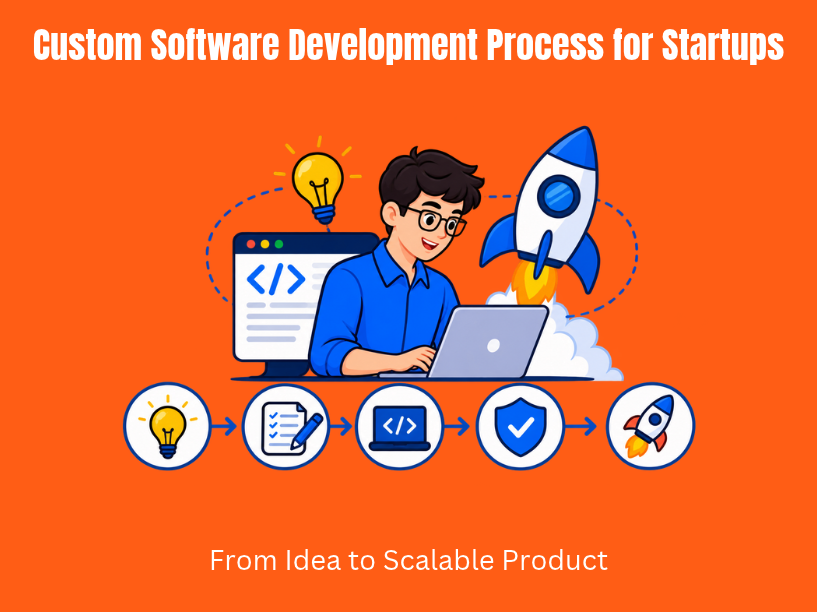
The custom software development process includes requirement analysis and product discovery, followed by structured phases that move from idea to working software. Here is the high-level roadmap:
Agile development focuses on breaking the process into smaller, manageable chunks – so you see progress every sprint rather than waiting months for a big reveal. TVL IT Solutions follows an agile development approach tailored to startup cadence: short sprints, frequent demos, and continuous feedback loops that keep founders in control.
The following sections walk through each step with startup-specific nuances.
This is typically the first one to three weeks. The goal is to align founders and the development team on vision, constraints, and priorities before anyone starts writing code.
Key discovery activities:
Key outputs from discovery:
Regular communication and feedback loops are essential in the development process, and that starts here. Startups should prioritize clear communication with development partners from day one – misalignment at this stage compounds into expensive rework later.
When working with a partner like TVL IT Solutions, founders should expect guidance on non-functional requirements (security, scalability, performance) and compliance needs even before the first line of code.
Every founder has a long feature wish-list. The discipline is in cutting it down to what actually proves value.
Use a prioritization method like MoSCoW to sort features:
Include only the flows critical to proving value. For a marketplace MVP, that might mean managing vendor logic manually (spreadsheets, email) until transaction volume justifies building custom vendor dashboards. For a fintech MVP, it might mean relying on a third-party KYC provider rather than building a proprietary identity verification engine.
Startups can reduce initial costs by 40-60% with MVPs by focusing resources on the critical path instead of building unnecessary features. Startups often build too many features at once – this is one of the most reliable ways to miss your launch window and burn through runway.
A B2B analytics startup trimmed its initial feature list from 28 items to 7 core workflows. They launched in 10 weeks instead of the projected 6 months. Post-launch user feedback reshaped 40% of the original wish-list, meaning half of those deferred features would have been wasted effort.
Your technology stack is the collection of technologies used across frontend, backend, database, cloud infrastructure, and DevOps. Choosing the right technology stack impacts software performance and scalability for years to come. Choosing a scalable technology from the beginning spares costly relocations later.
Popular stacks for startups in 2025–2026:
| Layer | Common Choices |
| Frontend | React, Next.js, Vue.js |
| Backend | Node.js, Python (Django/FastAPI), .NET |
| Database | PostgreSQL, MongoDB, Redis (caching) |
| Mobile | Flutter, React Native, Swift (iOS), Kotlin (Android) |
| Cloud | AWS, Google Cloud, Azure, DigitalOcean |
| AI/ML | Python, FastAPI, vector databases (Pinecone, Weaviate) |
React is a powerful front-end JavaScript library for building user interfaces, and it pairs well with Node.js backends for startups that want a unified JavaScript ecosystem. Python is known for its readability and ease of use in web applications and is the go-to for AI/ML features. The MEAN stack (MongoDB, Express, Angular, Node.js) is ideal for startups needing high performance and scalability in real-time applications.
Decision factors:
TVL IT Solutions advises on tech stack selection for each client, factoring in web, mobile, game, and enterprise integrations including Microsoft Dynamics and Salesforce. The wrong stack choice can force a costly rebuild within 18 months. The right one gives you a foundation that scales with your user base.
Design is not decoration. It is the interface between your product and your revenue.
The data is clear: 70% of users abandon apps due to poor UX design. On the other side, good UX design increases user engagement by 400%, and a well-designed user interface can boost conversion rates by 200%. Startups with strong UI/UX design see 50% higher user retention compared to those that treat design as an afterthought. Investing in UI/UX design can reduce development costs by 30% because well-defined interfaces reduce ambiguity for software developers during the build phase.
Key design activities and artefacts:
A SaaS onboarding redesign case: A startup noticed 60% of trial signups never completed setup. By simplifying the onboarding flow – reducing form fields from 12 to 4, adding inline guidance, and breaking the process into three clear steps – activation rates improved substantially. That redesign took two weeks. Building the original complex onboarding had taken six.
Work with real users or representative user interfaces during design validation. Show them interactive prototypes before your development team writes a single line of production code. The cost of changing a wireframe is a fraction of the cost of changing working software.
Agile development breaks work into short iterations of 1-2 weeks, called sprints. Each sprint delivers a working increment of the product – not a document, not a plan, but functional software that stakeholders can review and test.
How it works in practice:
What founders see every 1-2 weeks when working with TVL IT Solutions:
Agile development minimizes waste and allows for incremental improvements. When user feedback arrives mid-project – and it will – agile lets you adapt without throwing away weeks of work. Successful startups view software as an evolving product that requires continuous improvement, not a one-time deliverable.
This iterative development approach is a core reason why startups that follow structured agile processes ship faster and with fewer surprises than those using rigid, waterfall-style plans.
Skipping the testing phase results in bugs after launch – bugs that frustrate early adopters, damage credibility, and consume developer time that should be spent on new features.
Quality assurance includes unit testing, integration testing, and performance testing, among other types. Testing and quality assurance ensure software functions consistently across environments – browsers, devices, operating systems, network conditions.
Types of testing relevant for startups:
The key principle: continuous testing, not a single “big bang” test at the end. Automated tests run in continuous integration pipelines catch regressions before they reach users. Automated testing is not optional for startups that want to ship fast without breaking things.
Involve a few real users or friendly early customers in user acceptance testing to catch UX issues that automated tests cannot detect – confusing labels, unexpected flows, edge cases that only appear in real-world usage.
TVL IT Solutions builds automated testing and DevOps practices into startup projects, integrating quality assurance into every sprint rather than treating it as a final gate.
Deployment involves moving software to a production environment for users – transitioning from a staging or test environment to the real thing where customers log in, transact, and depend on your product.
Deployment should be automated to reduce manual errors. Manual deployment processes invite mistakes – missed configurations, forgotten environment variables, inconsistent builds. CI/CD (continuous integration / continuous deployment) pipelines automate this, ensuring every release follows the same verified steps.
Cloud infrastructure choices:
Startups typically choose managed cloud providers – AWS, Azure, or Google Cloud – because they offer scalability, reliability, and managed services without upfront hardware investment. Cloud hosting avoids upfront hardware costs and scales with usage, which is exactly what early-stage startups need.
A safe launch checklist:
Phased rollout approach:
Monitoring after launch helps track application errors and user behavior. Without observability, you are flying blind after go-live.
Launching is not the finish line. Post-launch support is essential for ongoing software maintenance – the product now has real users, real data, and real expectations.
What ongoing support includes:
Encourage a continuous feedback loop: analytics tools tracking activation, retention, and churn; user interviews and surveys; support ticket analysis. This feedback flows into a living project roadmap that evolves every month.
TVL IT Solutions offers long-term strategic partnerships, not one-off launches. They help startups beyond v1 – with scaling, refactoring, new features, regional expansion, and ongoing support that keeps the product healthy as the business grows.
This section does not list specific prices. Instead, it explains what mainly drives software development cost so founders can make informed trade-offs.
Key cost drivers:
Practical strategies to optimise development costs:
Startups can achieve significant cost savings by outsourcing software development to India, where access to deep technical talent at favorable rates makes offshore partnerships particularly attractive. TVL IT Solutions operates as an India-based partner offering this advantage without compromising quality or communication standards.
Track total cost of ownership – not just the initial build. Include ongoing maintenance, cloud usage, security patching, and scaling costs. The cheapest initial build often turns into the most expensive long-term decision if it creates technical debt or requires re-architecture within a year.
Even with a solid process, startup software development carries risks. Here are the most common mistakes and how they typically show up – plus how to avoid them.
Mitigation runs through every one of these: clear backlog, regular demos, decision logs, a single product owner, and a development partner willing to push back when scope inflates unreasonably.
Security is not a feature you add before fundraising. It is a foundation you build from the first sprint – especially if your startup handles sensitive data like personal information, payments, or health records.
Essential security practices:
Compliance considerations for 2024–2026 startups:
The risk of ignoring security:
A breach damages reputation, erodes user trust, triggers regulatory fines, and can derail fundraising. Investors conducting technical due diligence will flag a startup with no security posture as high risk. Keeping software secure is not a cost center – it is a precondition for business growth.
Your custom software is more than a product. It is intellectual property – and its ownership determines your ability to raise funds, negotiate acquisitions, and control your future.
What counts as IP in custom software projects:
Why this matters for founders:
What to do:
A cautionary example: A startup built its core platform through a freelance contractor without explicit IP assignment. When a strategic acquirer conducted due diligence, the contractor claimed partial rights to the codebase. The acquisition stalled for months and the valuation took a hit. A clear contract from day one would have prevented this entirely.
The partner you choose shapes the quality, speed, and long-term maintainability of your software. This decision deserves the same rigor as choosing a co-founder.
Evaluation criteria:
Technical expertise is crucial when selecting a development partner. Choosing a partner with industry experience speeds up development because they have already solved similar problems and know where the pitfalls are.
Red flags to watch for:
TVL IT Solutions positions itself as a partner that offers dedicated teams, fixed price, time and material, and hybrid model engagements tailored to startup needs. Their approach to choosing the right development partner emphasizes transparency, technical expertise, and long-term alignment over short-term project extraction.
The right engagement model depends on your stage, clarity of scope, and how much control you want over the day-to-day.
| Model | How It Works | Best For |
| Fixed Price | Scope, timeline, and budget defined upfront | Well-defined MVPs with clear requirements |
| Time & Material | Billed per hour or day; scope evolves | Exploratory projects, ongoing feature development |
| Dedicated Team | A committed team works exclusively on your product | Long-term products, scaling phases |
| Hybrid | Combines elements – e.g., fixed price for MVP, then T&M for iteration | Startups transitioning between stages |
Trade-offs:
TVL IT Solutions supports all four engagement models and collaborates with founders to choose based on stage, scope clarity, and business goals.
Situation: A B2B workflow automation startup in 2024 had three early paying pilot customers managing processes via spreadsheets and email. They needed a functional product to demonstrate at investor demos and onboard additional pilots. Budget was limited. Timeline was tight – 12 weeks to a launchable MVP.
Engagement: The founders chose a hybrid model – fixed price for discovery and MVP build, with the option to shift to time and material for post-launch iteration. TVL IT Solutions assigned a small, focused development team.
Process followed:
Outcomes:
Lessons learned:
Situation: A multi-vendor marketplace brand had launched on a standard eCommerce platform with plugins for inventory management, vendor payouts, and promotions. As order volume grew – especially during festive campaigns – plugin limitations caused stock mismatches, delayed vendor payments, and performance degradation under traffic spikes.
Why they moved to custom: The existing tools could not handle multi-vendor inventory logic with batch-level control, custom promotion rules (vendor-specific discounts, bundled offers), or real-time stock synchronization across warehouses. Off the shelf solutions had reached their ceiling.
Custom solution built with TVL IT Solutions:
Migration approach:
Results:
Modern startups increasingly embed intelligence into their products from day one. This includes AI/ML features (recommendations, fraud detection, personalization), analytics dashboards for operational visibility, and integrations with existing systems like CRMs and ERPs.
Common integration patterns:
Decision guidance for founders:
Software developed for a seed-stage startup will need to evolve as the company scales. The architecture that handles 500 users may struggle at 50,000.
Long-term maintenance practices:
Scaling triggers – when to re-architect:
Custom software can scale with business growth without constraints when the foundation is designed with modularity and scalability in mind.
TVL IT Solutions supports startups beyond v1, acting as a long-term technical partner for iterative development, infrastructure scaling, security patching, and feature expansion as the business grows.
A structured custom software development process does not eliminate risk – but it reduces it at every stage. Discovery catches misalignment before it becomes expensive. MVP definition prevents overbuilding. The right tech stack avoids costly migrations. Agile development keeps the product aligned with real users. And post launch support ensures the software performs and evolves long after launch day.
Key takeaways:
The global software development market continues to expand, and startups that treat their custom software development process as a competitive edge will outpace those who treat it as a checkbox.
If you are building your next product – whether it is an MVP, a platform migration, or a scale-up – TVL IT Solutions brings the technical expertise, flexible engagement models, and startup experience to turn your vision into working software that grows with your business. Explore TVL IT Solutions’ custom software development services to start the conversation.
It is a structured approach to building software tailored to a startup’s business goals, users, and growth needs. It includes discovery, MVP planning, technology selection, design, development, testing, deployment, and ongoing maintenance.
Custom software offers greater flexibility, scalability, data ownership, workflow customization, and control over security. It also helps startups overcome limitations such as disconnected tools, vendor dependency, and rising subscription costs.
The main stages are product discovery, requirement analysis, MVP definition, tech stack selection, UX/UI design, agile development, quality assurance, deployment, and post-launch support.
Startups can reduce costs by focusing on essential MVP features, using reusable components, choosing a practical technology stack, leveraging open-source libraries, and avoiding premature scaling or unnecessary features.
The timeline depends on project scope, complexity, integrations, and requirements. The article gives an example of a seed-stage startup launching an MVP within 12 weeks, including discovery, design, development, and QA.
At TVL IT Solutions, we specialize in delivering scalable, secure, and custom software development services tailored to your unique business needs. Whether you’re a startup or an enterprise, our team is ready to turn your vision into reality.
Get Started Now