
Your website is no longer a digital brochure. In 2026, it is your product demo, your sales funnel, your customer portal, and your competitive moat-all in one. If it runs on a generic template, it probably shows.
This guide breaks down everything you need to know about custom website development for businesses: what it is, when you need it, how the development process works, and how TVL IT Solutions delivers custom web solutions that drive real business growth. Whether you are a startup founder, an enterprise CTO, or a marketing leader evaluating your next website investment, this is your roadmap.
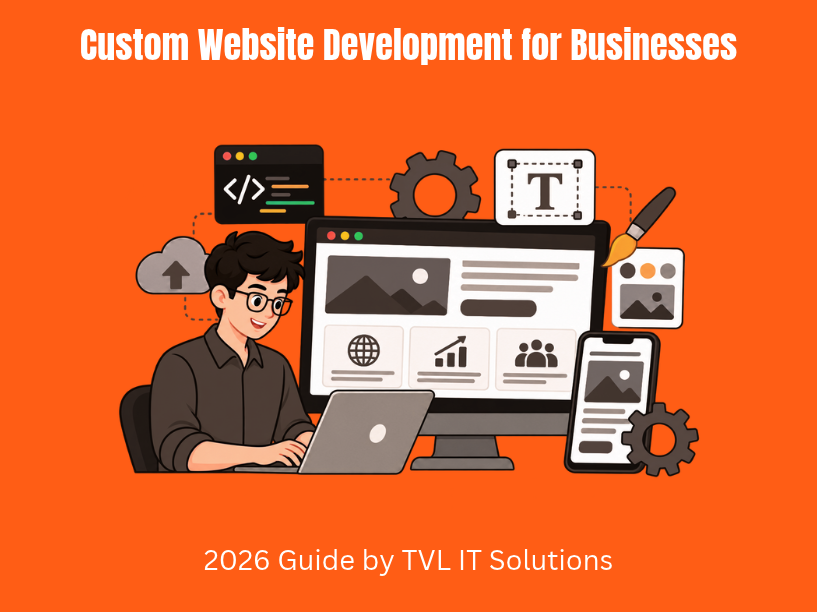
Custom website development means building a website from the ground up-designed and coded specifically to fit your business goals, workflows, branding, integrations, and technical architecture. It is the opposite of picking a website template, installing a few plugins, and hoping the pieces hold together. Custom websites are tailored to specific business needs, not bent into shape from someone else’s blueprint.
Custom website development provides tailored digital platforms built to match unique operational goals. That could mean a lead generation funnel for a B2B SaaS company, a self-service customer portal for a logistics firm, or a multi-region e commerce website development project for a global retailer. Custom functionality can include features like customer dashboards and CRM integrations-things that templates rarely support without heavy workarounds.
Custom web development covers two layers that work together:
TVL IT Solutions builds custom websites and web apps as part of broader digital transformation projects. Our clients include startups, SMEs, and enterprises that need secure, scalable, and business-ready platforms.
Here is the simplest way to think about the custom development process:
Business Goals → Strategy & Discovery → UX/UI Design → Development & Integrations → Ongoing Support & Optimization
Each phase feeds the next. Skip a phase, and the whole thing wobbles.
Between 2024 and 2026, user expectations, search engine standards, and regulatory pressure all moved in one direction: up. Google’s Core Web Vitals metrics now directly influence rankings and revenue. Mobile-first design is table stakes. AI-powered features like chatbots and recommendations are expected, not optional. A website should load in under three seconds to retain visitors-and most template-based sites struggle to hit that mark consistently.
Here are the concrete reasons custom website development matters right now:
Generic site builders come with restricted workflows, plugin bloat slowing site speed, and fragile scalability. As a business grows, these limitations compound. 58% of websites experienced a drop in session consumption-often because performance degrades as more plugins and features get bolted on.
Custom websites can handle increased web traffic effectively. They are built to scale, not to break.
Where off-the-shelf fails:
For startups, SMEs, and enterprises alike, the website is now part of the product-not just a marketing afterthought. Custom websites can improve SEO and increase traffic while also serving as the operational backbone of the business.
There are three categories of website builds: fully custom websites, semi-custom (customizing a high-quality theme), and template-only sites using pre built templates. Each has a place-but their ranges of suitability vary wildly.
Templates are “good enough” when you need:
Template websites save time and money compared to custom sites. That is their strength.
You really need custom website development when you require:
Custom web design costs are higher than website templates, but the return justifies the investment when complexity enters the picture. Pre-built templates may lead to similar designs among competitors, diluting your digital presence. Custom development allows for unique branding not possible with templates.
Custom websites offer better scalability than pre-built templates. They deliver faster speeds compared to pre-made templates. And they have better search engine performance due to clean semantic markup.
A scenario you will recognize: A B2B SaaS company launches with WordPress, a membership plugin, an email plugin, and a payment plugin. Over time, plugin conflicts slow the site. The onboarding flow cannot support complex subscription tiers. Performance drops. Security vulnerabilities surface. The team spends more time patching than building. Eventually, they move to a custom web app-React on the frontend, Node.js on the backend, a custom API layer-and everything works as intended.
TVL IT Solutions often starts from exactly this pain point. Clients come to us because they have outgrown their legacy systems and need a customized website solution that scales with them.
A custom website is only as good as the business strategy behind it. Here is how to translate typical business goals into web features:
| Business Goal | Web Feature |
| More qualified leads | Smart forms, conditional logic, guided flows, lead scoring integrated with CRM |
| Shorter sales cycle | Content automation, chatbots, self-service FAQs |
| Lower support load | Knowledge base, community forum, in-app support |
| Market expansion | Multi-language support, region-specific content, localization |
| Higher trial conversions | Streamlined onboarding flows, in-app tutorials |
Discovery workshops make this translation happen. They typically include:
TVL IT Solutions documents these findings in a product brief-a requirements blueprint that captures business goals, user personas, features, content types, performance targets, and integrations. This document drives every design and development decision that follows.
Custom website development should prioritize mobile responsiveness and performance from the start. SEO should be built into the development process with clean code and fast speeds. A custom website supports ongoing digital marketing efforts with better integration-connecting your site to your marketing stack, not working around it.
Concrete KPIs that influence design decisions include demo bookings, trial signups, NPS scores, and support ticket deflection rates. These numbers shape where CTAs go, how forms behave, and what content gets prioritized.
When done right, custom website development delivers measurable advantages:
Custom websites become long-term digital assets. Unlike disposable campaigns or throwaway landing pages, you own the code, the infrastructure, and the architecture. Custom websites can evolve with changing business needs. Custom development allows for easy modifications as requirements change. Scalability ensures websites can accommodate future traffic spikes and new features.
Well-architected custom built websites reduce technical debt and rebuild cycles. Many template-based sites need a full overhaul every 3–5 years as they outgrow their structure. A modular architecture from the start means you add features-not rewrite foundations.
TVL IT Solutions prioritizes scalability and maintainability at the architecture level, so your website supports business growth for years, not months.
Custom website development reflects your brand story, tone of voice, and visual system with precision. A business website built from scratch does not compromise on typography, color systems, layout structures, or interaction patterns-because none of these are locked behind a theme’s limitations.
Custom websites strengthen brand credibility through unique professional design. Custom development allows businesses to create a unique brand identity online. Custom websites enhance brand uniqueness and identity in ways that no template can match.
Concrete brand elements that templates rarely handle well:
76% of companies outsource for specialized skills in branding-which means most businesses recognize they need expert help to get this right. Custom websites provide a unique user experience tailored to branding. Custom web development allows for a brand-specific design approach that template galleries simply cannot replicate.
Example: A legacy corporate site with an outdated brochure-style design gets reimagined into a product-led experience-interactive demos, layered visuals, dynamic sections, modern typography, mobile-optimized blocks. The result: a visually appealing digital presence that reflects a modern, forward-looking brand identity.
TVL IT Solutions often collaborates with internal brand teams or creative agencies to build or evolve design systems as part of custom web design services. This ensures visual and experiential consistency across every digital touchpoint.
Site speed, Core Web Vitals, and search engine optimization are tightly linked in 2026. Search engines reward fast, well-structured sites-and penalize slow, bloated ones. Walmart saw a 2% lift in conversions per second load time improvement. Vodafone improved LCP by 31% and saw an 8% increase in sales. Custom web design can increase organic traffic by over 500% when performance and SEO architecture are prioritized together.
Performance tactics used in custom web development:
SEO-friendly structures baked into custom builds:
Clean code contributes to better SEO performance for custom-built websites. Custom web development offers better SEO performance than templates because you control every element that search engines evaluate-crawl budget, indexation rules, canonical tags, redirect chains, and page speed.
TVL IT Solutions bakes search engine optimization into the architecture phase, not as an afterthought. During backend API design and content modeling, we ensure every content field supports SEO metadata, clean URLs, and analytics-friendly output.
UX for custom websites starts from user research and real customer journeys-not from browsing a theme gallery and picking the one that “looks nice.” Custom website development enhances user experience through tailored navigation that reflects how your actual users think and behave.
Key UX elements in a well-built custom designed website:
Custom websites enhance user experience through tailored features that connect directly to conversion goals-whether that is a quote request, a free trial signup, a contact inquiry, or a booking. Custom websites provide a unique user experience compared to templates because every interaction is designed with intent.
39.6% of sessions are impacted by frustration-poor navigation, broken flows, confusing layouts. Meanwhile, 59% of consumers engage more with well-designed web content. The gap between good and bad UX is the gap between enhancing user engagement and losing site visitors.
Usability testing on clickable prototypes (Figma or similar) before development begins catches pain points early and reduces expensive rework later.
TVL IT Solutions teams include UX designers working closely with engineering. This tight collaboration avoids handoff gaps-ensuring designs are feasible, performance-aware, and buildable in the chosen tech stack.
Cybersecurity risks have escalated since 2024. Data breaches, supply-chain attacks, and tightening data privacy laws make security a non-negotiable part of any web development project.
Custom architecture reduces vulnerabilities tied to shared template code. Template websites are more vulnerable to security issues than custom sites because they depend on third-party plugins and themes-which may contain vulnerabilities, abandoned code, or inconsistent patching.
Security practices in custom builds:
Data protection and secure authentication are essential security considerations for custom websites. Custom websites reduce the risk of data breaches significantly. Custom web development incorporates standard security technologies like SSL. And custom web development allows for tailored security measures based on needs-whether that means SOC 2 readiness for B2B SaaS, HIPAA compliance for healthcare, or PCI-DSS for secure payment systems.
Compliance requirements by context:
| Regulation | When It Applies |
| GDPR | EU visitors or customers |
| CCPA | California-based users |
| SOC 2 | B2B SaaS or enterprise clients |
| HIPAA | Healthcare data |
| PCI-DSS | Credit card payment processing |
TVL IT Solutions follows a security-first development approach-code reviews, dependency management, periodic vulnerability scanning, and structured patching plans are standard, not optional extras.
Complex websites-multi-tenant SaaS platforms, enterprise portals, marketplaces, growing e commerce platform projects-require architecture that scales without crumbling. Custom web development allows for future scalability and updates that templates simply cannot support.
Modular architecture means components or services evolve independently. Microservices, where appropriate, allow distinct functions (cart, checkout, product catalog, user management) to scale and deploy separately. Versioned APIs (REST or GraphQL) let frontends, mobile apps, and partner portals all consume the same backend.
Horizontal scaling in practice:
Example: An eCommerce platform needs to handle seasonal traffic spikes-Black Friday, holiday sales. Using AWS or Azure, CDNs, edge caching, and microservices for cart and checkout, the platform scales resources up during peak demand and scales down afterward. No crashes. No lost sales.
Custom websites can integrate complex functionalities like e-commerce, real-time tracking, multi-vendor management, and advanced analytics-all within a single, scalable architecture.
TVL IT Solutions designs for versioned APIs, gradual feature rollout via feature toggles, and capacity planning so scaling bottlenecks are anticipated, not discovered during a traffic spike.
A custom web development company like TVL IT Solutions covers a broad service scope, all anchored to client business goals.
Main service lines:
Adjacent services that often connect to the website:
Engagement types range from greenfield builds and modernization of legacy apps to feature extensions on existing web platforms. Whether you need to create websites from scratch or migrate from a template-based CMS, the work aligns with your digital strategy and long term business growth objectives.
Full-stack means one team handles both the frontend (what users see and interact with) and the backend (servers, APIs, data). For business clients, this eliminates the miscommunication that happens when separate teams build separate layers.
A unified full-stack team delivers:
Typical frontend stacks include React, Next.js, or Vue. Backend frameworks span Node.js, .NET, Java Spring, Python Django, or PHP Laravel. TVL IT Solutions selects technology stacks based on performance requirements, security needs, long-term maintainability, and compatibility with the client’s existing infrastructure-not based on whatever is trending.
Full-stack ownership means a single team is accountable for the entire development solution, from database queries to pixel-perfect UI-leading to seamless user experiences across the entire product.
The frontend is the face of your business website. It shapes user perception, drives engagement, and directly impacts whether visitors stay or leave. Every web developer on the frontend team carries that responsibility.
Key frontend priorities:
TVL IT Solutions uses modern component-based approaches-reusable UI patterns that maintain consistency, simplify updates, and reduce bugs. This is the foundation of creating custom websites that are both visually appealing and maintainable. Learn more about our frontend web development services.
Frontend decisions directly impact SEO and Core Web Vitals. Server-side rendering for first meaningful paint, lazy loading images below the fold, preloading critical fonts, and minimizing client-side JavaScript for above-the-fold content-all of these are engineering choices, not design preferences. They determine whether your responsive website ranks or gets buried.
The backend handles the work users never see but always depend on: data processing, authentication, business logic, and third-party integrations. It is where a custom solution becomes truly powerful.
Typical integrations in modern custom websites:
API design matters for the long term. REST remains the conventional choice; GraphQL is growing for applications that need flexible data fetching. Versioned APIs ensure backward compatibility when you later add mobile apps or partner portals.
Database considerations:
TVL IT Solutions engineers design backends for resilience (failover and redundancy), observability (logging, metrics, tracing), and easy maintenance. This is what separates professional custom web development services from cobbled-together integrations.
A content management system lets non-technical team members-marketers, editors, content managers-create and update content without touching code. For any business that publishes regularly, a CMS is essential.
There are two main approaches:
Traditional CMS (WordPress, Drupal, Joomla): Mature ecosystems with rich plugin bases, lower learning curves, and simpler setups. Best for straightforward content sites with limited complexity.
Headless CMS (Contentful, Strapi, Sanity): Decouples content management from presentation. Content is delivered via APIs to websites, mobile apps, digital signage-anywhere. Benefits include structured content models, reuse across channels, better performance, and separation of concerns.
TVL IT Solutions recommends headless CMS when clients need:
For simpler brochure sites with limited content changes, a traditional CMS may suffice-but always with awareness of plugin maintenance and security overhead.
CMS integration with analytics, marketing automation, and translation workflows turns content management systems from a publishing tool into a growth engine. Structured content models with proper metadata fields support SEO, personalization, and localization from day one.
Modern custom websites run on cloud infrastructure. Local servers and shared hosting are relics for high performing websites that need reliability, speed, and scalability.
Common cloud practices:
Benefits are clear: reliable deployments with rollback capability, near-zero downtime, resource scaling aligned with demand, and global reach via CDNs.
TVL IT Solutions works with AWS, Azure, and GCP-selecting providers based on client preference, regional compliance requirements, and infrastructure needs. You can explore more about our approach tomodern technologies and cloud-native architecture.
Monitoring and logging catch performance issues early. Tools for error tracking, alerting, and post-release performance audits ensure your site stays fast and stable after launch-not just on launch day.
AI moved from “nice to have” to everyday feature between 2025 and 2026. Businesses that ignore AI-powered capabilities fall behind competitors who use them to serve users faster and smarter.
Practical AI applications in custom websites:
TVL IT Solutions offers AI/ML integration when it supports a clear business case-not as a buzzword. Every AI feature must solve a real problem or create measurable value.
Automation beyond AI:
Workflow automations-triggers, scheduled jobs, conditional logic-reduce manual work for sales, support, and operations teams. When a lead fills out a form, the system auto-notifies sales, logs the interaction in the CRM, and sends a personalized follow-up email. No human intervention needed.
Mini example: On a B2B resource hub, a content recommendation block suggests related articles based on the visitor’s journey. A chat widget surfaces common FAQ answers using AI. Lead scoring pushes hot prospects to sales automatically. These are not futuristic ideas-they are production features TVL IT Solutions builds today.
Custom websites should ship with an analytics strategy, not just a tracking script pasted into the header. The difference between “we have Google Analytics” and “we know why users drop off at step 3 of our signup flow” is the difference between data collection and data-driven decision making.
What a proper analytics setup includes:
Business stakeholders should not need to dig through raw data. BI tools or custom dashboards (Looker, Power BI, Tableau, or built-in admin dashboards) present metrics in formats that drive decisions.
TVL IT Solutions can build custom dashboards or integrate with your existing BI tools-giving marketing, sales, and operations teams the visibility they need to iterate, optimize, and grow.
TVL IT Solutions follows a structured development process designed for transparency, collaboration, and risk reduction. Here is how it works:
Collaboration is built in at every stage: stakeholder workshops, design reviews, sprint demos, and UAT sessions keep everyone aligned.
Risk mitigation approaches:
The process adapts to the engagement model-whether that is a dedicated team, fixed scope, or hybrid arrangement.
Different businesses need different ways to work with a development agency. There is no one-size-fits-all engagement model for custom website development services.
Dedicated Team A long-term extension of your product team. Shared roadmap, ongoing collaboration, evolving backlog. Best when your product roadmap spans months or years and priorities shift regularly.
Fixed Scope Clearly defined deliverables, timelines, and specifications. Best for well-specified custom websites-redesigns, migrations, or projects where requirements are locked down. Budget clarity from the start.
Time & Material Pay per resource or hour. Maximum flexibility when requirements are uncertain or evolving. Requires strong communication and project management to stay on track.
Hybrid Combines fixed scope for core modules with dedicated team or time & material for evolving features. Certainty where you need it, flexibility where you want it.
TVL IT Solutions helps clients choose the right model based on risk tolerance, internal capabilities, roadmap clarity, and whether priorities are short-term or long-term.
Launching a custom website is not the finish line-it is the starting line. Ongoing support is crucial because browsers update, devices change, dependencies become outdated, security vulnerabilities surface, and business needs evolve. Maintenance and support services are critical post-launch for custom websites.
Typical ongoing maintenance activities:
Continuous improvement uses analytics and user feedback to drive iteration: A/B testing, UX flow refinements, new features based on data, and content strategy adjustments.
TVL IT Solutions offers structured post-launch support focused on stability and evolution-not just break-fix. Our ongoing support arrangements prevent the “launch and forget” problem that plagues one-off builds, where sites become outdated, insecure, and eventually need complete rebuilding.
Website maintenance is not a cost center. It is how you protect and compound the value of your custom web investment over time.
These custom website development outcomes demonstrate how combinations of web development, integrations, and UX improvements drive measurable business impact.
If you are a founder, CTO, or marketing leader evaluating custom web development companies, here is what to look for:
Evaluation criteria:
Questions to ask potential partners:
Businesses must evaluate the technical expertise and tech stack of web development partners before committing. Ownership of the website’s source code should be confirmed before project completion-you should always own what you pay for.
Offshore partners like TVL IT Solutions add value through extended teams, time zone coverage for round-the-clock progress, and deep technical expertise. But quality must be vetted through references, portfolio review, and-ideally-a small pilot engagement. Learn more about how to choose a custom software development company.
Cultural fit and transparency matter more than polished sales decks. Early communication patterns, clear scope documentation, and honest feedback loops predict long-term success better than initial promises.
TVL IT Solutions is a custom web development company based in India, working with global clients across startups, SMEs, and enterprises. We deliver professional custom software and web development solutions designed for security, scalability, and long-term growth.
Our strengths:
Our capabilities span:
We focus on long-term partnerships, not one-off launches. Every project aligns with our clients’ growth roadmaps-because a custom development solution is only valuable if it grows with the business it serves.
Before approaching TVL IT Solutions or any custom web design company, prepare these items to make the engagement productive from day one:
You do not need to have all the answers. Start with a discovery or assessment call rather than jumping straight to feature lists. Even non-technical teams can rely on TVL IT Solutions to shape the technical approach-that is what we do.
The businesses that invest in custom website development today build the digital infrastructure that drives growth for years to come. Your website is not a brochure. Build it like a product.
Ready to discuss a custom website or platform tailored to your business goals? Reach out to TVL IT Solutions to start the conversation. We will help you turn business objectives into a tailored web solution that performs, scales, and grows with you.
Custom website development involves designing and building a website specifically around a business’s goals, workflows, branding, integrations, and technical requirements rather than using a pre-built template.
A business may need a custom website when it requires user portals, customer dashboards, complex pricing, multiple languages, advanced integrations, high performance, or specialized workflows that templates cannot support.
Key benefits include stronger brand identity, better user experience, improved performance, SEO-friendly architecture, enhanced security, automated workflows, easier integrations, and long-term scalability.
Common frontend technologies include React, Next.js, and Vue. Backend frameworks include Node.js, .NET, Java Spring, Python Django, and PHP Laravel. The choice depends on business requirements and technical needs.
The process includes discovery and strategy, UX/UI design, architecture and sprint planning, development, QA and security testing, deployment, and ongoing support and optimization.
At TVL IT Solutions, we specialize in delivering scalable, secure, and custom software development services tailored to your unique business needs. Whether you’re a startup or an enterprise, our team is ready to turn your vision into reality.
Get Started Now