Custom software development is the process of designing, building, integrating, and maintaining software created specifically for a single business, team, or use case. Unlike generic, off the shelf software that serves broad audiences, custom software aligns with your company’s exact workflows, data structures, and compliance needs. It is built to solve your problem, not a generalized version of it.
Think of a logistics firm in 2026 building a route optimization platform tuned for Indian highway patterns, regional fuel rules, and toll structures. No shelf software covers those specifics out of the box. That is exactly where custom software development steps in. Custom software can be tailored to specific business needs, enabling businesses to operate with precision rather than workarounds.
Custom software is designed to meet specific business workflows, whether that means a hospital’s patient intake process, a manufacturer’s production line scheduling, or a fintech startup’s compliance engine. The resulting product can take the form of a web application, mobile app, desktop tool, embedded system, or full SaaS platform, depending on what fits the organization’s operations.
The global custom software development market is projected to exceed $146 billion by 2030, according to Grand View Research. That growth reflects a clear shift: more organizations recognize that their processes are too unique or too regulated for generic tools.
TVL IT Solutions is an India-based custom software development company that builds secure, scalable, and business-ready systems for startups, SMEs, enterprises, and product teams worldwide. In this article, you will find a clear breakdown of pros and cons, real-world use cases, the development process, and how to choose a reliable custom software development partner.
Most businesses start with off the shelf solutions, generic CRM platforms, accounting tools, or HR software, because they are quick to deploy and require minimal setup. Off-the-shelf software typically requires less time to deploy than custom solutions, and that speed makes sense for standard processes. But choosing between custom and off-the-shelf solutions depends on specific business needs and priorities.
Here is where the gap appears. Off-the-shelf software typically covers 60-70% of needs, while custom software meets 100% of specific business needs. Ownership is another factor: with bespoke software, you control the source code and roadmap. Scalability is built around your growth patterns, not a vendor’s generic tier system. Custom solutions can seamlessly integrate with existing business systems, while off the shelf software often forces you into workarounds with mismatched connectors. On security and compliance, custom development lets you embed controls from day one. And over time, custom software can help avoid recurring subscription fees associated with off-the-shelf products.
Consider an Indian retail chain replacing spreadsheets and a generic POS with a custom billing and inventory management software tuned for GST rules, regional promotions, and multilingual interfaces. Off-the-shelf solutions are designed for mass use and general requirements, so they could not handle those specifics without heavy modification.
Many organizations combine off-the-shelf and custom solutions for a hybrid approach. For instance, extending commercial platforms like Microsoft Dynamics or Salesforce with custom modules or microservices fills specific gaps without building everything from scratch. Off-the-shelf suits standard processes. Developing custom software makes sense when workflows are unique, tightly regulated, or strategic for competitive advantage.
Custom software is an umbrella term covering many solution types. Here are the categories businesses deploy most often.
Enterprise systems include custom ERP, HRMS, supply chain management, and customer relationship management platforms. These replace fragmented tools with unified systems that mirror how the organization actually operates.
Web applications and portals range from B2B SaaS products to partner and vendor portals. A digital agency might build a client reporting dashboard, or a distributor might launch a self-service ordering portal for retailers.
Mobile apps serve field teams, customers, or both. Native Android and iOS apps, or cross-platform builds using React Native or Flutter, power everything from delivery tracking to patient check-in. Mobile app development remains one of the fastest-growing segments of custom development.
Industry-specific solutions address domain problems that horizontal tools cannot. Clinics now use custom telemedicine apps built post-COVID, integrating electronic health records, appointment scheduling, and patient portals. Manufacturing benefits from custom software for predictive maintenance and production scheduling.
Data, AI, and analytics platforms cover dashboards, ML-powered recommendation engines, natural language processing tools, and workflow automation bots that automate processes at scale.
Embedded, IoT, and game development applies when logic is tightly coupled to hardware or interactive experiences. Retail uses custom software for personalized shopping experiences, while gaming studios need performance-tuned backends and real-time rendering.
TVL IT Solutions regularly delivers web, mobile, game, AI/ML, Microsoft Dynamics, Salesforce customizations, and SaaS platforms across these categories.
Custom software development is already embedded in everyday life, from classrooms to warehouses to government service counters. A good custom software development partner starts with the domain context, not just the technology stack.
Education. Systems like Kerala’s statewide “Sampoorna” school management systems handle admissions, attendance, exams, and transfer certificates for thousands of schools. Similar platforms now support hybrid learning models that emerged from the 2020-2022 remote learning wave.
Retail and small shops. Custom billing and inventory tools are replacing manual ledgers in Indian kirana stores and mid-sized supermarkets. These tailored solutions handle local tax structures, offline-online sync, and regional language support that no generic tool provides out of the box.
Customer relationship management. Custom CRM and customer service portals unify sales, support, and marketing data to automate follow-ups, reporting, and customer interactions across channels.
Government. The UK has a well-documented history of large public sector IT programs with overruns. Modern custom software projects in the public sector now emphasize agile delivery, independent audits, and phased rollouts to avoid repeating those mistakes.
Manufacturing. Custom MES applications capture real-time shop floor data, integrate with IoT sensors, and reduce downtime through better production scheduling and traceability. Custom software improves patient care in healthcare industries through integrated EHR and telemedicine platforms.
Logistics. Custom software streamlines logistics with fleet management systems that account for route optimization, fuel variability, and compliance requirements specific to regional infrastructure.
Finance and banking. Custom software enhances operational efficiency in finance and banking through compliance engines, fraud detection, and automated reporting aligned with regulatory frameworks.
Developing custom software is a strategic investment with clear upside and real trade-offs. No solution is universally “best,” so understanding both sides matters before committing.
The custom software development pros are significant. Custom software can provide a competitive advantage in the market by supporting unique processes that competitors cannot replicate with generic tools. Custom software provides a competitive advantage through unique features that are impossible to achieve with mass-market products. It can enhance operational efficiency by up to 30% by eliminating workarounds and manual steps. Custom software development can enhance security and compliance because controls are embedded from the architecture phase. Custom software offers full ownership of the source code, giving you complete control over your roadmap. And 89% of companies require more customized applications than off-the-shelf solutions, reflecting how common the need has become. Custom software can be modified and scaled as business needs evolve, which protects your investment over time.
On the other hand, custom software typically requires a higher upfront investment compared to subscription tools. Development time for custom software can take months or longer, depending on complexity. There is a real risk of misaligned requirements if discovery is rushed, leading to costly rework. And you must plan for ongoing maintenance, upgrades, and DevOps capacity after launch.
Hybrid strategies can reduce risk. Using Microsoft Dynamics or Salesforce as a base and then building custom workflows on top gives you speed and customization without starting from zero. Evaluate your unique processes, compliance requirements, and growth ambitions before deciding.
Several triggers push organizations toward custom development: rapid growth, complex business challenges that generic tools cannot solve, compliance pressure, or frustration with multiple disconnected systems. Custom software development meets unique business needs that standard products force you to work around.
A fast-growing startup outgrowing spreadsheets and basic SaaS tools needs a proper product platform. When your team spends more time on workarounds than actual work, it is time to consider custom software development for startups and enterprises.
An SME with unique order-to-cash workflows that do not fit standard ERP templates benefits from tailored technology solutions that mirror its actual operations rather than forcing process changes.
Enterprises with decades-old legacy software face a common wall. 74% of organizations say legacy systems hinder business goals, and that statistic shows up repeatedly in industry research. Wrapping or modernizing those legacy systems with APIs and modern frontends is a frequent starting point for custom development.
Organizations in regulated sectors like healthcare, banking, insurance, and the public sector need data residency, audit trails, and enhanced security that are non-negotiable. Generic tools rarely satisfy those requirements fully.
A digital agency or product company planning to launch a new B2B SaaS product in 2025-2026 is another strong candidate. Building custom software gives them full control over the product experience and IP.
TVL IT Solutions typically recommends a phased approach: discovery, proof-of-concept or MVP, then iterative expansion. Custom software can be scaled and modified easily over time, so starting small and proving value first reduces risk.
Custom software development services cover the full set of activities from idea to long-term support. Here is what a capable development partner actually delivers.
Consulting and requirements analysis. Custom software development includes consulting and requirements analysis through business discovery workshops, domain analysis, and success metrics definition. This phase ensures that the software will align with your business requirements, not just technical preferences.
UX/UI design. Journey mapping, wireframes, interactive prototypes, and design systems translate business goals into intuitive interfaces. This is where user adoption is won or lost.
Backend and frontend engineering. End-to-end software development covers architecture planning to deployment, including APIs, databases, microservices, SPAs, PWAs, and backend web development paired with frontend development. For mobile, native and cross-platform mobile app development extends reach to field teams and consumers.
Integration and API development. Integration services connect CRMs, ERP systems, payment gateways, analytics tools, and third-party systems for seamless integration across your technology stack.
Quality assurance and test automation. Testing and quality assurance ensure software stability before launch through functional, regression, performance, and security testing.
Deployment, DevOps, and observability. Deploying software involves CI/CD pipelines, cloud infrastructure setup, logging, and monitoring. Deployment includes user acceptance testing and onboarding to confirm readiness.
Application support and evolution. Ongoing support includes updates and performance optimization. Post launch support keeps your system healthy, secure, and aligned with evolving market demands.
TVL IT Solutions offers these as either end-to-end ownership or as a development partner augmenting an internal product team.
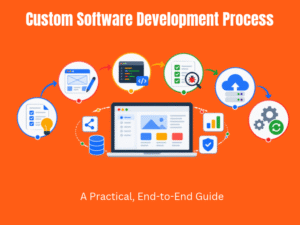
While development methodology varies across organizations, whether Waterfall, Agile, or hybrid, most custom software follows similar phases. The software development process includes initiation, design, and deployment stages, with iteration woven throughout.
Discovery and requirements. Stakeholder interviews, process mapping, and user research produce a product backlog or Software Requirements Specification. Requirements analysis is crucial for aligning software with client needs, and skipping this phase is the most common source of downstream problems.
Solution and architecture design. The team selects the technology stack (.NET, Node.js, React, Flutter, or cloud providers like AWS and Azure), defines database schemas, and maps integration patterns. Architecture decisions made here shape long-term scalability and maintainability.
UX/UI and prototyping. Clickable prototypes let stakeholders interact with the product concept before a single line of production code is written. Early user validation catches misalignment when changes are still inexpensive.
Development and implementation. Features are delivered incrementally in sprints with code reviews, continuous integration, and regular demos. This iterative approach keeps the development process transparent and adaptable.
Testing and quality assurance. Manual and automated tests verify functionality, performance, and security. Testing ensures software meets quality requirements before deployment.
Deployment and go-live. Production setup, data migration, and rollout strategies (phased, pilot, or full) bring the product to users. Deployment involves user acceptance testing and software launch.
Maintenance and continuous improvement. Ongoing maintenance is essential for software performance post-launch. Bug fixes, new features, and performance tuning keep the system relevant.
Consider a concrete example: a company building a custom CRM for a pan-India sales team starts with an MVP covering one region, validates adoption and data flows, then extends nationwide with additional modules for reporting, territory management, and automated customer interactions.
How you work with a custom software development partner matters as much as what you build. The right engagement model shapes communication, budget control, and flexibility.
Dedicated team. The client gets a long-term, cross-functional team (software developers, QA engineers, designers, project management leads) working as an extension of in-house staff. This dedicated team model suits ongoing product development, SaaS platforms, and complex systems with evolving roadmaps.
Fixed price. Scope, requirements, and timelines are defined in detail up front. This works best for well-defined, smaller or medium-sized projects with stable business requirements, such as an internal portal or a document management systems build.
Time and material. Billing is tied to actual time spent, with high flexibility to change scope and priorities. This model fits R&D, discovery phases, or evolving products where requirements may shift during the software project.
Hybrid engagement. A core dedicated team handles the product backbone while fixed-price deliverables cover specific modules or experimental features. This is common in larger enterprises that want predictable outcomes for some components but room for experimentation in others.
TVL IT Solutions offers all four models and helps clients choose based on risk tolerance, budget control preferences, and product maturity. The goal is to match the engagement structure to the reality of your custom software development project, not to force a one-size-fits-all contract.
Offshore custom software development means building with teams in another country to access talent, time-zone coverage, and operational efficiencies. India has been a leading hub for this model since the early 2000s, and the reasons remain compelling.
India offers a large, experienced engineering talent pool spanning web, mobile, AI/ML, and enterprise platforms. English-speaking teams and a long track record of working with North America, Europe, the Middle East, and APAC make collaboration straightforward. Mature processes for security, IP protection, and remote delivery have evolved over two decades of global partnerships.
An offshore custom software development company like TVL IT Solutions collaborates through regular stand-ups and sprint reviews, shared project management tools for full transparency, and overlapping hours with client time zones for real-time discussions. This approach brings the benefits of a strategic software development partnership without requiring the client to hire dozens of local developers.
Common concerns around communication, culture, and quality are addressed through clear SLAs, thorough documentation, and a dedicated project manager who acts as the single point of contact. Teams follow the same modern software development practices, including CI/CD, automated testing, and sprint-based delivery, that any top-tier local firm would use.
Consider a US-based healthtech startup that began building an MVP with an Indian dedicated team in 2023. Within ten months, they moved from concept to public beta, maintained strong security and compliance standards, and scaled the team as the product matured, all without the overhead of building an in-house engineering department from scratch.
The success of a custom software solution depends heavily on the right development partner, not just technology choices. Research shows that 31% to 65% of large software projects fail to meet objectives, and partner selection is a major factor in those outcomes.
Domain and technical expertise. Look for case studies and portfolios in similar industries and technology stacks. Proven experience in your industry is crucial when choosing a partner, because domain knowledge reduces discovery time and avoids naive architectural decisions.
Architecture and security mindset. Ask how they handle secure coding, data management, and compliance. A serious partner will discuss threat modeling, encryption standards, and access controls before you ask.
Communication and transparency. Look for partners with a solid development process and transparency. Frequency of updates, tooling (Jira, Azure DevOps, Git), and clear escalation paths indicate operational maturity.
Team structure and stability. Dedicated team versus rotating staff matters. Ask about seniority mix, the presence of solution architects, and how they handle knowledge transfer if team members change.
References and testimonials. Speaking with existing clients, especially for projects delivered between 2018 and 2025, gives you real signal. A good partner will understand your business goals and challenges, and past clients can confirm whether that understanding translated into results.
Post-launch support. Commitment to bug fixes, optimizations, and roadmap work after go-live separates genuine partners from firms that disappear after deployment.
Run a small discovery or pilot engagement before committing to a multi-year custom software project. TVL IT Solutions approaches new partnerships through discovery workshops, technical spikes, and transparent delivery roadmaps, giving both sides confidence before scaling up.
Many failures happen not because of code quality but because the product does not match real-world user needs. Building custom software that drives adoption requires discipline beyond engineering.
Start with clear business objectives and measurable outcomes. “Reduce manual data entry time by 40% in the finance team by Q4 2026” is actionable. “Make things better” is not. Clear goals keep everyone aligned throughout the software development lifecycle.
Involve end users early through interviews, prototypes, and usability testing. The people who will use the system daily understand friction points that stakeholders in conference rooms often miss.
Use iterative, agile delivery with short feedback loops instead of one large release at the end. Each sprint demo is a chance to course-correct before small issues become structural problems.
Prioritize UX and performance. Fast, intuitive digital solutions drive adoption. Slow or confusing software gets abandoned regardless of how technically elegant the backend is.
Build for scalability and security from day one. Cloud-native architecture, proper authentication, and role-based access controls are foundational, not afterthoughts.
Document decisions and processes so that future teams can extend the system safely. Poor documentation is a primary source of technical debt that compounds over time.
Plan for training, change management, and internal communication around go-live. A mid-size manufacturing company that co-created its production scheduling system with plant managers saw high adoption and fewer schedule conflicts precisely because the people using it helped shape it.
Even well-funded custom software development projects can fail if classic mistakes are not managed. Here are the pitfalls that derail projects most often.
Vague or shifting requirements without proper change control lead to scope creep. When every stakeholder adds “just one more thing” without trade-offs, timelines and budgets collapse. Strong product ownership on the client side is essential.
Underestimating integration complexity with existing systems and third-party tools is a consistent blind spot. Legacy systems, inconsistent data formats, and undocumented APIs can double the effort required for system integration work.
Ignoring non-functional requirements like performance, uptime, security, and observability leaves the system fragile under real-world load. These requirements must be specified and tested, not assumed.
Skipping structured testing or relying only on manual tests just before launch introduces avoidable risk. Automated regression, performance, and security testing should run continuously throughout development.
Not budgeting time and effort for data migration and data quality clean-up catches teams off guard. Dirty data migrated into a new system produces dirty results.
Treating go-live as the finish line instead of planning for ongoing maintenance is a recipe for decay. Complex systems require continuous attention, monitoring, patching, and iteration.
The UK government’s repeated public sector IT overruns serve as a reminder that scale and lack of governance can derail even heavily funded programs. Mitigation strategies include phased rollouts, proofs of concept, independent QA, and strong product ownership. These are not optional extras; they are essential guardrails for any serious custom software project.
Modern custom software must be secure by design. Rising cyber threats and stricter regulations make enhanced security a baseline requirement, not a feature to add later.
Core security practices start with threat modeling and secure architecture decisions. Zero-trust networking, least privilege access, and segmented environments (development, testing, production) reduce attack surfaces. Secure coding standards and regular code reviews catch vulnerabilities before they reach production.
Encryption in transit and at rest protects sensitive data. Regular penetration testing and vulnerability scanning identify weaknesses that static analysis misses. These practices apply whether you are building cloud solutions, on-premises systems, or hybrid deployments.
Compliance considerations vary by sector. Healthcare demands HIPAA-style controls for patient data. Finance requires KYC/AML frameworks and alignment with regulatory bodies like RBI or SEBI. Education systems must protect student data privacy. Each sector has its own rules, and a capable partner designs for those constraints from the start.
TVL IT Solutions designs tailored software solutions that align with a client’s internal governance policies and regional regulations, whether that means GDPR for EU users, data residency requirements in India, or sector-specific audit logging. Incident response planning, admin action audit trails, and role-based access controls are standard components, not add-ons.
Risk management also means operational discipline: separate environments, automated backup verification, and documented recovery procedures. These measures protect not just data but business continuity.
Concrete stories show what custom software can achieve in practice. The following case-style narratives represent the kinds of projects TVL IT Solutions handles, without disclosing confidential client details.
Regional retail chain. A mid-sized retail business operating across multiple Indian states struggled with fragmented billing systems, manual stock tracking, and inconsistent GST reporting. A unified custom POS and inventory platform replaced the patchwork, streamlining operations across locations. Stock accuracy improved significantly, and daily reconciliation that previously consumed hours was reduced to minutes. The system also supported multilingual interfaces and offline operation for stores with unreliable connectivity.
SaaS startup. A product company co-created its core platform with an offshore dedicated team, going from concept to public beta in under a year. The team used AI and ML development services to build recommendation features and advanced technologies for data management. Security and scalability were built into the architecture from day one, and the platform handled a tenfold increase in users during early traction without performance degradation.
Manufacturing company. A manufacturer with multiple plants deployed a custom production scheduling and quality management app to replace manual paperwork. The system captured real-time shop-floor data, integrated with IoT sensors, and provided traceability across the supply chain. The result was a significant reduction in manual data entry and improved on-time delivery rates.
Education provider. An education organization deployed a custom LMS and exam management system that supported remote learning during 2020-2022 and remains core to its hybrid teaching model. The platform handles admissions, attendance, assessments, and certificate issuance for thousands of students, with custom reporting dashboards for administrators. Innovative solutions like automated grading and parent notification modules reduced administrative burden substantially.
TVL IT Solutions is a custom software development company headquartered in India, focused on building secure, scalable digital products that deliver solutions aligned with real business operations.
The delivery philosophy is straightforward: understand business goals first, choose technology second. TVL IT Solutions emphasizes long-term partnerships with startups, SMEs, agencies, and enterprises rather than transactional project handoffs. Agile and iterative methods with clear milestones and demos keep every custom software development project transparent and on track.
Web development. Backend andfrontend engineering, APIs, and microservices power B2B, B2C, and internal tools. The team works across technology stacks including .NET, Node.js, React, and Vue.js to match each project’s needs.
Mobile app development. Native and cross-platform mobile app development services support field operations, consumer apps, and companion apps that extend web platforms to mobile users.
Game development. Custom game development services cover interactive experiences where performance, UX, and real-time responsiveness are critical.
AI and ML solutions. AI and ML development services power analytics, decision-support systems, and automation tools that deliver measurable operational efficiency gains.
Microsoft Dynamics and Salesforce. Customization and integration services connect these enterprise applications with your specific business workflows, extending their capabilities through custom modules and data flows.
Custom SaaS platform engineering. For product companies and digital agencies, TVL IT Solutions builds scalable SaaS platforms with multi-tenant architecture, robust data management, and API-first design.
Engagement models include dedicated team, fixed price, time and material, and hybrid, with the flexibility to adapt as your product matures. TVL IT Solutions operates as a development partner, not just a vendor, with shared roadmaps and continuous improvement built into every relationship. If you are exploring new platforms, modernizing legacy systems, or scaling existing products, explore how TVL IT Solutions could support your roadmap.
Custom software development is about aligning technology with your unique business model and goals, not just writing code. The decision between off the shelf solutions and custom software depends on process uniqueness, integration needs, compliance requirements, and growth ambitions.
Three takeaways matter most. First, plan carefully with clear business objectives and real user input. Second, choose a trustworthy custom software development partner with proven technical expertise, domain knowledge, and a transparent development process. Third, think beyond launch. Plan for evolution, ongoing maintenance, and continuous improvement because software that stops evolving starts decaying.
The market is moving decisively toward tailored solutions. Organizations that invest in custom software built around their specific business gain operational efficiency, competitive advantage, and the flexibility to adapt as conditions change.
If you are considering new platforms, modernizing legacy systems, or enabling businesses to scale existing products, TVL IT Solutions is ready to serve as your custom software development partner. Reach out to start with a discovery workshop and see how we can help turn your software vision into a working product.
Custom software development is the process of designing and building software specifically for a business’s unique workflows, requirements, integrations, and goals, rather than using a generic off-the-shelf solution.
Custom software can improve operational efficiency, support unique business processes, enhance security and compliance, integrate with existing systems, and provide greater flexibility and scalability as a business grows.
Businesses can develop custom web applications, mobile apps, SaaS platforms, CRM and ERP systems, AI and ML solutions, industry-specific software, IoT applications, and enterprise software tailored to their specific needs.
The process typically includes discovery and requirements analysis, solution architecture, UX/UI design, development, testing, deployment, and ongoing maintenance. Agile development allows teams to improve the software through continuous feedback and iteration.
Look for a partner with relevant industry experience, strong technical expertise, transparent communication, proven case studies, robust security practices, flexible engagement models, and reliable post-launch support. TVL IT Solutions provides end-to-end custom software development services for startups, SMEs, and enterprises.
At TVL IT Solutions, we specialize in delivering scalable, secure, and custom software development services tailored to your unique business needs. Whether you’re a startup or an enterprise, our team is ready to turn your vision into reality.
Get Started Now