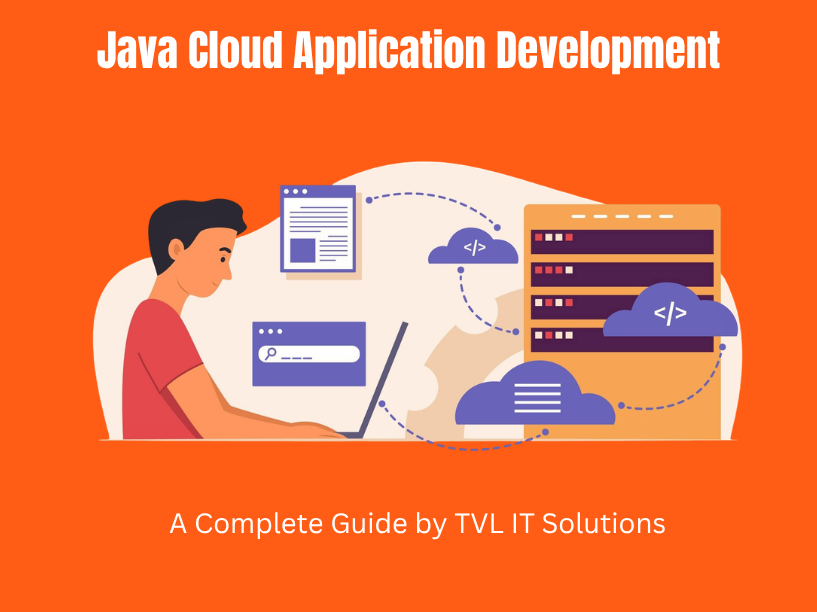
Java powers some of the most demanding systems in production today – banking portals processing millions of transactions, logistics platforms coordinating global supply chains, and ecommerce backends handling seasonal traffic surges. Java cloud application development means building, deploying, and operating Java applications on platforms like AWS, Microsoft Azure, and Google Cloud. Developing cloud applications using Java involves building scalable systems that respond to demand in real time. Java is used by over 10 million programmers worldwide, making it one of the most battle-tested languages for enterprise workloads. TVL IT Solutions specializes in designing secure, scalable cloud native Java applications for startups, SMEs, and enterprises. This guide covers architecture, java frameworks, cloud platforms, tooling, real-world case studies, and how to partner with an offshore java cloud development team.
Cloud computing has evolved across several deployment models. Public cloud deployment offers resources on a pay-as-you-go basis through providers like AWS and Google Cloud. Private cloud deployment provides dedicated infrastructure for a single organization, while community cloud deployment shares resources among multiple organizations with similar needs. Hybrid cloud deployment combines private and public clouds for flexibility, and multi-cloud deployment uses services from multiple vendors for resilience. Between 2015 and 2026, most new enterprise applications shifted away from on-premise servers toward these models.
Java remains a top choice for cloud development because of its platform independence – Java applications can run on any system without modification, thanks to the java virtual machine. The language supports multithreading and distributed computing for scalability, and its built in security features include authentication and data encryption. This rich ecosystem and decades of proven use in mission-critical systems give java developers confidence when building enterprise-grade software.
Concrete examples include real-time trading platforms, insurance policy engines, global ecommerce backends, and logistics systems like DB Cargo, which achieved roughly 60% lower operational costs after migrating to AWS and Java. The java virtual machine’s “write once, run anywhere” capability supports multi-cloud and hybrid environments – you can run the same microservice on AWS and Microsoft Azure with minimal changes.
Cloud native java applications are fundamentally different from simply lifting-and-shifting a legacy java ee monolith onto virtual machines. True cloud native development means designing for elasticity, failure tolerance, and continuous delivery from the start.
Building cloud native applications starts with a mindset shift. Cloud native architectures embrace microservices, containers, DevOps pipelines, continuous delivery, and observable systems designed to handle failure gracefully. Cloud-native design principles help applications scale dynamically rather than relying on oversized servers.
Microservices architecture splits applications into small independent services, each responsible for a single business domain. This enables independent deployment and scaling – a billing service scales separately from a notification service. Java’s ecosystem supports microservices architecture for cloud native apps through mature frameworks and libraries.
Stateless services facilitate fast deployments and scaling in cloud environments. Rather than storing session data locally, cloud native java applications externalize state into databases, caches like Redis, or message queues. Stateless architecture supports horizontal scaling of services through container replicas and autoscaling rules on platforms like AWS ECS, Azure Kubernetes Service, or Google Kubernetes Engine.
Containerization packages applications into Docker for consistent environments across development, staging, and production. Orchestration platforms like Kubernetes manage container lifecycles, handling restarts, rolling updates, and resource allocation. Modern JVMs optimize for container environments to improve resource usage, respecting CPU and memory limits set by orchestrators. Java applications can utilize Docker for packaging and deployment consistency across all cloud platforms.
Building resilient applications involves implementing patterns like circuit breakers, bulkheads, retries with exponential backoff, and timeouts on external calls. These prevent cascading failures when one service becomes unresponsive.
Observability in cloud applications includes logging, metrics, and distributed tracing. Structured JSON logs, JVM-level metrics, and distributed traces allow teams to follow a request across dozens of services. Continuous monitoring of applications tracks CPU usage and response times, enabling rapid diagnosis.
Using message brokers like Apache Kafka enables asynchronous processing in microservices, decoupling producers from consumers. Externalizing configuration enhances security and simplifies management – secrets and settings live in vaults or config servers, not in code.
TVL IT Solutions applies these principles by default in every new java cloud project to reduce downtime and production incidents.
Choosing the right framework shapes everything from startup time to memory consumption. Here is how the major options compare for modern java cloud development.
Spring Boot and Spring Cloud form the core stack for many enterprise cloud native java applications. Java frameworks like Spring Boot simplify microservices development through auto-configuration, embedded servers, and a massive plugin ecosystem. Spring Cloud simplifies cloud-based application development for Java by adding service discovery, configuration servers, API gateways, and circuit breakers via Resilience4j. Apache Struts still supports building robust web applications in the cloud for teams maintaining legacy codebases.
Quarkus, Micronaut, and Dropwizard target lighter workloads. Java frameworks like Quarkus optimize serverless applications with startup times as low as 40 milliseconds in native mode and memory footprints around 60–100MB – compared to Spring Boot’s typical 2–4 seconds and 200–500MB. Quarkus optimizes Java applications for Kubernetes environments specifically. Micronaut is designed for building cloud-native Java applications using compile-time dependency injection with minimal reflection. Dropwizard is used for developing high-performance RESTful web services where you need a lean, opinionated stack.
Vert.x and Eclipse MicroProfile serve specialized needs. Vert.x excels at reactive, non-blocking workloads – ideal for high-throughput event streams. MicroProfile provides standards-based rest apis, health checks, and fault tolerance for enterprises that value governance. TVL IT Solutions selects between these based on workload characteristics and team expertise.
Using cloud-native frameworks simplifies deployments and supports scalability across environments. Standard build tools like Maven and Gradle produce artifacts; Docker images follow multi-stage builds for size optimization; Helm charts and Kubernetes manifests describe deploy targets. Automated CI/CD pipelines – using GitHub Actions, GitLab CI, or Azure DevOps – enhance deployment speed and reduce errors through automated builds, tests, container image creation, and rollout to cloud environments.
Most java cloud application development targets one or more of the three dominant cloud platforms, and each provides deep Java support along with managed services that simplify operations.
AWS supports Java through EC2, Elastic Beanstalk, aws lambda for serverless computing, Amazon RDS, and managed Kubernetes via EKS. The aws sdk for Java integrates with S3 for data storage, SQS for message queues, SNS for pub/sub notifications, and DynamoDB for NoSQL workloads. A typical pattern: a Spring Boot microservice uses the AWS SDK to store invoice files in S3, triggers processing via SQS, and persists records in RDS.
Microsoft Azure offers Azure App Service for PaaS-hosted java apps, Azure Kubernetes Service for container orchestration, azure functions for event-driven serverless workloads, and managed databases including Cosmos DB and Azure SQL. IDE integrations with IntelliJ and Eclipse are strong, and Azure Monitor provides JVM profiling, log aggregation, and tracing.
Google Cloud provides google cloud functions for lightweight event processing, google kubernetes engine for container orchestration, cloud run for serverless containers that scale to zero when idle, and Cloud SQL, Spanner, and BigQuery with Java client libraries. A Quarkus-based container deployed on Cloud Run can serve a REST API that scales automatically – you only pay for actual request processing time.
Using a cloud provider’s services can ensure auto-scaling and load balancing without manual intervention. TVL IT Solutions helps clients choose the right cloud platform based on existing ecosystem, compliance requirements, data residency, and target regions – across public, private cloud, or hybrid setups on the google cloud platform or any other provider.
Many organizations still run legacy java ee monoliths on WebLogic, WebSphere, or JBoss. These systems scale poorly, require weekend deployment windows, and carry high operational overhead. Migrating to cloud native development unlocks independent releases, fine-grained scaling, and reduced blast radius from failures.
Breaking a monolith into domain-oriented microservices – user management, billing, inventory, notifications – starts with identifying service boundaries. The strangler fig pattern enables gradual replacement: new features go to microservices while the monolith handles existing traffic. An API gateway handles routing, centralized auth, and rate limiting across old and new services.
Centralized config and secrets management through Spring Cloud Config, AWS Parameter Store, or HashiCorp Vault keeps sensitive data out of repositories. Data strategies favor database-per-service patterns; event-driven communication via Apache Kafka or cloud-native messaging services enables loose coupling between domains.
Deployment patterns vary by workload: containers on Kubernetes for always-on services, serverless Java functions for event-driven tasks, and scheduled containers for batch processing. TVL IT Solutions designs scalable architecture diagrams, builds proof-of-concept services, and then gradually migrates critical features to cloud native Java components – minimizing business risk through phased rollouts rather than big-bang rewrites. Explore our enterprise backend development approach for more detail.
Cloud native java development is not just about moving to the cloud – it demands continuous performance tuning and cost optimization through efficient resource usage.
Java’s memory management can lead to high resource consumption if container CPU and memory requests are misconfigured. Right-sizing these limits prevents both over-allocation (wasted spend) and under-allocation (throttling). Java applications may experience latency during startup due to JIT compilation; ahead-of-time compilation frameworks like Quarkus and Micronaut solve this for serverless platforms and cloud run deployments with near-instant startup. Caching frequently accessed data with Redis or cloud-managed caches reduces latency and avoids repeated expensive database queries. Java applications often face compatibility issues with numerous libraries, so dependency management needs careful attention. Security configurations in Java cloud applications can also be complex, requiring dedicated review of IAM policies, network boundaries, and data encryption at rest and in transit.
Reliability in cloud environments relies on health checks and readiness probes in Kubernetes, blue-green and canary deployments to reduce release risk, and automated rollbacks on failed deployments through CI/CD pipelines. These measures translate to cost savings through reduced idle capacity, fewer production incidents, and better scaling behavior during traffic spikes.
Monitoring tools like Prometheus and Grafana are essential for cloud applications, providing dashboards that reveal performance bottlenecks, GC pauses, and thread pool saturation. TVL IT Solutions continuously monitors logs, metrics, and traces to drive tuning decisions for Java workloads, helping clients maintain secure, high-performing systems.
European Ecommerce Startup – AWS EKS Migration: A mid-size ecommerce company migrated a Spring MVC monolith into Spring Boot microservices on AWS EKS. The team used the AWS SDK for Java to integrate with S3 and RDS. After migration, peak-season stability improved significantly, deployment cycles dropped from days to hours, and the platform could scale efficiently during holiday traffic surges. A healthcare provider in the same ecosystem later adopted the identical architecture pattern.
Logistics SME – Quarkus on Google Cloud Run: A North American logistics company built a new cloud native Java application using Quarkus on Google Cloud Run with Cloud SQL for persistence. Container startup times dropped to under 100 milliseconds in native mode, and fine-grained autoscaling handled spiky route optimization API traffic without paying for idle infrastructure. This demonstrated how Java is increasingly optimized for serverless computing environments.
Fintech Modernization – Azure Kubernetes Service: A fintech firm modernized a legacy java ee application by containerizing critical modules and deploying to Azure Kubernetes Service. The team introduced MicroProfile-based microservices around the monolith’s core, preserving business logic while gaining independent deployability. Infrastructure spend dropped by roughly 55%, mirroring results from similar documented migrations.
In each scenario, TVL IT Solutions contributed architecture design, an offshore dedicated team model, high security controls, and long-term maintenance partnerships.
TVL IT Solutions delivers end-to-end services for java cloud application development. Our capabilities include custom backend development with Java and modern cloud frameworks, architecture consulting and migration planning for legacy enterprise applications, building B2B SaaS products with cloud native Java stacks, and integrating AI and ML capabilities with Java-based cloud backends. Java’s role in AI and machine learning is expanding, and Java’s Project Loom simplifies concurrency for cloud applications handling large numbers of concurrent users.
We offer flexible engagement models – dedicated team, time and material, fixed scope, and hybrid – focused on long-term collaboration and technical reliability. Offshore development from India provides access to experienced Java engineers familiar with AWS, Azure, and Google Cloud environments, supporting around-the-clock delivery cycles.
Whether you need to develop applications from scratch, modernize a monolith, or deploy applications on serverless platforms, our teams bring deep expertise in the extensive java ecosystem and cloud native architectures. We help you build infrastructure that handles demand at scale while keeping systems observable, secure, and cost-effective.
Ready to discuss your Java cloud application roadmap? Reach out to TVL IT Solutions to explore your next modernization project or new SaaS build.
Java cloud application development involves building, deploying, and operating Java applications on cloud platforms such as AWS, Microsoft Azure, and Google Cloud.
Java supports platform independence, multithreading, distributed computing, scalability, and built-in security, making it well suited for enterprise cloud applications
Popular frameworks include Spring Boot, Spring Cloud, Quarkus, Micronaut, Dropwizard, Vert.x, and Eclipse MicroProfile. The right framework depends on workload and application requirements.
Cloud-native Java applications can provide dynamic scalability, independent deployments, resilience, improved observability, continuous delivery, and better resource management.
Yes. Organizations can gradually modernize legacy Java applications by identifying service boundaries, adopting microservices, using API gateways, and applying phased migration patterns such as the strangler fig approach.
At TVL IT Solutions, we specialize in delivering scalable, secure, and custom software development services tailored to your unique business needs. Whether you’re a startup or an enterprise, our team is ready to turn your vision into reality.
Get Started Now