
If you ship mobile apps in 2026, you already know the landscape is brutal. Android fragmentation involves 6+ major OS versions simultaneously, with Android 16 claiming roughly 21.6% of devices while earlier versions still account for significant traffic. iOS 18 introduced Apple Intelligence, revamped privacy features, and new system-level behaviors that directly affect how your mobile app renders and requests permissions. Meanwhile, 5G rollout continues to widen the gap between best-case and worst-case network performance.
User patience has not grown alongside device capabilities. Research consistently shows that 53% of mobile visits end when load time exceeds 3 seconds. A single stuttering animation, a broken checkout flow, or a missing accessibility label can tank your app store rating overnight.
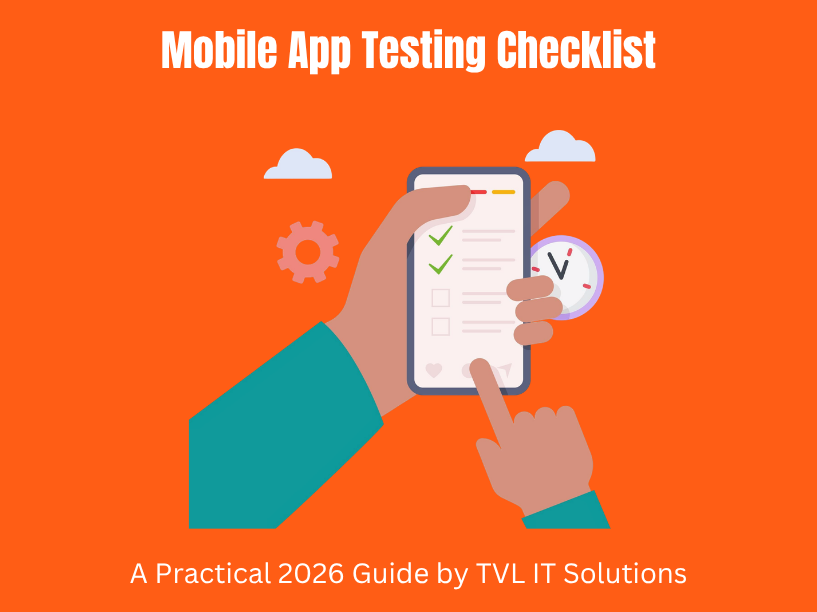
This is why a structured mobile app testing checklist helps reduce defects and improve user satisfaction. It turns vague quality goals into concrete, repeatable items your team can execute before every release candidate. A mobile app testing checklist should cover functional user flows, compatibility, performance, and security measures across both Android and iOS builds.
This article targets product owners, QA leads, and engineering managers who need a reliable testing process. It turns abstract “testing types” into actionable items you can tick off for every build. While many checklist items also apply to web testing for responsive web apps, the focus here is on mobile-specific risks.
TVL IT Solutions is an India-based custom software development and QA partner with hands-on experience testing mobile applications across fintech, e-commerce, and SaaS since 2015. The checklist below covers functional testing, UX, performance testing, security testing, compatibility testing, installation and app upgrades, network behavior, and automation strategy.
A mobile app testing checklist is a structured list of concrete test items grouped by area – functional, UX, performance, security, and more – that teams run before releasing Android and iOS builds. Each item is binary: pass or fail, with an assigned owner, target device, and a link to the relevant requirement or user story.
It differs from a full test plan. A test plan outlines scope, resources, strategy, roles, and timelines. A testing checklist is execution-focused: it is what QA and developers actually run during regression or smoke tests. Testing practitioners agree that verifying software behavior outside of ideal settings is critical, and the checklist enforces exactly that discipline.
A mobile app testing checklist contains 12 categories. Organize it in a spreadsheet or test management tool with columns for item description, priority (critical, high, medium, low), status, device and OS version, tester name, date, and a link to the related Jira ticket or requirement.
Map checklist sections to your SDLC stages:
Tailor the depth to your context. Startups may trim to high-risk flows like login, signup, and checkout. Enterprises in regulated domains – healthcare, banking – should use the full set.
Consider a retail app preparing for Black Friday in November 2026. The team schedules a two-day regression window: Day 1 covers functional and UX flows across six device/OS combos, Day 2 covers performance, security, and network and offline behavior. This approach makes comprehensive testing manageable even on tight timelines.
Good mobile testing starts before you open the app. Define scope, risks, platforms, and devices up front.
Build your device matrix using analytics data from your actual user base. The goal: identify how many devices and operating systems you need to cover. Testing should cover 8–12 device and OS combinations for 90%+ user traffic. At minimum, choose at least three Android manufacturers (Samsung, Xiaomi, Google Pixel) and two recent iOS versions, plus two screen sizes per platform.
Decide on these parameters early:
Emulators are great for fast feedback during development, but emulators cannot replicate hardware-specific issues like thermal throttling, GPS drift, or sensor latency. Use real devices – or a real-device cloud – for final validation. At least one device per platform should be a physical unit for smoke testing.
Cross-functional input matters. Product, design, QA, and backend teams should align on which user journeys and business rules are “must not break” for every release. Map these as your core functionalities.
TVL IT Solutions helps clients pick realistic device sets based on their actual traffic, not guesswork, and maintains that matrix quarterly as mobile app trends shift device popularity.
Functional testing is the backbone of app testing. It confirms the mobile app does what the requirements and user stories promise. Functional testing verifies every user flow from entry point to completion, and gaps here cause the most visible production incidents.
Core end-to-end user paths include sign-up, log-in, core feature action, and log-out. Beyond those, cover:
For user input validation, test every form with:
Verify that error messages are clear, localized where needed, and never expose internal details like stack traces or raw server responses.
Platform specifics require attention. On android devices, verify the hardware and gesture back button behavior – pressing back during an unsaved form should prompt confirmation. On iOS, confirm swipe gestures and navigation bar behavior. No user should get stuck or lose unsaved work.
Case study: In a TVL IT Solutions logistics project, users could submit shipment IDs without validation. Special characters caused silent server errors, and users believed their submissions succeeded while tracking actually failed. After adding checklist items for boundary and malicious input, all fields validated on both client and server, reducing support tickets by 70%.
UI and UX testing ensures the visual presentation and user experience are polished. Accessibility testing ensures apps are usable for individuals with disabilities – and with 1.3 billion people experiencing significant disability globally, this is not optional.
UI consistency checks:
Keyboard behavior is a common pitfall. On Android, the keyboard may push content up; on iOS, it may overlay content. Your checklist should verify that interactive elements like “Submit” or “Pay” remain visible and tappable when the keyboard opens.
Usability testing evaluates how easily users complete tasks. It reveals problems in mobile UX design that functional testing misses. Key items include:
Real users provide feedback on an app’s ease of use. Usability testing uses human observation to assess user experience, and manual testers often catch flow awkwardness that test scripts cannot.
Accessibility (WCAG 2.1 AA):
Note that accessibility bugs often cluster in custom components – carousels, custom dropdowns, and non-standard navigation elements.
Example: TVL IT Solutions helped redesign a consumer fitness app where the early version lacked high contrast and screen readers labels. After implementing high-contrast themes and large-text modes, the client saw a 30% increase in signups among older demographics.
Performance testing ensures the mobile application remains fast and stable on real mobile devices, including mid-range phones common in emerging markets. Performance testing ensures apps perform well on mid-range devices, not just flagships.
Monitoring app launch speed and CPU consumption is essential for performance testing. Key metrics to verify:
| Metric | Android Target | iOS Target |
| Cold start time | < 2 seconds | < 500 ms to first frame |
| Warm start | < 1.5 seconds | < 300 ms |
| Scroll smoothness | 60 fps, no jank | 60 fps, no jank |
| Memory usage | Stable under load | No unbounded growth |
| Crash-free rate | > 99% | > 99% |
Performance testing measures launch time, response time, and memory usage across a range of hardware. Test on budget android devices with 3–4 GB RAM alongside flagships, because smooth app performance on high-end hardware can mask issues that affect most of your users.
Performance testing checks app behavior under real-world network conditions. Simulate latency spikes and degraded bandwidth to see how the app performs when API responses slow down.
Battery testing items:
Reliability testing identifies issues that affect long-term use, including crash testing and memory leak detection. Tools like Android Profiler and Xcode Instruments help profile CPU, memory, and energy consumption.
Example: TVL IT Solutions identified a memory leak in a ride-hailing client’s live map screen during performance testing. Map layers weren’t freed when users navigated away, causing progressive crashes. Fixing this improved crash-free sessions from ~95% to ~99.5%.
Mobile app security testing is non-negotiable for apps handling payments, health data, or confidential business information. Security testing identifies vulnerabilities in mobile applications before attackers do. Security testing should follow the OWASP Mobile Application Security standard, with MASVS providing the requirements baseline and MASTG offering concrete test cases.
The OWASP Mobile Top 10 defines critical mobile security risks. Core checks include:
Storage and cryptography:
Network communication:
Session management:
Platform interaction:
A single security breach can lead to GDPR penalties, reputational damage, and user churn. Treat security test cases as release blockers, not nice-to-haves.
Case study: TVL IT Solutions discovered during a security audit that a production build was emitting crash logs containing user authentication tokens. After adding explicit checklist items verifying that crash logging excludes sensitive data, the team prevented similar issues in all subsequent releases.
Compatibility testing verifies app behavior across device models and OS versions, ensuring consistent behavior regardless of manufacturer, screen configuration, or OS variant. Compatibility testing checks behavior across 6+ major OS versions – a reality driven by device fragmentation in the Android ecosystem.
Device-specific checks:
Research shows that 23% of test failures stem from device-specific rendering differences. This makes device compatibility one of the highest-impact areas in your app testing checklist.
Test on at least one tablet per platform where applicable. Ensure the mobile app doesn’t appear stretched or broken, and that navigation patterns scale to larger screens. For teams building cross-platform apps, verify that platform-specific UI conventions are respected on each OS.
OS version targeting:
Assumptions from web testing – that responsive layouts behave the same everywhere – fail on mobile due to vendor-specific rendering, system dialogs, and system UI overlays.
TVL IT Solutions builds compatibility matrices from real usage data, identifying the top 8–10 device/OS combos that cover 90% of active users. This ensures effort goes where it matters, not spread thin across dozens of unlikely configurations.
Real users switch between WiFi, 4G, and 5G, ride elevators, and receive calls mid-task. Network condition testing verifies app behavior across multiple network types, and your checklist must mimic these real world conditions.
Network condition tests:
Offline behavior:
Interruption tests:
Device interaction testing checks app responses to incoming calls and notifications. Specifically test:
TVL IT Solutions often runs these tests on field networks in addition to lab conditions for critical consumer apps. For mobile device users on ride-hailing, messaging, and e-commerce platforms, lab-only testing misses the connectivity variance that real environments introduce.
Most real users install once and then only receive app upgrades. Testing fresh installs alone misses the upgrade paths where bugs hide. Installation testing ensures app updates do not result in data loss.
Fresh installation checks:
App upgrades testing:
Edge cases to cover:
Case study: A TVL IT Solutions SaaS client used encrypted local storage with offline capability. A missing migration script between config versions 2 and 3 caused user data to become inaccessible after upgrade. Adding explicit checklist items for all migration scripts and versioned schema testing prevented the issue from reaching production.
Upgrade and data migration testing is especially critical for apps with encrypted local storage and complex offline capabilities, where a single missed script can lock users out of their own data.
Effective teams mix manual testing and automated tests rather than choosing one over the other. Each approach has a role, and the testing process benefits when both are applied strategically.
Manual testing excels at:
Automated testing excels at:
Research shows that 60–70% of mobile testing checklist items can be automated. Automating tests reduces execution time from days to hours, freeing manual testers to focus on exploratory work. Automated tests can run on every build instead of just before release, catching regressions early.
Typical automation layers:
| Layer | Tools/Frameworks |
| Unit tests | JUnit, XCTest |
| API / integration tests | Postman, REST-assured |
| UI automation | Appium, Espresso, XCUITest |
| Visual regression | Screenshot comparison tools |
Appium is a leading framework for mobile test automation, supporting both Android and iOS with a single automation framework. For teams building cross-platform apps with React Native or Flutter, verify that the chosen framework handles platform differences in rendering.
Maintenance matters. Automation adds value only when test scripts, locators, and device matrices are actively maintained. Test failures from outdated scripts erode trust in the suite. Review and update scripts quarterly, aligned with major releases or UI redesigns.
TVL IT Solutions offers dedicated QA and test automation engineers who embed in client teams under dedicated, time-and-material, or hybrid engagement models to design, build, and maintain the entire testing process.
Turning the ideas above into a living template is the operational piece that makes everything stick across sprints and release cycles.
Structure your template by section:
| Section | Example Items | Priority |
| Functionality testing | Login, checkout, search | Critical |
| UX & accessibility | Contrast, screen readers, nav depth | High |
| Performance & battery | Cold start, memory usage, battery drain | Critical |
| Security | Token storage, TLS, session mgmt | Critical |
| Compatibility | OS versions, screen sizes, OEM skins | High |
| Network & offline | Offline mode, data sync, interrupts | High |
| Installation & upgrades | Fresh install, migration, uninstall | Medium |
| Automation coverage | Which flows have test scripts, which don’t | Medium |
Each item needs a priority, owner, pass/fail status, device/OS, and a link to the corresponding Jira ticket or requirement in tools like Jira or Azure DevOps. This traceability connects test results to business needs and supports auditing in regulated industries.
Keep a “baseline” master checklist. For each release, create a copy and re-prioritize based on scope – a security-heavy release gets extra security items; a pure UI redesign emphasizes compatibility and different devices.
Review the checklist quarterly or whenever Apple and Google release major OS updates. New features like widgets, privacy permissions, foldable displays, and system dialogs need fresh checklist items to stay current with software development trends.
TVL IT Solutions often kicks off new engagements by running a joint checklist workshop: mapping current QA coverage, identifying gaps in mobile application testing, and delivering a customized, ready-to-use mobile app testing checklist template tailored to the client’s domain and infrastructure.
A robust mobile app testing checklist reduces production defects, improves app store ratings, and accelerates releases by making quality expectations explicit and measurable. Instead of relying on memory or ad-hoc checks, your team operates from a shared, traceable set of pass/fail items that cover every risk area.
The checklist spans functional and user input handling, UI and accessibility testing, performance and battery behavior, security aligned with OWASP MASVS, compatibility across os versions and form factors, network and interruption resilience, installation and app upgrades, and the strategic balance of manual versus automation testing.
You do not need to implement everything at once. Start with the most critical sections – functionality testing, security, and performance – and expand the checklist over a few release cycles as your testing process matures.
TVL IT Solutions partners with startups, SMEs, and enterprises as an offshore software and QA team to design, execute, and continuously evolve mobile testing checklists for Android and iOS apps. Whether you need a dedicated QA team, embedded test automation engineers, or a one-time audit, the engagement model flexes to your needs.
Next steps:
A well-maintained checklist turns app quality from an aspiration into a repeatable practice. Start with what matters most to your users, and let the checklist grow with your product.
A mobile app testing checklist is a structured list of test items used to verify functionality, UX, performance, security, compatibility, and other release requirements.
It should include functional testing, UI and accessibility, performance and battery testing, security, compatibility, network and offline behavior, installation, upgrades, and automation.
Compatibility testing helps ensure an app works consistently across different devices, screen sizes, manufacturers, and operating system versions.
Yes. Emulators are useful for development, but real devices help identify hardware-specific issues such as thermal throttling, GPS drift, and sensor latency.
Automated testing is useful for regression, smoke tests, performance benchmarks, and repeatable functional, UI, and compatibility tests, while manual testing remains valuable for exploratory and usability testing.
At TVL IT Solutions, we specialize in delivering scalable, secure, and custom software development services tailored to your unique business needs. Whether you’re a startup or an enterprise, our team is ready to turn your vision into reality.
Get Started Now