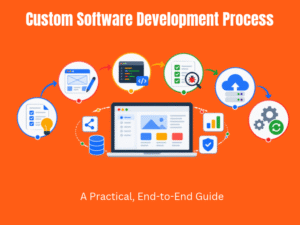
Every successful software product starts with a clear process. Whether you are building a mobile app for a startup or scaling an enterprise platform, the software development process is the structured roadmap that takes you from an initial idea to working software and beyond. At its core, this process maps to the software development life cycle (SDLC)-a framework that organizes every stage of building software into manageable, measurable phases.
Traditional software engineering relied heavily on sequential approaches like the waterfall model, where each phase finished before the next began. Modern software development looks different. Agile development, DevOps, and hybrid models now dominate, driven by distributed development teams, heightened security expectations, and the need for rapid product iteration across global markets.
TVL IT Solutions is a custom software development partner based in India that applies mature SDLC practices across web, mobile, game, and enterprise solutions. In this guide, we walk through the key phases of the development life cycle SDLC, compare popular software development methodologies, share real-world examples, and help you select the right software development approach for your next software development project.
The Software Development Life Cycle (SDLC) is a structured framework to build software. It provides the end-to-end backbone that structures planning, system design, writing code, unit testing, deployment, and the maintenance phase-ensuring nothing critical falls through the cracks.
In regulated industries like fintech and healthcare, SDLC-based models are now standard. 87% of organizations use Agile development methodologies, and the remaining mix of Waterfall and hybrid approaches is concentrated in compliance-heavy domains where detailed documentation and audit trails are non-negotiable.
The business benefits are tangible:
For offshore software collaborations, a documented SDLC is especially critical. Clear expectations, formal handover points, and transparent reporting reduce misinterpretation and protect both sides. TVL IT Solutions builds its SDLC around security-first principles and scalable architecture, tailored to custom software and B2B SaaS products.
The software development lifecycle consists of canonical phases that apply whether your project team follows Agile, Waterfall, or a hybrid approach. SDLC stages include planning, requirements analysis, design, implementation, testing, deployment, and maintenance. Some frameworks expand these into up to ten distinct steps, adding explicit phases for feasibility, prototyping, or feedback loops.
In agile methodologies, these phases compress into short iterations-often two-week sprints-where design, coding, and testing happen within each cycle. In sequential approaches, each phase completes before the next begins, typically once per release.
Here is how the seven key phases map out:
| Phase | Primary Focus |
| 1. Discovery & Requirements | Define what to build and why |
| 2. Planning & Project Setup | Scope, schedule, team, tools |
| 3. System Design & Architecture | Blueprint the software’s architecture |
| 4. Implementation | Write and review code |
| 5. Testing & QA | Validate quality and security |
| 6. Deployment | Release to production environment |
| 7. Maintenance & Improvement | Sustain, adapt, evolve |
TVL IT Solutions adapts this same SDLC backbone to different engagement models-dedicated team, fixed price, time & material, and hybrid-so the process fits the client rather than forcing the client into a rigid template.
This phase determines whether the software development project should exist at all, and what success looks like. Requirements gathering sets the foundation for the entire project.
Discovery activities include:
Requirements analysis clarifies functional and non-functional software requirements. The process includes collecting detailed requirements from stakeholders, and requirements can be user, system, or functional in nature. Requirements gathering identifies user needs and software functionality across several dimensions:
Feasibility analysis runs in parallel. Technical feasibility evaluates whether the chosen stack, integrations, and any AI/ML needs can deliver. Operational feasibility looks at the support model. Legal and compliance feasibility addresses data residency, privacy regulations, and industry-specific mandates.
Prototyping helps validate ideas before full-scale software development. For example, TVL IT Solutions recently evaluated whether to build a mobile app natively or with a cross-platform framework for a startup. The discovery phase included performance benchmarking, offline-mode analysis, and app store policy review-before a single line of production code was written.
Typical outputs: a Requirements Specification, high-level architecture sketch, risk assessment summary, and initial delivery roadmap.
Planning converts validated requirements into a realistic execution plan for development teams. This is where the project plan takes shape.
Planning defines project scope, resource requirements, and timelines. Key decisions at this stage include:
Risk management starts here. The project team identifies technical risks (complex integrations, unfamiliar programming languages), delivery risks (external dependencies, regulatory approvals), and introduces mitigation strategies like proof-of-concepts or time-boxed spikes.
Environment setup and tooling decisions also happen in this phase: code repositories, continuous integration pipelines, issue tracking, communication tools, and documentation standards for the development environment.
TVL IT Solutions defines collaboration cadences-daily standups, sprint reviews, demos-and reporting formats upfront. For offshore engagements, this transparency is essential, especially when project managers and stakeholders sit in different time zones.
The design stage translates requirements into software architecture and UI/UX wireframes. This is the blueprint phase where high-level architecture and detailed component designs are finalized.
Key architecture decisions include:
Design artifacts typically include architecture diagrams, data models, API contracts with technical specifications, and clickable prototypes for user-facing features.
Cross-cutting concerns must be addressed early: security controls, logging, observability, and scalability for expected user growth. Ignoring these creates technical debt that compounds over time.
Consider a B2B SaaS analytics platform that must handle large traffic spikes at month-end. The design phase might specify microservices for data processing, autoscaling policies, distributed caching, and observability dashboards-all decided before implementation begins.
TVL IT Solutions aligns system design with long-term maintainability so that future teams can evolve the software system without major rewrites.
This is where software developers turn system design into working software through coding. Implementation is the most visible phase of developing software, but its quality depends entirely on the phases that preceded it.
Work is broken into user stories or tasks, prioritized via a product backlog, and organized in sprints or iterations in agile development. Each sprint produces a potentially shippable increment, keeping the entire development process focused on delivering value.
Coding best practices that matter:
Unit testing and automated checks integrate directly into CI pipelines. Each code change triggers automated validation, catching defects before they propagate. This keeps code changes safe and the codebase stable.
Rapid application development practices accelerate delivery where appropriate-scaffolding admin interfaces, using low-code components for standard CRUD operations, or leveraging framework generators to reduce boilerplate.
TVL IT Solutions delivered an MVP for a logistics tracking app in a few sprints by combining reusable modules with custom software elements. The project team focused on core differentiating features while accelerating standard functionality through proven patterns.
Robust software testing is non-negotiable for reliable, secure software, especially for enterprise and fintech clients. Software testing identifies bugs before software deployment, and quality assurance tests software for flaws and security vulnerabilities.
Testing includes unit tests, integration tests, and user acceptance tests, organized across multiple levels:
| Testing Level | What It Validates |
| Unit testing | Individual functions and methods |
| Integration testing | Interactions between components and services |
| System testing | End-to-end behavior of the complete software system |
| Regression testing | Existing features still work after code changes |
| Performance testing | Response times, throughput under load |
| Security testing | Vulnerability scanning, penetration testing |
Automated testing continuously checks new code during development, fitting naturally into agile methodologies and DevOps pipelines. Test automation covers API tests, UI smoke tests, and performance baselines that run on every build.
User acceptance testing with real users or business representatives validates that the software functions as expected. User feedback from UAT guides final adjustments before release. Rigorous testing ensures software meets quality standards and user needs.
Security testing practices include static code analysis, dependency vulnerability scanning, and penetration testing for internet-facing software applications. TVL IT Solutions encourages “shift-left” testing-building quality checks as early as the coding phase to avoid expensive defects later. This approach to software quality reduces rework and strengthens confidence in every release.
Deployment makes software available to users, transitioning from development environments to the production environment where real users interact with the system. Deployment involves setting up database and server configurations, provisioning infrastructure, and ensuring rollback mechanisms are ready.
Modern deployment strategies reduce risk:
Monitoring and logging matter from day one. Application performance metrics, error tracking, and alerting for critical issues ensure that development and operations teams can respond quickly. DevOps integrates development and operations practices to automate and accelerate deployment, making continuous integration and delivery a reliable pipeline rather than a manual event.
Consider deploying a new version of a retail web application just before a major festival season. A canary deployment protects revenue by validating the release with a small user segment before full rollout-catching issues that testing alone might miss.
TVL IT Solutions’ DevOps practices help clients achieve frequent, low-risk releases for both web and mobile apps.
The software development process does not end at launch. Long-term success depends on ongoing maintenance, and this is often where the real value of a software solution compounds.
Maintenance involves monitoring software for performance and security updates post-launch. Performance monitoring is crucial for maintaining software efficiency. Regular maintenance ensures software performs effectively over time.
Four types of maintenance keep software healthy:
User support is essential for addressing software-related issues. User feedback, analytics, and production metrics feed back into the backlog, driving iterative development and continuous improvement. This feedback loop ensures the product development lifecycle keeps generating value, not just maintaining the status quo.
TVL IT Solutions often stays engaged as a long-term technology partner, helping clients maintain software applications and continuously deliver new capabilities for SaaS products and enterprise systems.
Software development methodologies structure the SDLC phases differently depending on the project’s risk profile, compliance needs, and pace of change. SDLC models differ in planning, changes, and workflow management.
Waterfall Model The waterfall model is a traditional linear approach to software development. Waterfall is a traditional linear software development model that works well for fixed-scope, compliance-heavy software projects with stable project requirements. Its strength is predictability and detailed documentation. Its weakness is inflexibility when requirements evolve.
Agile Methodologies Agile methodologies prioritize flexibility and collaboration in development. Agile is an iterative approach that focuses on continuous delivery and flexibility to changes. Agile development uses short sprints, evolving backlogs, and frequent delivery of working software.
Hybrid and Iterative Models The spiral model combines elements of both Waterfall and iterative approaches, emphasizing risk assessment at each loop. The incremental model develops software in small, manageable sections. Rapid application development emphasizes quick prototyping and user validation. Lean methodology aims at maximizing efficiency and eliminating waste in software development.
DevOps DevOps is a cultural and technical extension that blends development and operations teams to enable continuous integration, delivery, and monitoring.
Choosing the right model depends on:
Since the Agile Manifesto in 2001, agile development has become the dominant approach for modern software development. Agile methodologies are used by 87% of organizations for software development, and for good reason.
Key agile concepts in practice:
Cross-functional development teams-including developers, testers, designers, and product owners-collaborate closely within each sprint. Customer involvement in Agile methods occurs throughout the entire software lifecycle, and Agile requires continuous customer involvement and frequent feedback.
Scrum is a structured Agile framework that utilizes short cycles called sprints for development. Kanban uses a visual workflow management system to optimize task flow with work-in-progress limits.
TVL IT Solutions ran two-week sprints with a UK-based fintech client, scheduling shared sprint demos across time zones. This kept stakeholders aligned, and when business priorities shifted mid-sprint, the team adjusted the backlog without derailing the entire project.
Agile can coexist with formal SDLC documentation when enterprises need both auditability and speed. The agile model does not mean no documentation-it means the right documentation at the right time.
The same SDLC principles apply across product types, but implementation details differ significantly.
Web Development Web applications demand attention to SEO, responsive user interfaces, scalable architecture for unpredictable traffic, and fast page performance. Backend and frontend engineering decisions-choosing frameworks, caching strategies, CDN configuration-directly shape the product development process.
Mobile App Development Mobile apps introduce app store guidelines, device and OS fragmentation, and offline capabilities that influence system design and testing strategies. Choosing between native and cross-platform frameworks (React Native, Flutter) is a design-phase decision with long-term cost and performance implications.
Game Development Games emphasize rendering performance, real-time interactions, and specialized testing for gameplay balance and latency. Embedded software for consoles or VR adds hardware-specific constraints.
AI & ML and Enterprise Systems For AI and ML solutions or enterprise platforms, data quality, model lifecycle management, and integration testing with existing systems (ERP, CRM) are key process considerations. Complex projects in these domains demand heavier upfront planning and ongoing model validation.
TVL IT Solutions adapts its software development process and engagement model to match each product type and client objective-because a game studio and a healthcare SaaS company should not follow identical processes.
Mature software engineering relies on measurable outcomes, not intuition. Quality metrics and efficiency metrics lead time, deployment frequency, and change failure rate reveal the health of your development process.
Key metrics to track:
Governance practices include architecture reviews, security reviews, coding standards enforcement, and periodic audits-essential for enterprises with strict compliance requirements.
TVL IT Solutions sets up dashboards and regular review cadences with clients to ensure transparency and data-driven decisions. Continuous improvement is an ongoing practice, not a one-time initiative.
TVL IT Solutions is a custom software development and offshore partner focused on secure, scalable, business-ready solutions. But the value goes beyond writing code-TVL IT Solutions collaborates with startups, SMEs, and enterprises to define or refine their software development lifecycle from the ground up.
Capabilities span:
Flexible engagement models-dedicated team, fixed price, time & material, and hybrid-support different stages of a client’s digital transformation journey.
In one engagement, TVL IT Solutions helped a mid-sized enterprise cut deployment lead time by implementing structured sprint cycles, automated testing, and continuous integration pipelines where none existed before. In another, TVL worked with a product startup to move from ad-hoc development to a repeatable product development lifecycle, enabling the team to ship new features every two weeks instead of quarterly.
The best time to strengthen your software development process is before the next software project starts. If you are evaluating how to improve delivery speed, software quality, or team scalability, reach out to TVL IT Solutions to explore how a structured, security-first development process can support your business goals.
The software development process is a structured approach for planning, designing, coding, testing, deploying, and maintaining software throughout its lifecycle.
The seven key SDLC phases are discovery and requirements, planning, system design, implementation, testing and QA, deployment, and maintenance and improvement.
The right methodology depends on factors such as requirement stability, regulatory constraints, team maturity, project risk, and stakeholder availability.
Testing helps identify bugs, quality issues, and security vulnerabilities before deployment. It can include unit, integration, system, regression, performance, and security testing.
After deployment, software requires ongoing maintenance, monitoring, security updates, bug fixes, performance improvements, and new features based on user feedback.
At TVL IT Solutions, we specialize in delivering scalable, secure, and custom software development services tailored to your unique business needs. Whether you’re a startup or an enterprise, our team is ready to turn your vision into reality.
Get Started Now