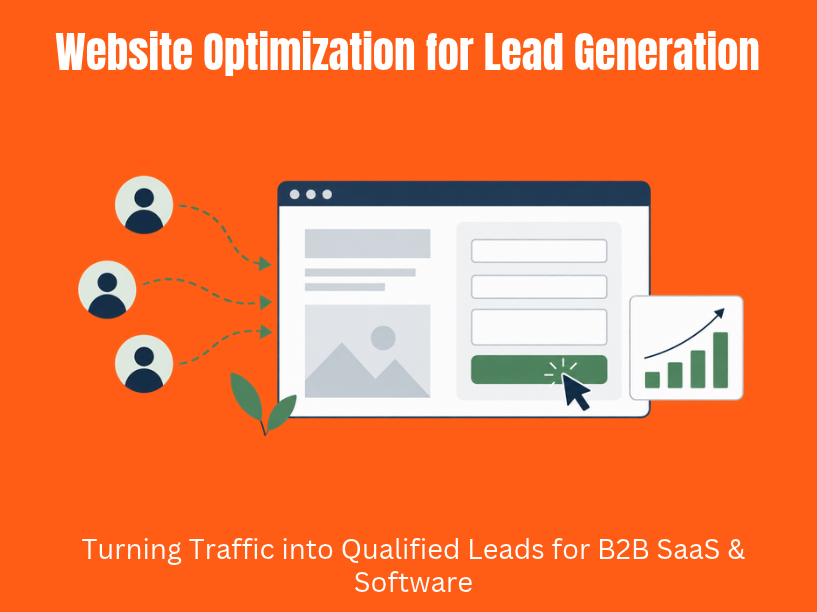

Most B2B software and SaaS websites still function like digital brochures. They list services, show a portfolio, mention tech stacks, and end with a generic “Contact Us” form at the bottom. Many websites follow this exact pattern and wonder why inbound inquiries stay flat. Meanwhile, 69% of marketers say new-customer acquisition is getting harder year over year.
The buyer journey has shifted. Today, 94% of B2B buyers use AI during their purchasing journey. Prospects research solutions across search engines, comparison platforms, and AI assistants before they ever speak to a sales team. By the time they reach out, more than half of their decision is already made. At TVL IT Solutions, we see this firsthand: custom software buyers globally evaluate vendors through content, case studies, and trust signals long before booking a call.
This article shows you how to turn a standard business website into a lead generation website that consistently delivers qualified leads for custom software, AI/ML, and B2B SaaS solutions. A lead generation website is engineered to engage, qualify, and convert visitors through multiple conversion points, unlike a standard site that passively presents information. We will cover UX, search engine optimization, content marketing strategy, landing pages, building trust, and measurement.
Lead generation websites follow a deliberate flow that moves anonymous website visitors toward becoming qualified leads. Here is how that system works for software and SaaS buyers:
This system turns a passive site into a pipeline engine where every visitor interaction generates actionable data points for your revenue team.
The difference between a digital brochure and a lead generation website is simple: one displays information, the other converts it into pipeline.
A standard software company site lists services like web development, mobile apps, AI/ML, and game development. It has a few portfolio items, maybe a blog, and a generic “Contact Us” link buried in the navigation. There is little to guide visitors toward a specific desired action.
A lead generation website operates differently. Every blog post, case study, and service page has specific conversion points. Instead of “Contact Us,” visitors see CTAs like “Book a 30-minute architecture review” or “Download the ERP integration checklist.”
Consider a typical “Custom Software Development” page. The standard version lists tech stacks and team skills. The optimized version opens with a problem-focused headline (“Solving Scale and Security Challenges in Fintech Apps”), includes social proof from finance clients, and features a mid-page lead magnet for CTOs evaluating offshore partners. A lead generation website converts 2-5% of visitors into leads, while optimized lead generation sites can achieve conversion rates over 9%.
Navigation, internal links, and sidebars become part of the conversion journey. They guide visitors from awareness content to solution pages to landing pages. TVL IT Solutions regularly reviews existing client sites and converts them from brochure mode to full lead gen mode without redesigning everything from scratch. The result: same web traffic, significantly more leads.
Every high-converting lead generation website shares key elements that work together to convert visitors into prospects. Here is what your design and content team must include:
Essential components:
Clear messaging should highlight the main value proposition immediately to visitors. Effective navigation and logical menus are important elements of the user experience that keep bounce rates low.
Performance and UX:
Mobile optimization is crucial as 59.4% of web traffic is mobile. Fast load times directly impact conversion rates, with even a one-second improvement yielding measurable lift. Pages must also follow accessibility best practices.
Supporting components:
Live chat or chatbots reduce friction for high-intent visitors. Sticky or repeated CTAs keep conversion opportunities visible. Short video walkthroughs, like a two-minute AI/ML platform overview, build credibility fast. FAQ blocks address purchase objections around security, IP ownership, time zones, and maintenance. We are visual creatures, so use icons, diagrams, and clean layouts to increase engagement.
The page layout should be scannable with short paragraphs, subheads, and visual hierarchy so busy buyers can skim in under 30 seconds. TVL IT Solutions bakes these elements into custom web platforms and SaaS dashboards from day one.
Think of your site as a connected funnel rather than isolated pages. Each page has a role in moving visitors closer to conversion.
The ideal flow:
Traffic source → blog or SEO page → service or solution page → landing page or contact → thank you page → nurture sequence.
Homepage. Quickly answers three questions: “What do you build?”, “Who is it for?”, and “Why trust you?” with a primary CTA like “Schedule a product demo” or “Plan your next release with our experts.” This is the first interaction many visitors have with your brand.
Blog and resource hub. Captures early-stage interest with topics like “Guide to choosing an offshore software partner in India in 2026.” High-quality blog posts drive SEO and attract qualified visitors who are just beginning their research.
Service pages. Pages for web development, mobile apps, AI/ML, Microsoft Dynamics, Salesforce, and enterprise solutions function as mid-funnel conversion hubs. Each should speak to a target audience in a specific vertical.
Dedicated landing pages. Campaign-specific pages for offers like “Legacy system modernization for manufacturers” or “Healthcare patient portal development” feature a single, focused CTA with minimal navigation.
Support pages. About, Contact, and Thank You pages are trust-building and engagement opportunities, not static endpoints. A Thank You page can recommend related case studies or invite the visitor to a webinar.
Content marketing must be engineered for lead generation, not just pageviews. Every piece of content should move a potential customer one step closer to a conversation.
TVL IT Solutions builds a content marketing strategy around buyer journeys for custom software, SaaS products, and offshore development engagements. The process maps topics to three stages:
Long-form guides, technical deep dives, and implementation playbooks perform exceptionally well for technical audiences evaluating enterprise solutions. These resources demonstrate expertise and experience that generic blog posts cannot match.
Every content asset must promote a next step. Embed checklists, webinar invitations, ROI calculators, or architecture consultation offers directly within the content. Lead magnets should provide immediate value tailored to audience pain points. Do not publish content that ends without a conversion opportunity.
Content should be regularly updated with new frameworks, cloud services, or security standards. Outdated material erodes credibility and rankings. Treat your content library like a product with a maintenance schedule.
The goal of an SEO strategy is not rankings alone but qualified pipeline. Website optimization for lead generation starts with aligning search engine optimization to commercial intent.
Keyword research for buyer intent. Identify terms your potential customers actually search: “custom telehealth app development,” “Salesforce integration partner for fintech,” “offshore dedicated development team India.” SEO strategies should focus on targeted keywords to attract qualified traffic, not generic high-volume terms that bring unqualified visitors.
Cluster by funnel stage. Group keywords into clusters: core service pages target decision-stage terms, blog posts target awareness queries, and case studies serve consideration-stage searches. This structure captures organic traffic across the entire buyer journey.
On-page SEO alignment. Titles, H1s, meta descriptions, and optimized image alt text should incorporate primary lead generation keywords naturally. Every page needs proper heading hierarchy and internal links that support the conversion funnel.
Technical SEO essentials. Fast page load speed is critical for maintaining user engagement and reducing bounce rates. Mobile performance matters since mobile web traffic accounts for 59.4% of global web traffic. Clean URL structures and secure HTTPS implementation round out the foundation.
Generative engine optimization. With 85% of marketers reshaping their SEO strategy for AI, structure content with clear headings, answer-first paragraphs, and original data to appear in AI-generated summaries. However, 41% of consumers report AI overviews frustrate their search process, which means traditional organic results still drive significant traffic.
TVL IT Solutions often pairs new software platforms or SaaS products with SEO-optimized marketing sites to accelerate early-stage customer acquisition.
Landing pages are focused, campaign-specific pages built solely to generate leads. Unlike full service pages, they remove distractions and center on one conversion goal.
High-converting landing page design:
Landing pages convert at an average rate of 9.7%, but poorly designed ones drop well below that. Every page should include a clear call to action that matches where the visitor sits in their decision process.
Conversion points across the site. Beyond dedicated landing pages, place header CTAs, in-content banners, and footer offers throughout your site. Exit-intent popups can capture leads by offering last-chance incentives like a free architecture consultation or downloadable guide. These capture the visitor’s attention right before they leave.
Tailor lead magnets to intent. Technical checklists and code samples work for engineers. ROI calculators and business case frameworks resonate with executives. Match the offer to the audience.
Example. An optimized landing page for “Dedicated offshore development team for US startups” might include fields to qualify company size, tech stack, and timeline, along with testimonials from startup clients and a downloadable engagement model comparison.
Test and improve. A/B testing can identify the most effective website elements through continuous optimization. Test headlines (“Get your software roadmap” vs. “Start scalable development”), button copy, form length, and layout variations to improve conversion rates over time.
In high-stakes software decisions, building trust is as critical as technical capability. Buyers need proof that you deliver results before they invest in a partnership.
About page. Tell your story: TVL IT Solutions’ founding in India, focus on secure and scalable custom software development, and long-term global partnerships. Include leadership photos with short bios, engineering culture details (code reviews, QA, DevOps), and security practices.
Case studies with real outcomes. Strong case studies follow a clear structure: client industry, problem, solution architecture, and measurable results. For example, TVL IT Solutions built a custom AI scheduling engine for a European manufacturer in 2025, cutting planning time by 60%. Include concrete outcomes like improvements in deployment speed, error reduction, or user adoption without exaggerated claims.
Additional trust signals:
Trust signals such as security badges and client logos help reduce uncertainty for leads evaluating offshore partners. Embedding social proof like testimonials and reviews can enhance user trust significantly across your highest traffic pages.
All trust elements should be visually clean, scannable, and linked throughout the site wherever high-intent visitors might be close to converting.
Small UX changes in forms and CTAs often generate the biggest lift in lead generation. Here is where to focus.
Form strategy. Use short forms for top-funnel offers: name, email, and role. For demo or project scoping, ask for company size, timeline, existing systems, and budget range category. Forms with fewer fields typically lead to higher completion rates, so only ask for what you need at each stage.
Progressive profiling. Use marketing automation so returning visitors gradually share more visitor information over time rather than facing a heavy form on every visit.
CTA examples that reduce friction:
Avoid generic labels like “Submit” or “Learn More.” A lead generation website must have clear calls-to-action, and effective CTAs should match the visitor’s decision process stage.
UX best practices. Clear labels, inline validation, minimal required fields, and mobile-friendly inputs keep forms usable. Add microcopy that reduces hesitation: privacy assurances, brief notes on response time (“We reply within one business day”), and a clear explanation of what happens next. Quick follow-up after form submissions increases the chances of converting leads into real conversations.
TVL IT Solutions tests different CTA placements (hero, mid-page, end-of-page) on service and solution pages to find the highest-converting combinations for each audience.
CRM and marketing automation are the nervous system of a lead generation website. Without them, form submissions sit in inboxes instead of driving pipeline.
Integration. Connect forms and landing pages with tools like HubSpot, Salesforce, Microsoft Dynamics 365, or custom CRMs. TVL IT Solutions frequently builds custom integrations and dashboards so revenue teams see real-time lead gen performance across multiple channels.
Lead routing rules. Assign leads by geography (US, Europe, India), by industry (healthcare, manufacturing, fintech), or by solution interest (AI/ML vs web vs mobile). This ensures the right team member follows up with the right context.
Basic nurture flows:
Use behavior-based triggers to identify higher intent. Revisiting a pricing page, downloading multiple technical docs, or viewing the “Dedicated Team Model” page all signal readiness. Personalization of content can enhance engagement and conversion rates at every stage.
Closed-loop reporting. Connect deals won back to original landing pages, blog posts, or campaigns to refine content and spend. This is how you generate leads more efficiently over time. The data is clear: 77% of customers reported improved lead generation after automation. When your site, CRM, and nurture flows work together, you create a system that compounds results.
Move from “launch and forget” to continuous optimization driven by data. Continuous measurement and analytics improve lead generation and website performance consistently.
Core metrics to track:
| Metric | What It Tells You |
| Overall conversion rate | Visitor-to-lead efficiency |
| Conversion rate by page type | Which pages convert best |
| Form completion rate | Where users drop off mid-form |
| Time on page and scroll depth | Content engagement quality |
| Funnel drop-off points | Where the buyer journey breaks |
Segment by source and device. Break data by traffic source (organic, paid, referral, social) and by device (desktop vs mobile). Over half of web traffic comes from mobile devices, yet many B2B sites see lower conversion on mobile, revealing a clear optimization opportunity.
Tools and methods. Use heatmaps, session recordings, funnel analysis, and regular UX audits to identify friction. Numbered lists of testing priorities help teams stay focused.
Testing ideas for software buyers:
TVL IT Solutions often pairs custom development with an optimization roadmap, revisiting key pages quarterly to respond to new buyer behavior and AI search changes. Treat the site as a living product with a backlog of experiments, similar to a SaaS feature roadmap.
Concrete stories illustrate what website optimization for lead generation looks like in practice for custom software and SaaS.
Startup example. A UK-based startup partnered with TVL IT Solutions in 2024 to build both its SaaS platform and a lead gen website. By combining targeted SEO content, industry-specific landing pages, and clear CTAs, the startup moved from near-zero inbound leads to a steady pipeline of demo requests within a few months. Lead generation websites should provide valuable resources for contact information, and this startup delivered exactly that through downloadable product comparison guides.
Enterprise example. A manufacturing company modernized its legacy system and used SEO-driven content plus targeted landing pages to attract plant managers and operations leaders. One landing page spoke to uptime and IoT integration; another addressed cost of downtime and predictive maintenance. The result: fewer low-fit inquiries, more executive-level interest, and sales cycles shortened by roughly 20% because leads were already educated.
What drove the improvements:
Benefits were qualitative too: better-qualified conversations, clearer expectations about engagement models (dedicated team, fixed price, hybrid), and less scope ambiguity. Results came from consistent, measurable improvements rather than overnight success. Similar frameworks apply across every sector TVL IT Solutions serves, including healthcare, logistics, fintech, and education.
A modern lead generation website is a system. It attracts the right visitors through search engine optimization and content marketing, guides them with relevant content and clear navigation, and converts them with well-designed landing pages and conversion points. Every element, from CTAs to CRM integration, plays a role in generating more leads and revenue.
Audit your current site against the elements discussed: value propositions, CTAs, mobile performance, case studies, social proof, and integration with marketing automation. Identify your highest traffic pages and ask whether they actively convert or passively inform.
TVL IT Solutions is a long-term strategic software development partner that can both build custom web platforms and optimize existing sites specifically for lead generation in B2B software and SaaS. If your site is not converting visitors into pipeline, we can help you find out why.
Consider requesting a website and funnel review to identify where your site is leaving leads on the table and how to align your product roadmap with a stronger digital lead gen strategy. As AI-driven search and evolving buyer expectations reshape the answers prospects find online, the sites that adapt now will own the pipeline through 2027 and beyond.
Website optimization for lead generation involves improving a website’s UX, content, SEO, CTAs, landing pages, forms, and conversion points to turn visitors into qualified leads.
A B2B SaaS website can generate more leads through targeted SEO, industry-specific landing pages, clear CTAs, lead magnets, case studies, short forms, trust signals, and CRM automation.
Key pages include the homepage, blog or resource hub, service or solution pages, dedicated landing pages, About, Contact, and Thank You pages. Each should support a specific stage of the buyer journey.
SEO helps attract qualified visitors by targeting commercial-intent keywords, organizing content by funnel stage, optimizing on-page elements, improving technical performance, and creating content that supports the buyer journey.
Important metrics include overall conversion rate, conversion rate by page type, form completion rate, time on page, scroll depth, and funnel drop-off points.
At TVL IT Solutions, we specialize in delivering scalable, secure, and custom software development services tailored to your unique business needs. Whether you’re a startup or an enterprise, our team is ready to turn your vision into reality.
Get Started Now