
Most teams start the same way: sign up for a CRM, pick a project management tool, connect a few apps with Zapier, and move on. Tools like HubSpot, QuickBooks, and Slack cover the basics well. But at some point, the workarounds pile up. Reports don’t match. Data lives in five places. The tool that worked for 10 people breaks down at 80.
That’s when the question shifts from “which SaaS do we subscribe to?” to “should we build something that fits how we actually work?” This is the core of the custom software vs off the shelf software decision, and getting it wrong can lock you into years of misfit tools or unnecessary spending.
The question is not “build vs buy” in the abstract; it is “where does each option generate the best return over 3 to 5 years for your specific business?” This article breaks that down with real data, practical frameworks, and examples drawn from web, mobile, AI, ERP, CRM, and SaaS platform projects. TVL IT Solutions, an experienced custom software development partner, helps startups, SMEs, and enterprises make this decision based on evidence rather than assumptions.
Off the shelf software refers to pre-built, packaged software products sold or licensed to many businesses at once. In 2026, most of these ship as SaaS subscriptions. Off-the-shelf software is a pre-built product designed for a broad market, and its updates are managed by the vendor, not the customer.
Concrete examples by category: CRM systems like HubSpot or Zoho CRM, accounting tools like QuickBooks Online or Xero, project management tools like Asana or Trello, collaboration platforms like Slack or Microsoft Teams, e-commerce engines like Shopify, and HR platforms like BambooHR. Off-the-shelf software is designed for common business needs and standardized operations; it may require adaptation to fit unique business processes.
The licensing model is typically per-user or per-organization, with feature tiers and add-ons. Community support, online tutorials, and large user bases make adoption easier. But competitors use the same tool with the same features, which limits differentiation. Off-the-shelf software features may not align with specific business needs, and it is ready-made for immediate use rather than tailored to a single company workflow.
| Benefit | Limitation |
| Deploy in days or weeks with minimal setup | Limited customization; vendor controls the feature roadmap |
| Lower upfront costs through subscription pricing | Per-user or per-feature fees grow as headcount increases |
| Vendor handles hosting, security patches, and updates | Integrations with internal or legacy systems can be shallow |
| Large user communities and rich documentation | Competitors access the same features; no competitive edge from the tool itself |
Custom software, also called bespoke software or tailor-made software, is built specifically for one organization’s workflows, data models, rules, and user roles. It is designed for a business’s unique needs, not for a mass market audience.
Examples relevant to TVL IT Solutions projects include a custom logistics platform for multi-warehouse inventory, a field-service mobile app with offline sync, a specialized fintech dashboard for portfolio analytics, and an AI-driven learning management system. Custom software can be web apps, mobile apps, internal tools, customer portals, or full SaaS platforms. It can also modernize or extend legacy systems; for instance, replacing Excel-plus-email workflows with a unified portal, or wrapping an old ERP with a modern API layer.
Custom software is designed to evolve with a business’s growth and provides a competitive advantage through unique features and proprietary algorithms. A custom software provider like TVL IT Solutions builds and maintains the solution, but the client owns the product vision and data.
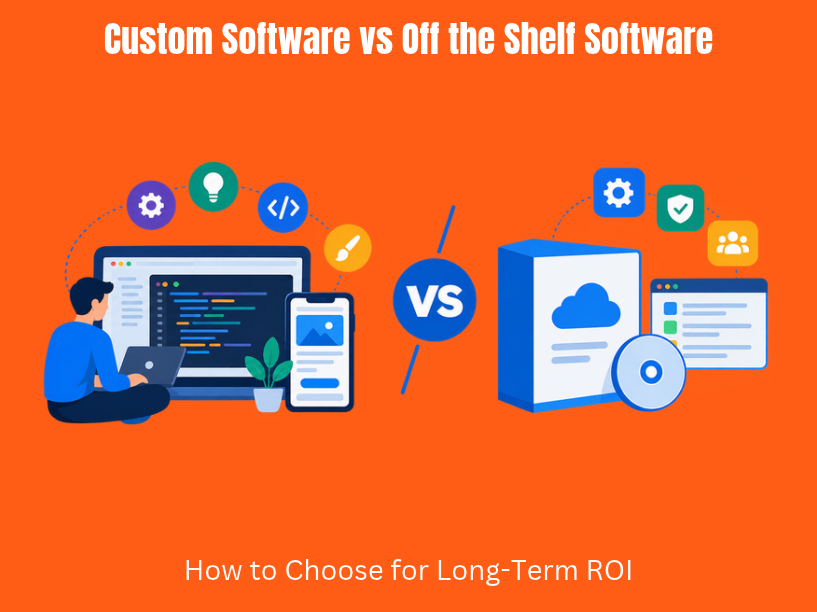
Here is a quick, skimmable overview comparing the two options across criteria that matter most to decision-makers.
| Criteria | Custom Software | Off the Shelf Software |
| Speed to deploy | Weeks to months (discovery, design, build, test) | Days to weeks (sign up, configure, train) |
| Fit to processes | Built around your workflows and rules | Designed for average workflows; gaps filled by workarounds |
| Cost structure | Higher initial investment; you own the asset | Lower upfront cost; ongoing subscription fees compound |
| Scalability | Architecture designed for your growth trajectory | Vendor-defined tiers; scaling often means higher pricing |
| Integration | Designed with integration in mind from the start | Pre-built connectors cover common cases; deep sync is harder |
| Ownership | Complete control over software evolution | Vendor controls roadmap, pricing, data access |
| Risk | Requires strong architecture to avoid technical debt | Vendor lock-in; price increases of 10-25% per year are common |
Off the shelf solutions win for speed and predictability in simple, standard processes. Custom solutions win for long-term fit and competitive advantage in complex or differentiating workflows. Custom software provides complete control over software evolution, while off the shelf software limits deeper customization options.
Consider a 20-person marketing agency choosing between a well-known project management SaaS and a custom project-and-finance portal tailored to their billing, time tracking, and client reporting. The SaaS works on day one. But within a year, the agency may find itself exporting data to spreadsheets for invoicing, manually reconciling hours, and paying for three separate tools to cover what one custom platform could handle.
Many organizations benefit from a hybrid approach using both custom and off-the-shelf software. Keep both options on the table; the right software solution is often a combination.
Off the shelf software wins on implementation speed. Sign up, configure, import data, train users, go live. For teams that need a working system within days, ready made software is the practical choice. Off-the-shelf software is suitable for quick and affordable solutions when time pressure is real.
Custom software development typically has a longer time-to-market than off-the-shelf solutions. The custom software development process includes discovery, UX design, architecture, iterative development, testing, and phased rollout, typically spread over several weeks to several months depending on scope. AI-assisted development tools have reduced build times by 30-40% compared with 2020 benchmarks, but custom development still requires more upfront time.
A startup in 2024 that needed a CRM within two weeks wisely chose a ready-made solution. By 2026, as pipelines, approval rules, and partner workflows grew complex, that same startup began planning a custom sales portal. The off the shelf tool got them started; the custom build will carry them forward.
The risk of optimizing only for speed: bending your business processes to fit generic tools creates friction, rework, and hidden costs within one to two years.
Off the shelf software generally has lower upfront licensing fees, while custom software typically requires a significant upfront investment for development. Custom software development can cost between $20,000 and $200,000, depending on complexity and scope. But upfront cost is only one part of the equation. Budget is a key factor when choosing software solutions, yet the three-to-five-year total cost of ownership often tells a different story.
A study of 312 enterprise projects (2019-2024) found that custom software costs about 1.5 to 2 times more than off the shelf in year one. By year three, 68% of those custom solutions delivered lower total costs. Off-the-shelf software has lower upfront costs but higher long-term expenses because subscription fees, add-on charges, and per-user pricing compound. Off-the-shelf solutions can lead to long-term cost increases; SaaS vendors raise prices by 10-25% per year on average.
Custom software can reduce total cost of ownership over time. Off-the-shelf software often incurs ongoing licensing fees as teams grow, while a custom-built system has a fixed development cost and predictable maintenance. Custom software requires a higher initial investment than off-the-shelf solutions, but the long-term return often justifies it.
When calculating your five-year TCO, include:
Flexera reported that roughly 32% of SaaS licenses go unused in many organizations. That waste adds up. Well-architected custom solutions from a development partner like TVL IT Solutions reduce manual work, eliminate spreadsheet dependence, and consolidate multiple tools into one system.
Off the shelf tools allow limited configuration within a vendor-defined framework: custom fields, workflow rules, report templates. For standard processes, that’s sufficient. For unique business processes or rapidly evolving operations, it breaks down.
Custom software can adapt as business needs evolve. Adding modules, integrating new data sources, supporting new regions, currencies, or product lines happens on your terms. Custom software allows for intentional feature additions over time, and scalability is often better with custom software solutions because the architecture is designed for your growth pattern, not a generic one.
A mid-sized logistics firm starts on a generic TMS SaaS. It works for domestic routes. When the firm expands into three countries with different fuel surcharge rules, tax regulations, and carrier APIs, the SaaS hits a wall. A custom logistics platform with country-specific routing and pricing logic removes those constraints. Custom software is better suited for long-term expansion because the system grows with the business rather than against it.
TVL IT Solutions plans scalable architecture from day one: cloud-native infrastructure, modular design, and API-first patterns. Hybrid architectures are common; off the shelf CRM paired with a custom quoting engine or recommendation module that creates competitive edge.
Signals you need more flexibility:
Fragmented tools cause real damage. When orders live in Shopify, inventory in a legacy ERP, shipping data in a 3PL portal, and finance in QuickBooks, teams spend hours reconciling numbers that should match automatically. Integration requirements influence software choice more than most teams realize at the outset.
Off the shelf software handles integration through vendor APIs, middleware like Zapier or Make, and prebuilt connectors. These cover common use cases. But nuanced, cross-system workflows; real-time syncs; and custom data transformation rules often exceed what pre built software connectors can do. Off-the-shelf software may require compromises for integration, and integration with legacy systems is often challenging for off-the-shelf software.
Custom software allows seamless integration with existing systems because it is designed with integration in mind from the start. A custom platform can act as a central orchestration layer rather than another silo. TVL IT Solutions built a web portal for a European SME that synced orders from an e-commerce platform, inventory from a legacy ERP, and shipping data from a third-party logistics API into a single real-time view for operations and finance. That kind of workflow automation eliminated hours of manual reconciliation per week.
Custom software can adapt to evolving integration needs over time. As you add new vendors, channels, or operating systems, the integration layer expands with you instead of forcing you to adopt yet another connector tool.
Questions to ask any software provider about integration:
Off the shelf software operates under license or subscription. The vendor controls release cycles, feature roadmaps, pricing changes, and data access patterns. You configure; you don’t control. Custom software allows for complete control over features and updates, including the hosting environment, architecture, and security posture.
Off-the-shelf software is a common target for attacks because millions of organizations run the same codebase, making it a high-value target for exploits. Off-the-shelf software may introduce hidden security vulnerabilities through third-party plugins or shared infrastructure. Custom software can be tailored to specific security needs; a fintech platform can enforce field-level encryption, a healthcare system can implement HIPAA-aligned audit trails, and a payments tool can follow PCI-DSS patterns.
Quality and maintenance are critical for custom software security. Maintenance and support for custom software is handled internally or by a vendor like TVL IT Solutions, which applies secure coding practices, regular penetration testing, role-based access control, and encryption aligned with each client’s regulatory context. Custom software allows control over data access policies, so you define who sees what, how long data is retained, and where it is stored.
A regional financial services firm chose custom software for a loan origination system to keep sensitive data within a private cloud and pass local compliance audits that a shared SaaS environment could not satisfy.
The typical custom software development process follows a sequence: discovery and requirements, UX/UI design, architecture planning, iterative development (usually Agile), testing and QA, deployment, and ongoing support.
Discovery goes beyond feature lists. The TVL IT Solutions team analyzes current tools, pain points, data flows, and business goals to ensure alignment with real business requirements rather than a wish list of nice-to-haves. This development phase sets the foundation; getting it wrong leads to rework, scope creep, and wasted budget.
TVL IT Solutions builds cross-functional development teams tailored to each project type. A web platform gets backend and frontend engineers, a business analyst, QA, and DevOps. An AI/ML solution adds data scientists. A Salesforce or Dynamics extension brings certified consultants. The software company matches the team to the problem, not the other way around.
Engagement models include dedicated teams for long-term product builds, fixed-scope projects for clearly defined applications, time and material for evolving requirements, and hybrid options that combine elements based on the development process stage.
In a 2025 engagement, TVL IT Solutions replaced three disconnected off the shelf tools with a single custom SaaS platform for a European logistics SME. The outcome: manual task volume dropped, reporting consolidated into one dashboard, and the customer portal usage increased because clients could track shipments without calling support.
How this process reduces risk compared to ad hoc development:
Example 1: Off the shelf is the right call. A five-person consulting firm in 2023 chose Google Workspace, Trello, and a standard CRM to manage projects and clients. Problem: the firm needed mail services, task tracking, and basic client records without technical complexity. Approach: they adopted existing tools, configured them in a day, and trained the team in a week. Outcome: in 2026, the same tool stack runs smoothly because the firm’s processes are simple, non-differentiating, and unchanged. The low upfront cost and free trial periods let them test before committing. No custom development was needed.
Example 2: Custom wins. A mid-sized on-demand delivery company in 2024 outgrew generic routing and tracking tools. Problem: dispatch rules, driver assignments, and customer notifications required logic that no readymade software pieces could model. Manual coordination between three separate platforms added hours of work daily. Approach: the company partnered with TVL IT Solutions to build a custom dispatch system, driver mobile app, and customer tracking portal. Outcome: on-time delivery rates improved, customer support call volume dropped, and the custom platform became a competitive advantage the company markets to new clients.
Example 3: Hybrid approach. An edtech startup uses off the shelf billing (Stripe) and marketing tools (Mailchimp) for back-office operations. Problem: its core product, an AI-powered adaptive learning engine, could not run on any existing platform. Approach: the startup kept shelf solutions for commodity functions but commissioned TVL IT Solutions to build a custom learning engine and admin panel. Outcome: the bespoke software drives user engagement and retention, while off the shelf tools handle billing and mail services without custom development cost. Such solutions combine the best of both approaches.
Use three lenses to evaluate your software solution options: strategic importance, pain level, and future change.
Strategic importance. Processes tied to brand, customer experience, or margins are strong candidates for custom software. A pricing engine, fulfillment system, or core product workflow creates or defends competitive advantage. Back-office tasks like payroll or basic accounting rarely justify building custom software.
Pain level. Measure friction from your current company workflow:
Translate those numbers into a cost. If the annual cost of friction exceeds the cost of a custom build, the case makes itself.
Future change. Look three to five years ahead. New markets, acquisitions, product lines, and regulations will change your business operations. Assess whether generic tools can realistically support that complexity.
Quick checklist:
If most answers lean toward “strategic, high pain, high change,” custom solutions or hybrid models become the stronger path. TVL IT Solutions often starts engagements with a short discovery phase to run this analysis before proposing any build.
Off the shelf solutions are the smarter option in specific situations:
For commodity capabilities like email marketing, generic support ticketing, or project management, best-in-class SaaS is better than reinventing the wheel with custom development. The tech capabilities are mature, community support is strong, and vendor updates keep features current.
The limitations remain: limited customization, dependence on the vendor’s roadmap, and the risk that your company workflow diverges from what the tool supports. Start with off the shelf while tracking pain points and adoption metrics. When the tool starts constraining business growth, that’s the signal to reassess.
TVL IT Solutions sometimes recommends staying with existing SaaS and focusing custom work only where it multiplies value. Honest assessment matters more than selling development hours.
Good candidates for off the shelf right now:
The inflection points are predictable. Rising transaction volumes, many edge cases, complex pricing logic, multi-country operations, or unique customer experiences that generic tools cannot model. These are often the operations that directly create or defend competitive edge.
A manufacturer needed country-specific tax calculations, multi-currency support, and sophisticated approval workflows. Standard ERP add-ons could not handle the rules without expensive vendor customization that still left gaps. A custom built software solution centralized scattered data from spreadsheets, email, and third-party apps into one coherent system, improving forecasting, compliance reporting, and daily decision-making. Custom software requires commitment, but the return justifies it when the right conditions exist.
TVL IT Solutions often phases these projects. Start with a narrow but critical module, a quoting engine, a routing planner, a compliance dashboard, and expand into a full custom platform as ROI is proven. This approach limits risk while delivering value early.
Strong signals you’re ready for custom software:
TVL IT Solutions is an India-based custom software development company that delivers web, mobile, enterprise, AI/ML, Salesforce, Microsoft Dynamics, and game development services to clients globally. The company provides custom software development services across industries including fintech, logistics, edtech, healthcare, and SaaS product teams.
Before writing code, the team evaluates existing systems, business requirements, growth plans, and current SaaS usage. The advisory-first approach means TVL IT Solutions recommends build, buy, or hybrid based on evidence. If off the shelf tools serve you well, the recommendation is to keep them. Custom development enters only where it creates measurable value.
In a recent engagement, TVL IT Solutions recommended a hybrid strategy for a B2B services company: keep the off the shelf CRM but build a custom partner portal and analytics dashboard. The partner portal unlocked a new revenue channel that the CRM alone could not support. The custom made software handled partner onboarding, deal tracking, and performance reporting, while the CRM continued managing direct sales.
TVL IT Solutions supports dedicated teams for ongoing product development, fixed-scope projects, time and material for exploratory work, and hybrid engagement options. The long-term strategic partnership mindset means ongoing maintenance, feature evolution, security updates, and support adapt as the business grows and markets change.
Key strengths:
If you’re comparing custom software vs off the shelf for a specific process or platform, start with a conversation. Schedule a discovery session to review your current tool stack and identify where custom software might create real competitive advantage for your business.
Custom software is built specifically for a business’s workflows, requirements, and goals. Off-the-shelf software is pre-built for a broad market and offers standardized features that may require workarounds.
Neither option is always better. Off-the-shelf software suits businesses with standard processes and tight deadlines, while custom software is better for complex workflows, specialized requirements, and competitive differentiation.
Off-the-shelf software generally has lower upfront costs through subscriptions. Custom software requires a higher initial investment, but it may reduce long-term costs by consolidating tools, reducing manual work, and avoiding recurring per-user fees.
A business should consider custom software when existing tools require frequent workarounds, integrations regularly break, transaction volumes increase, or unique workflows cannot be supported by ready-made solutions
Yes. A hybrid approach combines ready-made tools for standard functions, such as billing and marketing, with custom software for specialized operations, unique workflows, or features that provide a competitive advantage.
At TVL IT Solutions, we specialize in delivering scalable, secure, and custom software development services tailored to your unique business needs. Whether you’re a startup or an enterprise, our team is ready to turn your vision into reality.
Get Started Now