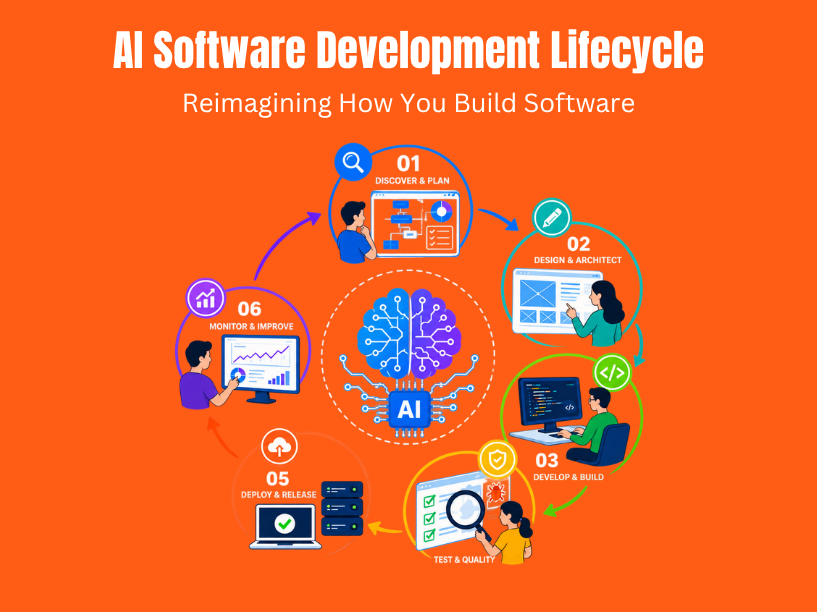
The AI software development lifecycle is the integration of ai tools, ai agents, and agentic ai workflows across every phase of classic software development: planning, design, build, test, deploy, and operate. The AI Development Lifecycle (ADLC) differs from traditional Software Development Lifecycle (SDLC) because it treats artificial intelligence as a core collaborator, not a sidebar feature. AI reduces planning time from weeks to minutes, generates code and tests in parallel, and monitors production systems for drift and failure.
An ai driven sdlc is not just about code completion or ai assisted coding tools. It is a structured, human-in-the-loop framework that turns ai experimentation into repeatable, governed software delivery. TVL IT Solutions, a custom software development partner based in India, designs and runs ai led SDLCs for startups, SMEs, and enterprises. In one 2025 engagement, a fintech startup cut its feature development lifecycle from three months to under four weeks by adopting an ai powered SDLC with TVL IT Solutions, combining agentic planning, automated test generation, and continuous monitoring.
Traditional software development is deterministic and produces the same output for the same input. Classic models like Waterfall, Agile, and DevOps assume that a given function, once coded, behaves predictably. AI systems are probabilistic and their behavior is learned from data rather than hardcoded rules. That single difference forces new lifecycle practices in testing, validation, requirements, and operations.
Here is how the ai transition reshapes each dimension of the development process:
The mental model shifts from sequential phase handoffs to continuous, ai powered flows. Agentic ai and autonomous agents orchestrate multi-step tasks: analyzing tickets, generating specs, scaffolding code, running tests. Software teams no longer wait for one phase to finish before the next phase begins.
TVL IT Solutions structures its AI/ML development services around seven stages when helping clients build software. This model extends Agile and DevOps rather than replacing them; it layers ai usage, governance, and human review on top.
Reproducibility and experiment tracking (model versions, dataset versions, configuration logs) are built into every stage. These practices do not exist in classic SDLC and are non-negotiable for probabilistic systems.
An ai software development life cycle fails when teams adopt ai tools without tying them to measurable outcomes. Research forecasts that 60 to 90 percent of AI projects may fail in 2026 if organizations skip data governance and clear business alignment. Data quality and bias impact the effectiveness of AI models used in software development, so the process must start from business value, not technology enthusiasm.
Organizations must implement governance to ensure AI aligns with standards. TVL IT Solutions helped a global logistics SME in 2024 by embedding AI-enhanced backlog prioritization and effort estimation into their custom software development workflow. On-time delivery improved, and rework dropped because the ai agents surfaced bottlenecks before sprint reviews.
Translating business goals into AI-SDLC objectives:
Not every problem needs AI. Deterministic logic is safer and less expensive for well-understood business processes like form validation or static rule engines. Responsible ai means knowing where NOT to use it. TVL IT Solutions positions AI in enterprise backend systems and ai applications where it amplifies business value rather than adding complexity.
AI accelerates project planning from days to minutes. At TVL IT Solutions, a typical ai driven discovery workflow begins with data ingestion: the system pulls support tickets, CRM records, product analytics, and transcripts from stakeholder interviews. Generative ai models then summarize pain points, cluster related requests, and generate requirements documents from unstructured inputs.
For a SaaS client in 2025, this approach reduced alignment meetings from six sessions to two. The AI agent drafted user stories, flagged compliance risks, and proposed a sprint roadmap. Product managers reviewed the output, adjusted priorities, and approved the final specs in a single session. AI reduces planning time from days to minutes when the inputs are well-structured.
Practical safeguards keep the process auditable:
AI-powered project management tools generate timelines, dependency maps, and capacity plans. But natural language prompts alone do not capture business context. Product managers bring contextual understanding of market dynamics and competitive positioning that no model can replicate. AI handles repetitive tasks like ticket categorization and impact estimation; humans handle judgment.
AI can generate prototypes in a single pass. Design tools now convert rough sketches into clickable wireframes that follow platform guidelines like Material Design or Human Interface Guidelines. This collapses the design phase from iterative back-and-forth into rapid, feedback-driven cycles.
On the technical side, AI recommends architectures (microservices vs. monolith), database choices, and integration patterns for web backend, mobile, and enterprise systems. TVL IT Solutions uses AI to evaluate trade-offs in latency, scalability, and security when designing custom software.
For an India-based eCommerce platform in 2025, AI suggested a microservices architecture with auto-scaling rules calibrated to seasonal traffic peaks during Diwali and Republic Day sales. The system factored in historical load data and predicted a 4x traffic spike, recommending pre-provisioned container clusters.
Key AI capabilities in the design phase:
Designers and architects curate every AI proposal. Alignment with brand guidelines, compliance requirements, and performance benchmarks remains a human responsibility. AI tools can improve code quality by 31 to 45 percent when architectural decisions are sound from the start.
AI assistants and ai agents integrate into IDEs (VS Code, JetBrains) to generate scaffolding, boilerplate, unit tests, and documentation. 55% faster code generation is achievable with AI tools when developers work on backend, frontend, mobile, and game projects. AI tools can automate repetitive tasks, increasing developer productivity on routine tasks like CRUD operations and API wiring.
AI agents can spin up initial implementations for multiple microservices in parallel. Engineers focus on domain logic and edge cases while ai assistance handles the mechanical work. TVL IT Solutions encourages developers to use AI for refactoring, code review suggestions, and cross-language migration. In one project, a team migrated an on-premise CRM to Microsoft Dynamics 365 by having AI generate mapping and transformation code from legacy .NET to modern Node.js backends. An architect supervised every generated module.
AI can automate repetitive tasks, improving delivery speed. But ai driven development carries real risks.
Do:
Don’t:
AI-driven development can improve code quality by 31 to 45 percent when paired with review processes and secure coding standards. Without those checks, ai generated code becomes a liability.
AI tools can create test cases automatically during testing by analyzing existing codebases and historical defect patterns. AI can automatically create test cases from code analysis, covering unit, integration, API, and UI layers without manual enumeration.
AI can create adaptive testing that focuses on impacted areas. Instead of running the full regression suite on every commit, AI identifies which modules changed and targets tests accordingly, speeding up ci cd pipelines for web, mobile, and SaaS applications.
For security, AI performs static analysis and vulnerability pattern detection against the OWASP Top 10. In a realistic scenario: an AI agent flagged a risky authorization gap in a new mobile banking feature where session tokens were not invalidated on role change. It proposed a patch. Senior engineers reviewed the fix, refined the token invalidation logic, and merged it within hours.
AI tools can automatically categorize and prioritize bug reports, reducing triage time for enabling teams. Validation and evaluation of AI models require statistical evaluations and safety checks before any model reaches production.
How AI improves SDLC testing:
Quality gates remain human-governed. QA leads, security engineers, and architects sign off at defined checkpoints despite AI-automated checks.
Deployment processes become faster and more automated with AI. AI augments ci cd pipelines by predicting pipeline failures, recommending configuration fixes, and triaging build errors. GitHub Actions and similar CI tools gain AI layers that propose fixes when builds break, cutting mean-time-to-resolution.
Deployment of AI systems involves model serving and specialized infrastructure needs. MLOps practices unique to an ai software development lifecycle include model packaging, versioning, canary deployments, shadow deployments, and rollback policies. GitHub released tools in 2024 and 2025 that integrate model registry features into deployment pipelines.
AI enables proactive maintenance by monitoring systems continuously. AI can detect anomalies before failures occur in maintenance, analyzing logs, metrics, and traces in real time. For a global retailer deploying an AI-powered recommendation engine, continuous monitoring tracked click-through rates per cohort. When performance dropped 12 percent after a model update, the system triggered automatic rollback within minutes.
Continuous monitoring of AI models focuses on model drift and predictive accuracy degradation. AI maintenance includes collecting new data and retraining models to ensure performance over time.
AI in runtime operations:
Responsible ai in the context of an ai software development life cycle means transparency, accountability, fairness, privacy, and safety. AI governance ensures human oversight in automated processes. Responsible AI frameworks help manage risks in software development by codifying controls rather than relying on ad-hoc reviews.
Governance policies should define acceptable AI tool usage and sensitive data handling protocols. AI governance includes validation and transparency throughout development. When training models on production logs, user conversations, or support tickets, privacy-by-design and data minimization apply: anonymize data, restrict access, log every query.
In a healthcare engagement, an insurance client’s risk-scoring model showed bias against patients from specific zip codes. Responsible ai safeguards, specifically bias audits at the testing stage, caught the disparity before deployment. The model was retrained on balanced data and re-evaluated. Without those controls, the biased model would have reached production.
Essential responsible AI controls for your AI-SDLC:
TVL IT Solutions weaves these controls into every engagement model: dedicated teams, time and material, and hybrid. Governance is consistent across projects, not bolted on after the fact.
Roles evolve when software engineering teams adopt an ai software development lifecycle. Senior engineers shift from writing routine code to architecture, code review, and judgment calls on high risk changes. Mid-level engineers orchestrate ai agents, define prompt libraries, and enforce coding standards for ai generated output. Junior engineers learn by inspecting and refining what AI produces, building skill through review rather than greenfield coding.
Product managers use AI to synthesize market data and user feedback for faster decision making. Designers collaborate with AI for rapid prototyping. QA teams focus on risk modeling and scenario design rather than manual test scripting, reducing cognitive load on repetitive tasks.
New rituals for helping teams adopt AI:
Common roadblocks include skepticism about AI quality, fear of role displacement, and uncertainty about measurement. Transparent metrics address these: track cycle time, defect rates, and rework before and after AI adoption. In one engagement, TVL IT Solutions helped a distributed engineering team across India, Europe, and North America standardize AI usage through shared playbooks and weekly prompt retros. Collaboration improved because every team operated from the same iterative process.
In a new era where agentic ai delivers 24.71 features per hour in controlled experiments, excellence is measured by how fast business teams and software teams learn and adapt together.
Adopting an ai driven sdlc follows three phases: Design, Pilot, and Scale ai adoption across your organization.
Design. Map your current development life cycle. Identify specific tasks where AI delivers the highest return: test generation, backlog grooming, code generation for boilerplate, or deployment automation. TVL IT Solutions runs this assessment as part of its AI and ML consulting engagements.
Pilot. Pick one to two software teams and a well-bounded product scope, such as a new mobile feature or analytics module. Define explicit metrics (cycle time, defect escape rate, developer satisfaction). Apply human-in-the-loop safeguards at every stage. Measure real world results over two to three sprints.
Scale. Codify what worked into AI playbooks and prompt libraries. Integrate ai workflows with existing DevOps toolchains. Extend to web development, mobile, and enterprise projects. TVL IT Solutions provides dedicated teams, hybrid models, or co-located squads to co-own both the ai transition and daily software delivery.
The gap between teams using AI as a peripheral helper and teams running a governed ai sdlc will define who ships faster, safer, and with fewer escaped defects in 2026. If you are ready to explore an ai powered development lifecycle tailored to your context, start a conversation with TVL IT Solutions about your next pilot.
The AI Software Development Lifecycle (AI-SDLC) integrates AI tools, AI agents, and AI-driven workflows into planning, design, development, testing, deployment, and operations.
Traditional SDLC focuses on predictable software behavior, while AI-SDLC accounts for probabilistic AI systems through model validation, data quality, drift monitoring, governance, and human oversight.
The seven stages are discovery and business alignment, data and feasibility, AI-enhanced design and architecture, AI-assisted development, AI-driven testing, AI-powered deployment and MLOps, and continuous monitoring and improvement.
AI can accelerate requirements analysis, generate code and tests, assist with architecture, automate testing, identify security vulnerabilities, support deployment, and monitor production systems for anomalies and model drift.
AI governance helps ensure transparency, accountability, privacy, fairness, security, and human oversight throughout the software development lifecycle.
At TVL IT Solutions, we specialize in delivering scalable, secure, and custom software development services tailored to your unique business needs. Whether you’re a startup or an enterprise, our team is ready to turn your vision into reality.
Get Started Now