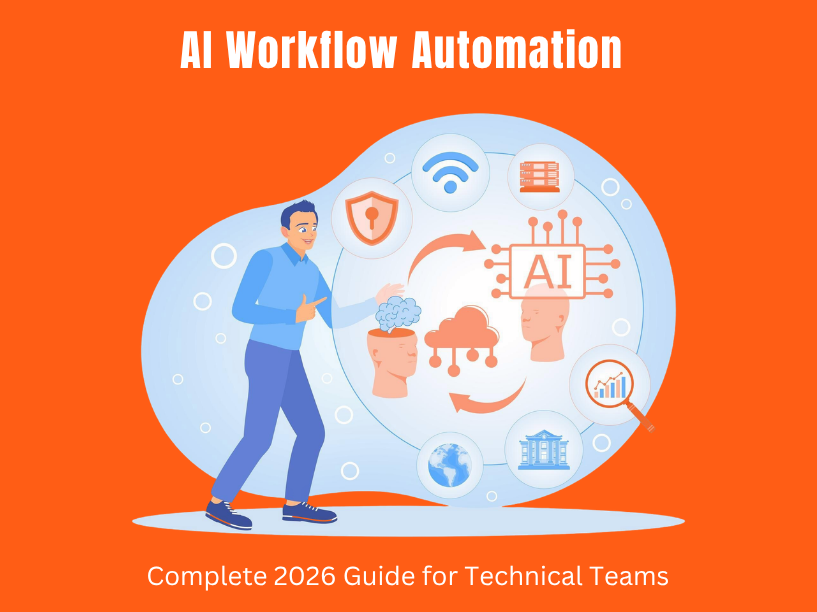
AI workflow automation is reshaping how engineering, product, and operations teams handle multi-step business processes. This guide breaks down what it is, how it works under the hood, which tools and architectures matter in 2026, and how to implement it without overpromising or underdelivering. Whether you run a startup or manage enterprise systems, the frameworks here will help you choose the right approach for your organization.
AI workflow automation is the orchestration of business processes where artificial intelligence models (not just fixed if/then rules) drive decisions and handle data that traditional automation tools cannot parse. It combines machine learning, natural language processing, generative ai, and ai agents to process unstructured inputs and take action across multiple systems.
Traditional rule-based automation works like this: a form is submitted, an email fires. Every path is predefined. AI workflow automation works like this: a PDF contract arrives via email; NLP extracts key clauses; a classifier scores the risk level; conditional logic assigns the contract to the right legal owner; the sales team gets a notification with a summary.
AI can triage support tickets based on sentiment, route them to the right team, and draft a reply, all before a human reviews the output. 88% of organizations consider AI key to successful automation, which explains why adoption has accelerated across every industry. AI workflow automation integrates artificial intelligence into standard business processes, turning fragmented manual tasks into governed, observable pipelines.
TVL IT Solutions designs and builds these ai workflows into real products and enterprise systems, acting as a custom AI and software engineering partner for teams that need more than off-the-shelf connectors.
For CTOs and engineering leads, ai workflow automation is an architecture pattern, not a single product. It chains together data ingestion, AI-driven understanding, decision or prediction, and automated action across applications.
A typical ai workflow follows this sequence:
This architecture can be implemented via a commercial ai workflow automation platform, custom microservices, or a hybrid of both. The orchestration layer ties everything together with conditions, retries, error handling, and human approval gates. AI workflows can automate complex tasks with minimal human input when the architecture is well designed.
Robotic process automation, iPaaS connectors, and BPM suites work well in one specific context: structured, predictable inputs with fixed outputs. Traditional automation follows rigid if-then rules. It excels at data entry into legacy forms, syncing records between two databases, or triggering notifications on schedule. Traditional automation excels at structured, repetitive tasks where the input format never changes.
AI automation handles unstructured inputs and adapts over time. It reads the content of an email, understands its intent, and routes it, rather than checking a subject-line keyword. AI can process data and make decisions dynamically based on the content itself.
Here is where each fits:
A study published on arXiv in September 2025 comparing RPA (UiPath) with agentic automation found that RPA outperformed on speed and reliability for stable repetitive tasks, while AI-based approaches required less development time and handled interface changes more flexibly.
TVL IT Solutions often implements a hybrid pattern: a deterministic skeleton of conditional logic with AI decision nodes injected at classification, extraction, and routing steps. This keeps complex workflows auditable while handling ambiguity.
AI agents are autonomous components that plan multi-step actions and decide which tools or APIs to call at runtime. Workflows follow predefined paths with fixed or conditional branches and human-in-the-loop checkpoints. The trend in AI workflows is toward increased agentic capabilities with human approval mechanisms.
Workflow example: An invoice arrives. OCR extracts fields. A classifier checks for anomalies. The invoice routes to an approver. Every step is predefined.
Agent example: A research assistant receives a question. It decides whether to search the web, query an internal knowledge base, or ask a human for clarification. The path is chosen dynamically.
TVL IT Solutions recommends deploying ai agents for exploration, research, and negotiation tasks where flexibility matters. For compliance, core financials, and regulated processes, guarded workflows with governance controls are safer. Guardrails matter: tool permissions, budget limits, and mandatory human review at critical decision points prevent agents from taking actions outside acceptable boundaries.
Every ai workflow automation platform, whether commercial or custom-built, shares the same core building blocks. The differences lie in how deeply each component is implemented and how much control your team retains.
Connectors and APIs. These link the workflow to source and sink systems: CRMs, ERPs, ticketing tools, email services, file stores, and internal microservices. Without broad connector coverage, the workflow cannot span the full business process.
Data layer. Warehouses, data lakes, and vector stores hold structured records, embeddings for semantic search, and intermediate results. A PostgreSQL database, for instance, stores workflow state while a vector index powers retrieval-augmented generation.
AI engines. Large language models, fine-tuned classifiers, NLP pipelines, and computer vision models perform the cognitive work. Teams choose between cloud-hosted provider models (OpenAI, Anthropic, Google) and locally hosted models where data residency or latency requires it. You can use your own api keys with most providers.
Orchestration and logic. The workflow engine manages conditional logic, loops, retries, parallel branches, and error handling. This is where workflow logic lives. TVL IT Solutions often builds this layer in Node.js or Python calling hosted LLMs and connecting to Salesforce, Jira, and data warehouses.
Monitoring, logging, and governance. Audit logs, dashboards, alerting, model versioning, and drift detection keep the system observable. Without this layer, debugging failures in multi step workflows becomes guesswork.
Some teams use commercial ai workflow automation platforms (Zapier, Make, Power Automate, n8n). Others ask TVL IT Solutions to build custom orchestrators when security, latency, or integration depth demands it.
AI powered workflow automation reduces manual work, compresses cycle times, and standardizes data quality across systems. AI workflow automation allows organizations to handle higher workloads without proportional headcount increases. AI workflow automation systems operate continuously, without breaks or downtime.
Faster processing. AI workflow automation enhances speed and throughput in business processes. A SaaS support team that previously triaged tickets manually in 15-20 minutes per batch can run NLP classification in seconds. AI can improve decision-making speed by reducing manual data handling.
Fewer errors. AI workflow automation minimizes human error in repetitive processing loops. Standardized extraction and validation reduce data discrepancies between CRM, ERP, and analytics systems. AI-driven systems can make real-time decisions based on data analysis rather than manual review.
Engineering team impact. Instead of maintaining ad hoc scripts for data transformation, engineers work with reusable workflow components, version-controlled prompt templates, and centralized monitoring. This frees capacity for strategic feature development.
Observability. Centralized logs, dashboards, and alerts replace the black box of scattered cron jobs and spreadsheets. Every workflow run is traceable.
Capacity reallocation. AI workflow automation provides scalability by handling workload spikes without increasing staffing. Teams redeploy people from repetitive tasks to higher-value product and engineering work.
AI workflow automation chains multiple systems and decisions into complete business processes, replacing the patchwork of disconnected scripts that individual engineers maintain.
Consider a lead-to-qualified-opportunity flow: a contact submits a form; AI enrichment pulls firmographic data; a machine learning model scores the lead; conditional logic routes high-score leads to sales teams with personalized context; follow-up sequences trigger based on engagement signals; the CRM updates automatically. AI can enrich leads with AI-generated company summaries at the enrichment step.
Contrast this with the alternative: an engineer wrote a Python script that pulls form submissions. Another script enriches data via an API. A third script updates Salesforce. Each script runs on a different schedule, fails silently, and has no centralized logging. When one breaks, the pipeline stalls until someone notices.
TVL IT Solutions designs modular automated workflows with reusable components so teams can update individual ai steps (swap a model, add a new data source, adjust routing rules) without rebuilding the entire chain.
Here is a step-by-step walkthrough of a canonical ai system: support ticket triage and response drafting.
Step 1: Event trigger. A customer submits a ticket via a helpdesk tool. A webhook fires, sending the ticket payload to the orchestration service.
Step 2: Preprocessing. The system detects the language, redacts PII (email addresses, phone numbers, account IDs), and normalizes the text. AI workflow automation can process customer replies, data entry, and report generation automatically at this stage.
Step 3: NLP classification. A trained classifier assigns the ticket a topic (billing, bug report, feature request), a sentiment score (frustrated, neutral, positive), and an urgency level. AI workflow automation can handle complex decision-making tasks through layered classification.
Step 4: Decision logic. Based on the classification, the workflow routes the ticket: billing issues go to the finance support tier; critical bugs escalate to engineering on-call; feature requests route to the product backlog. This is where conditional logic and complex logic determine the path.
Step 5: AI-generated reply draft. For common categories, a generative ai model drafts a response using retrieval-augmented generation against the knowledge base. The draft includes relevant documentation links.
Step 6: Human review. The draft enters a review queue. A support agent approves, edits, or rejects it. AI platforms enable real-time data processing and actions, but human oversight remains essential for complex tasks.
Step 7: Send and log. The approved response sends to the customer. The entire interaction, including model inputs, outputs, confidence scores, and agent edits, logs to the monitoring system.
Where do machine learning models come from? Some are pre-trained (like large language models); others are fine-tuned on company-specific data (ticket histories, product taxonomies). Retraining cadence depends on data drift: monthly for stable domains, weekly for fast-moving ones. Fallback strategies activate when the model API is down: the system reverts to deterministic keyword rules or queues tickets for manual triage.
Technical teams, with partners like TVL IT Solutions, choose between serverless functions for low-volume workflows, containerized microservices for scale, and platform-native automations for speed of deployment.
The ai workflow automation tools landscape in 2026 breaks into four categories:
No-code and low-code workflow builders. Zapier connects over 9,000 apps for no-code automation. Make supports advanced branching logic in workflows. These platforms serve non technical teams and quick departmental automations well but hit limits on governance, performance, and custom AI model integration.
Enterprise integration platforms. Power Automate, Workato, and MuleSoft with AI add-ons provide deeper connectors, RBAC, and compliance features. Enterprise teams with complex stacks and regulatory requirements typically start here.
AI-native orchestration tools. Agent platforms and RAG orchestration frameworks (LangGraph, CrewAI, AutoGen) serve developer-first teams building intelligent automation that requires dynamic tool usage and autonomy. These are among the automation tools in 2026 gaining traction with technical teams.
Developer-first frameworks. n8n offers a free self-hosted option for automation, giving technical teams full control over data and execution. Custom orchestration built by partners like TVL IT Solutions fits here when off-the-shelf ai workflow tools lack the latency, security, or integration depth required.
Most organizations combine two or three categories. A marketing team runs Zapier for social media posting while the engineering team runs custom microservices for core data pipelines. TVL IT Solutions often acts as the orchestration layer that connects these workflow automation tools into a coherent system, particularly when legacy systems need integration.
Modern ai workflow automation systems embed several distinct AI capabilities. Each serves a different function inside the pipeline.
Natural language processing. NLP powers email routing, chatbot understanding, sentiment analysis, and knowledge base search. AI workflows are capable of understanding natural language and interpreting unstructured information, which is what separates them from keyword-matching rules.
Classification and entity extraction. Machine learning models categorize inputs (ticket type, document category, lead quality) and pull structured fields from unstructured text (names, dates, amounts, clause types). Modern AI workflow tools can summarize, classify, and extract information from inputs in a single pass.
Anomaly detection and forecasting. ML models flag unusual patterns in transactions, operational metrics, or user behavior. AI workflows can automatically flag anomalies in data processing, catching issues that rule-based thresholds miss. Forecasting models predict churn risk, demand spikes, and resource needs.
Intelligent document processing. OCR combined with NLP handles invoices, contracts, medical records, and HR documents. A document processing pipeline reads a scanned invoice, extracts line items, validates totals, and routes for approval.
Generative AI. Large language models draft customer responses, write code suggestions, summarize meetings, and create marketing content. Human review is mandatory where risk is high (legal correspondence, medical communications, financial advice). AI can automate social media posts using generated content for lower-risk scenarios.
Computer vision. Image classification, object detection, and visual inspection support manufacturing QA, retail inventory, and security monitoring workflows.
AI workflows evolve over time. Unlike static automations, they learn from user corrections, A/B test results, and metric tracking.
A ticket classifier trained on last year’s product taxonomy needs retraining after a new product launches. Prompt templates used for reply drafting get revised after hallucination reviews flag inaccurate responses. Conversion rates from AI-scored leads inform model recalibration for sales teams.
TVL IT Solutions typically sets up evaluation environments (dev, staging, production) with golden test sets. Before a new model version or prompt template reaches production, it runs against these test sets. If precision or recall drops below thresholds, the deployment blocks automatically.
Monitoring completes the loop: drift detection alerts when model accuracy degrades; latency dashboards catch performance regressions; cost-per-invocation tracking ensures token spend stays within budget. Safe rollback mechanisms revert to the previous version if a deployment causes issues. This continuous improvement cycle is what separates intelligent workflows from static scripts.
AI workflow automation produces strategic outcomes that go beyond shaving minutes off routine tasks.
Customer experience. When support tickets resolve faster and responses are contextually accurate, satisfaction scores improve. AI workflow automation increases business efficiency by reducing turnaround times that customers feel directly. Klarna processed 2.3 million customer conversations in its first month using AI agents, reducing average resolution time from roughly 11 minutes to 2 minutes.
Faster experimentation. AI workflows allow companies to respond to market changes quickly. Dynamic pricing adjustments, demand surge responses, and new product launch sequences can be prototyped and deployed in days rather than months.
Data quality. AI automation improves data accuracy by standardizing information processing across CRM, ERP, and analytics platforms. Fewer discrepancies between systems mean more reliable reporting and fewer manual reconciliation cycles.
Operational resilience. AI workflow automation drastically lowers operational overhead by automating repetitive tasks that previously required dedicated headcount. AI-driven decision making allows for real-time data analysis and action, keeping operations responsive around the clock.
Competitive advantage. Organizations that operationalize ai workflows between 2024 and 2026 build institutional capabilities (trained models, refined prompts, proven architectures) that late adopters cannot quickly replicate. AI automation enables scalability by handling increased workloads efficiently as the business grows.
AI workflow automation captures data-driven insights at every workflow stage, giving CEOs visibility into margins, CTOs data on technical debt reduction, and ops leaders real-time throughput metrics.
Popular use cases for AI workflow automation include customer support and sales lead qualification, but adoption spans every major function.
Customer support. AI triages incoming tickets by sentiment and urgency, suggests replies from the knowledge base, and escalates edge cases to human agents. AI can triage support tickets based on sentiment, reducing average first-response time from hours to minutes.
Sales and marketing. AI enriches inbound leads with firmographic data and engagement scoring. AI can enrich leads with AI-generated company summaries, giving SDRs context before outreach. AI can automatically create tasks based on social media sentiment analysis to capture emerging opportunities.
Finance. Invoice extraction pipelines pull line items from scanned PDFs, match them against purchase orders, and route discrepancies for approval. AI can flag invoices that deviate from historical patterns, catching duplicate payments or unusual amounts. One financial services case study showed KYC onboarding cost reductions exceeding 80% per client through AI-driven document processing.
IT and DevOps. SOC alert triage workflows classify security signals, correlate events, and escalate confirmed threats. AI can automate social media posts using generated content for internal communications and incident updates.
Operations and supply chain. Demand forecasting models feed automated reorder workflows. Anomaly detection flags supply chain disruptions before they cascade. Integration with legacy ERP systems is where TVL IT Solutions’ custom development work is often needed.
Product and engineering. AI-assisted code review, automated test generation, and bug triage using NLP over issue trackers reduce manual tasks for engineering teams.
SaaS company, bug triage automation. A mid-market SaaS company with 200+ daily Jira tickets deployed NLP classification to auto-tag tickets by component, severity, and affected product area. Average triage time dropped from 20+ minutes per batch to under 3 minutes. The workflow logs every classification decision for audit purposes. TVL IT Solutions architected the pipeline, integrated the classification model with Jira’s API, and set up monitoring dashboards.
Regional logistics firm, delivery re-routing. A logistics provider serving three countries integrated ML delay predictions into their dispatch system. When a delay probability exceeds a configurable threshold, the workflow automatically re-routes deliveries, notifies customers via SMS, and updates the tracking portal. Manual schedule adjustments dropped by over 60%. The firm’s learning curve was managed through structured onboarding sessions TVL IT Solutions provided to the operations team.
Financial services SME, invoice processing. A mid-sized financial services company replaced manual PDF invoice handling (data entry, matching, approval routing) with an AI extraction workflow integrated into their ERP. The system reads invoices, extracts structured fields, validates against historical records, and routes exceptions to a human reviewer. Processing time fell from multiple days to same-day completion.
Picking the right pilot workflow determines whether your first AI automation project builds momentum or stalls. Here is a practical selection framework.
Volume and frequency. Target processes that execute dozens or hundreds of times per day. High-volume workflows deliver measurable ROI faster than low-frequency ones.
Manual effort concentration. Look for “swivel chair” work: people copying data between systems, classifying inputs by reading them, or chasing approvals via email. Manual data entry across multiple platforms is a strong signal.
Clear success metrics. If you cannot define before/after measurements (cycle time, error rate, throughput), the project cannot prove its value. Pick workflows where metrics already exist or are easy to capture.
Manageable risk. Start with well-bounded processes like support triage, invoice processing, or lead scoring, not mission-critical open-ended decisions like loan underwriting. Automate routine tasks first.
Data availability. The workflow needs accessible, sufficiently clean data. If the required data lives in disconnected spreadsheets with no API access, integration work comes before automation.
TVL IT Solutions typically runs discovery workshops with stakeholders to map candidate workflows, catalog data sources, identify integration points, and rank candidates by effort-to-impact ratio. Starting with manageable pilots, then scaling, is how teams build confidence and institutional knowledge around implementing ai in custom software.
When evaluating ai workflow automation platforms in 2026, use a structured rubric across six dimensions.
AI depth. Does the platform natively support LLM integration, embeddings, retrieval-augmented generation, classification, and generative blocks? Or does it require external workarounds? Look for ai functionality that goes beyond simple API calls.
Integration breadth. How many connectors and APIs does the platform offer? Can it reach your CRM, ERP, ticketing system, internal services, and legacy systems via webhooks or custom connectors? Workflow automation systems need to span your full stack, not just SaaS apps.
Governance and security. Does it support role based access control, audit logs, prompt and model logging, PII masking, and data residency options? Governance is non-negotiable for enterprise teams handling sensitive data.
Performance and latency. What are the platform’s throughput limits? Can it handle your peak volume without degradation? AI workflow automation tools that work well at 50 requests per hour may fail at 5,000.
Extensibility. Can you bring your own models, use your own api keys, write custom code, and extend the platform’s behavior? Paid plans from commercial platforms often gate critical ai features behind higher tiers.
User experience. Does the platform serve both technical teams (who want code control) and non technical teams (who need visual builders)? The learning curve affects adoption speed.
Run short proof-of-concept pilots with one or two candidate automation tools rather than choosing from marketing pages alone. TVL IT Solutions is tool-agnostic: they help clients evaluate, integrate, or build on top of existing platforms rather than locking into a single vendor.
When demoing ai workflow automation platforms, ask these pointed questions:
TVL IT Solutions can help clients interpret vendor responses and stress-test claims with realistic workloads before committing.
Architectural choices shape the cost, reliability, and compliance posture of ai powered workflow automation.
Cloud-native orchestrator. The workflow engine runs in a cloud environment (AWS, Azure, GCP), calling SaaS APIs and AI endpoints over HTTPS. This pattern suits teams without on-prem constraints who want fast deployment and elastic scaling. Event-driven triggers via webhooks or message queues (Kafka, SQS, Pub/Sub) start workflows in near-real-time.
Hybrid: on-prem data, cloud AI. Regulated organizations keep sensitive data in on-prem databases but call cloud-hosted AI models for inference. Data leaves the perimeter only in anonymized or tokenized form. This pattern balances compliance with access to state-of-the-art models. A case study from mTouch Labs (June 2026) described a custom platform built with Temporal, Next.js, PostgreSQL, and Kafka that reduced manual handoffs and improved transparency using exactly this hybrid approach.
Fully on-prem or private cloud. Finance, healthcare, and government organizations run everything inside their own infrastructure. Locally hosted models (open-source LLMs, custom ML) replace cloud AI providers. Latency improves, but model capability and maintenance costs increase.
Batch vs event-driven. Event-driven patterns (webhooks, queues) suit real-time needs: support tickets, fraud alerts, live data processing. Batch jobs suit overnight data transformation, report generation, and large-scale document processing where latency tolerance is higher.
TVL IT Solutions works with client architecture teams to design or adapt these patterns. The choice depends on data residency requirements, latency targets, existing systems, and compliance obligations. Building this layer well from the start avoids costly re-architecture later, which is why backend engineering expertise matters.
Governance for ai workflows is more complex than for traditional automation. The outputs are probabilistic, not deterministic. Training data can contain bias. Models drift over time. Regulatory scrutiny is increasing.
Identity and access management. Role based access control restricts who can create, edit, execute, or view workflows and their outputs. Encryption protects data in transit and at rest. Secret management vaults store API keys and credentials.
AI-specific controls. Prompt logging with PII redaction captures what the model received and produced without exposing sensitive data. Model whitelisting restricts which models a workflow can call. Content filtering and toxicity detection prevent harmful outputs from reaching end users. AI workflow automation adapts to context and can intelligently manage exceptions, but guardrails ensure it does so within acceptable boundaries.
Approval workflows. High-risk decisions (payments, legal correspondence, HR actions, compliance reports) pass through human approval gates before execution. These are configurable per workflow step and per risk tier.
Versioning. Prompt templates, model versions, and workflow definitions are version-controlled. Changes deploy through staging environments before reaching production. Audit logs capture every modification.
Standards and regulations. Enterprises align with SOC 2, ISO 27001, GDPR, CCPA, and industry-specific regulations. Data lineage documentation tracks where training data originated and how it flows through the system.
TVL IT Solutions applies security-first development principles when building ai workflows: threat modeling during design, secure coding practices, regular security audits, and governance patterns embedded from the first sprint.
The human-in-the-loop pattern inserts mandatory human review before high-risk actions execute. A payment above a threshold, a legal communication to a customer, or an HR decision requires a human to approve, edit, or reject the AI’s output before the workflow proceeds.
Confidence thresholds make this configurable. When a model’s confidence score exceeds a defined threshold (e.g., 0.95), the action executes automatically. Below that threshold, the item routes to a human review queue. This balances speed with reliability.
Fallback strategies activate when models underperform or go offline. The workflow can revert to deterministic rules, escalate to a human operator, or park items in an exception queue for batch review. These mechanisms prevent a single AI failure from stopping the entire business process.
TVL IT Solutions designs layered safety mechanisms that combine confidence routing, exception queues, and deterministic fallbacks. The goal is operational continuity, not blind trust in model outputs. Human error decreases when humans review only the cases that need judgment, rather than processing every item manually.
Low-code and no-code builders are good for fast prototyping and simple flows. A marketing team can connect a form submission to an AI summarizer to a Slack notification in minutes. For complex workflows with performance requirements, deep integration needs, or complex logic, custom-built orchestration services give technical teams full control.
When to start low-code: You need to validate a hypothesis quickly. The workflow spans standard SaaS apps. The data is not sensitive. The team is small.
When to migrate to custom code: The workflow handles regulated data. Latency must stay below strict thresholds. You need custom machine learning models. The workflow spans legacy systems that lack API connectors. Version control, CI/CD, and automated testing are required.
Many mature organizations use a layered approach: business-owned automations run in low-code workflow automation tools for departmental needs (marketing sequences, HR notifications), while mission-critical automations run in code with shared libraries, proper testing frameworks, and environment separation.
Maintainability is the deciding factor. Low-code platforms abstract complexity but make debugging harder when things break. Custom code adds overhead but gives visibility into every decision the ai system makes.
TVL IT Solutions helps teams navigate this choice. For startups exploring affordable trending technologies, a low-code prototype validates the idea before committing to custom development. For enterprises with existing stacks, custom orchestration integrates with their architecture without vendor lock-in.
Implementing ai workflow automation follows a structured path. Skipping phases creates technical debt that compounds as the system scales.
Phase 1: Discovery and workflow mapping. Stakeholders from product, engineering, operations, and compliance map candidate workflows. Activities include documenting current steps, identifying pain points, cataloging data sources, and ranking workflows by impact and feasibility. Deliverable: a prioritized workflow catalog with integration maps.
Phase 2: Data and integration readiness assessment. Engineering evaluates data quality, API availability, model hosting requirements, and security constraints. Gaps in data access or system connectivity surface here, before development starts. Deliverable: a readiness report with blockers and remediation steps.
Phase 3: Pilot design and prototyping. The team builds a working prototype of the highest-priority workflow. This includes selecting or training ai models, designing workflow logic, and wiring connectors. For SaaS platforms, this phase often produces a functional end-to-end demo. Deliverable: a working prototype with initial performance metrics.
Phase 4: Production hardening. Testing, observability, and governance get built in. This includes load testing, failure scenario testing, monitoring dashboards, alerting rules, RBAC configuration, and audit logging. Deliverable: a production-ready system with runbooks and rollback procedures.
Phase 5: Rollout and change management. The workflow deploys to production users. Training sessions, documentation, and feedback channels prepare the organization. Gradual rollout (starting with a subset of users or cases) reduces risk.
Phase 6: Continuous improvement and expansion. Teams monitor performance, collect user feedback, retrain models, and iterate on prompt templates. Successful patterns become templates for the next workflow. Deliverable: quarterly performance reviews and expansion plans.
TVL IT Solutions structures engagements along similar phases, adapting scope and duration to the client’s size and readiness. Starting with manageable pilots rather than big-bang replacements reduces risk for startups, SMEs, and enterprises alike.
The hardest part of ai workflow automation is often not the technology; it is the people.
Resistance. Teams worry about job displacement. Transparent communication about how automation changes roles (from repetitive tasks to oversight and improvement) reduces anxiety. Demos showing real time savings build credibility faster than slide decks.
Trust. End users who do not trust AI outputs will bypass the workflow. Involving them early in design, letting them correct outputs, and showing accuracy metrics over time builds trust incrementally.
Documentation. Workflow diagrams, runbooks, FAQs, and internal how-to guides ensure knowledge does not live in one engineer’s head. TVL IT Solutions often supports clients with enablement sessions, pairing with technical teams to hand over knowledge and build internal ownership of the ai automation system.
Clear roles. Define who owns each workflow, who approves changes, and who monitors performance. Ambiguity in ownership causes drift and neglect.
Without baseline measurements, claims of improvement are subjective. Define and capture metrics before and after implementation.
Process metrics. Cycle time (end-to-end duration), throughput (items processed per hour), error rate (percentage requiring rework), and SLA adherence. AI workflow automation improves efficiency by reducing manual errors and accelerating processes. These metrics prove it.
AI-specific metrics. Model accuracy, precision, recall, false positive and negative rates, and inference latency. For generative outputs, hallucination rate and user acceptance rate (percentage of drafts approved without edits) matter. Cost per run (measured in compute units, not currency) tracks efficiency.
Business metrics. Customer satisfaction scores, conversion rates (for sales workflows), resolution times (for support), and rework rates. AI workflow automation increases business efficiency by reducing turnaround times across these functions.
Monitoring dashboards. BI tools or monitoring platforms display workflow health: number of runs, failure rates, exception queue depth, and agent actions per period. AI workflow automation captures data-driven insights at every workflow stage, feeding these dashboards automatically.
TVL IT Solutions builds observability into the architecture from the first phase. Dashboards are not an afterthought; they are part of the production-hardening deliverable, giving teams the data to continuously optimize their ai services.
Startups and enterprises face different constraints when adopting best ai workflow automation practices.
Startups move fast. They have lean teams, fewer legacy systems, and a willingness to experiment. They often start with SaaS workflow automation tools to validate hypotheses before investing in custom infrastructure. A three-person ops team can automate lead scoring and support triage using a low-code platform within a week. The risk is outgrowing the tool before building a proper replacement.
Enterprises move carefully. They manage complex stacks, regulatory requirements, change management overhead, and multiple stakeholders. They typically need on-prem or hybrid setups, governance-heavy ai workflow automation platforms, and formal approval processes for every workflow change. A regulated financial institution automating KYC document review needs audit logs, model explainability, role based access control, and compliance certification before the workflow touches production data.
Same workflow, different implementation. Sales lead processing in a startup might use Zapier to pull form submissions, call an AI enrichment API, and push results to a Google Sheet. The same workflow in a regulated enterprise runs on custom microservices with encrypted data pipelines, model versioning, approval gates, and integration with an existing CRM platform.
TVL IT Solutions adapts engagement models for both scenarios: dedicated teams for long-term enterprise projects, time-and-material for startups iterating quickly, and fixed-scope projects for well-defined automation builds.
TVL IT Solutions is an India-based custom software development company with deep experience in AI/ML, web and mobile engineering, and enterprise platforms (Microsoft Dynamics, Salesforce). The company builds ai workflow automation into real products and enterprise systems, not just proof-of-concept demos.
Architecture and data flow design. TVL IT Solutions maps data sources, decision points, and integration requirements before writing code. This prevents the common failure mode of building automation that does not connect to the systems that matter.
Custom AI services and integrations. When off-the-shelf ai tools lack the latency, accuracy, or compliance features a client needs, TVL IT Solutions builds custom machine learning models, NLP pipelines, and AI-powered modules tailored to the domain.
CRM and ERP extension. Many workflows require extending Salesforce, Dynamics 365, or custom ERPs with ai powered workflows for lead scoring, document processing, or anomaly detection. TVL IT Solutions has delivered these integrations across industries.
Dedicated development teams. For long-term evolution of intelligent automation, TVL IT Solutions provides dedicated teams that maintain, extend, and optimize workflows as ai technologies and business requirements change.
Security-first and scalable architecture practices, including code reviews, performance testing, and governance controls, are embedded from day one. Flexible engagement models (dedicated team, fixed-scope, time and material, hybrid) align with different organizational needs.
Scenario 1: Extension of an in-house team. A SaaS company with a 15-person engineering team needs to add AI features (ticket classification, automated summaries) to their product. TVL IT Solutions embeds 3-4 engineers who build the AI pipeline, integrate it with the existing codebase, and transfer knowledge over 6 months.
Scenario 2: Cross-functional workflow design. A manufacturing company’s operations team and internal IT want to automate quality inspection reporting. TVL IT Solutions leads technical discovery, designs the workflow architecture, builds the computer vision and reporting pipeline, and trains the ops team to manage it.
Scenario 3: Offshore engineering backbone. A digital agency wins a contract requiring ai automation but lacks in-house ML expertise. TVL IT Solutions acts as the engineering backbone, building and maintaining the AI components while the agency manages the client relationship.
Responsibility boundaries are clear: the client owns strategy and domain expertise; TVL IT Solutions owns implementation, technical discovery, and knowledge transfer. Long-term partnerships are common, with TVL teams helping maintain and extend ai workflows as the underlying ai technologies evolve.
Here is how to move from reading to doing within the next quarter.
Step 1: Pick one high-impact workflow candidate. Choose a process with high volume, heavy manual effort, and clear metrics. Support triage, invoice processing, and lead scoring are proven starting points.
Step 2: Map its current steps and systems. Document every handoff, decision point, data source, and system involved. Identify where manual tasks consume the most time and where errors occur.
Step 3: Identify where AI adds value. Pinpoint steps that require classification, prediction, generation, or processing of unstructured data. These are your AI insertion points.
Step 4: Choose your approach. Decide whether to pilot on an existing workflow automation platform or via a small custom build. Factor in data sensitivity, integration complexity, and team skills.
Step 5: Define success metrics and monitoring from day one. Set baseline measurements. Build dashboards. Automate repetitive tasks in measurement itself so you do not rely on manual tracking.
Involve technical, operations, and compliance teams early to avoid rework. Organizations lacking in-house bandwidth or AI expertise can explore a conversation with a specialist partner like TVL IT Solutions to accelerate the path from pilot to production.
Near-term trends point toward deeper integration of ai agents into orchestrated workflows, more domain-specific machine learning models (finance-tuned, healthcare-tuned) that reduce hallucination, stronger governance tooling, and increased hybrid and on-prem adoption in regulated industries.
The organizations that win will be those that turn AI from isolated experiments into governed, observable workflows embedded in daily operations. Process mining powered by AI will identify bottlenecks automatically. Cost optimization through model routing, prompt economy, and caching will become standard practice. Vertical workflow playbooks tuned for specific industries will accelerate adoption.
Continuous improvement, not one-off projects, separates teams that extract lasting value from ai workflow automation. Workflows should evolve with data, business strategy, and regulations. 88% of organizations view AI as key to successful automation; the gap is between viewing and doing.
TVL IT Solutions partners with companies that want to build secure, scalable, ai powered workflow automation into their products and processes. If your team is ready to move from experimentation to production-grade intelligent automation, reach out to start a conversation.
AI workflow automation uses artificial intelligence to understand data, make decisions, and automate actions across multiple business systems and processes.
Traditional automation relies mainly on predefined rules, while AI workflow automation can interpret unstructured data, make dynamic decisions, and handle scenarios that fall outside fixed rules.
Key benefits include faster processing, fewer errors, improved observability, greater scalability, better data quality, and reduced manual work across business processes.
Common use cases include customer support ticket triage, sales lead qualification, invoice processing, HR workflows, IT and DevOps automation, supply chain operations, and product engineering.
Businesses can start by identifying a high-impact workflow, mapping its systems and processes, identifying AI opportunities, selecting a low-code or custom approach, and defining measurable success metrics.
At TVL IT Solutions, we specialize in delivering scalable, secure, and custom software development services tailored to your unique business needs. Whether you’re a startup or an enterprise, our team is ready to turn your vision into reality.
Get Started Now