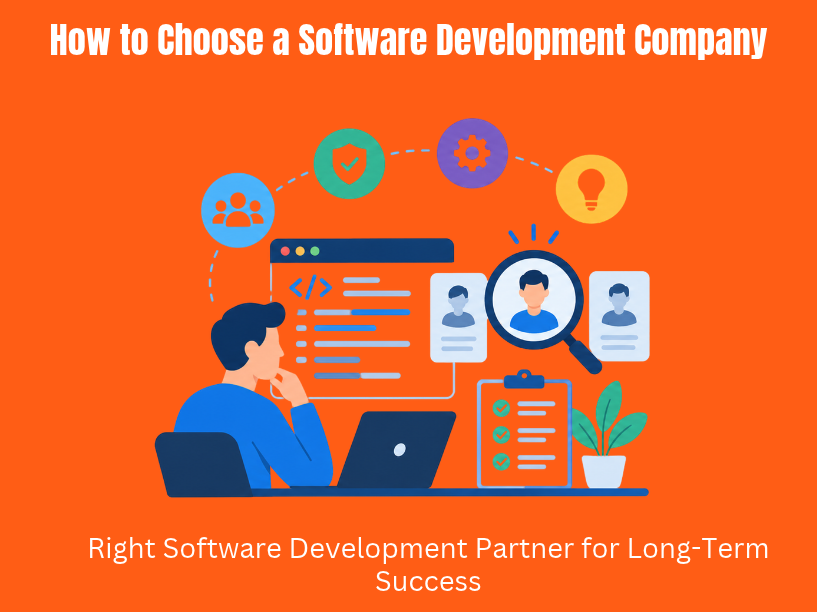

Choosing a software development company in 2026 directly influences your time-to-market, product quality, security posture, and ability to sustain long-term digital transformation. Whether you are a founder building your first product, a product leader scaling an existing platform, or a CIO modernizing internal systems, the stakes are real.
A wrong choice leads to missed deadlines, over-budget projects, weak security, unclear intellectual property ownership, and poor communication that compounds over time. Studies show that nearly 40% of offshored projects fail to achieve their intended benefits, largely due to mismanaged requirements and communication gaps. Poor communication during selection almost always indicates future delays.
This article provides a practical, step-by-step framework to help you choose a software development partner with confidence. It covers everything from defining business goals and evaluating technical expertise to running a pilot project and planning post launch support. You will find real-world examples, checklists, and data-backed guidance rather than a superficial vendor list.
TVL IT Solutions is an India-based custom software development company that has served as a long-term offshore development partner for startups and enterprises globally. We will reference their approach as one concrete example throughout this guide.
The selection process must start from your business goals and success metrics, not from technology stack preferences or vendor catalogs. If you cannot articulate what success looks like, you cannot evaluate whether a development company can deliver it.
Define clear, measurable business objectives. For example, “reduce manual processing time by 40%,” “support 500,000 monthly active users within 12 months,” or “achieve 99.9% uptime across three geographic regions.” These outcomes shape which software development partner you need.
Consider how project goals differ. A logistics startup building a route-optimization SaaS needs strong backend algorithms, real-time data throughput, and possibly AI/ML. A retail company digitizing in-store operations needs offline resilience, inventory integration with existing software like Salesforce or Microsoft Dynamics 365, and polished UX. Goals determine whether you prioritize performance, scalability, domain experience, or regulatory understanding.
Before contacting any development company, use this mini-checklist internally:
Clarity here makes later vendor comparisons objective and simplifies evaluation of project requirements, technical expertise, and delivery approach.
Constraints often decide which software development partner model is realistic. Your timeline, budget boundaries, and risk tolerance shape the engagement before a single line of code is written.
Common project timeframes vary significantly. An MVP with core features typically takes three to six months. Complex, multi-module enterprise platforms or AI-heavy systems may require nine to fifteen months or more. Tighter timelines demand larger, more senior development teams, stricter project management, and a partner with a track record in similar delivery windows. Establish milestones linked to payments to ensure project progress stays visible and accountable.
Your risk profile matters too. Conservative organizations prefer detailed up-front scope, well-defined project scope, and lower uncertainty. Fixed price works best for well-defined project scopes where requirements are stable. Experimental teams comfortable iterating toward product-market fit benefit from flexible models where time and materials pricing offers flexibility for changing project scopes.
Honest alignment between expectations and constraints prevents future conflict, scope creep, and budget blowouts. If your project requires rapid iteration, say so. If regulatory compliance is non-negotiable, flag it now. These constraints directly inform later decisions about location model, contract type, and team composition.
The global software development outsourcing market is projected to grow from roughly $555 billion in 2024 to nearly $898 billion by 2031. In a saturated market with tens of thousands of providers, a systematic approach to shortlisting is essential.
Start with reliable discovery channels. B2B review platforms like Clutch and GoodFirms let you filter by industry focus, project size, location, and technology stack. Pay attention to narrative reviews rather than just star ratings-clients describing a vendor’s ability to handle requirement changes or manage communication breakdowns are far more informative.
LinkedIn, founder communities, SaaS groups, and local startup hubs are valuable for referrals. Tech conferences from recent years also surface credible vendors. Internal referrals from trusted peers can shortcut the search but should still be validated with the same rigor as unknown vendors.
Include at least one offshore partner in your evaluation. For example, an India-based custom software development company like TVL IT Solutions lets you compare capability, communication practices, and talent depth against onshore options.
Aim for a shortlist of four to seven vendors. Immediately rule out firms with no portfolio, vague service descriptions, no named technology stack, or no visible legal entity. These are signs you will encounter trouble later.
Technical expertise is crucial when selecting a software development company, and it must be proven with concrete evidence-not marketing language or buzzwords. Companies should demonstrate expertise in required technologies relevant to your project.
Assess stack alignment first. If your project needs React, Angular, Node.js, .NET, Java, or Python on the web side, verify it. For mobile, check experience with Swift, Kotlin, Flutter, or React Native. For AI and ML solutions, look for TensorFlow, PyTorch, or MLops pipeline experience. For enterprise, confirm hands-on work with Salesforce or Microsoft Dynamics 365.
Evaluating technical expertise involves reviewing past projects and technology stacks for similar complexity. Look for projects similar to yours in industry (fintech, healthcare, e-commerce, education, gaming) and scale (user volume, data size). A 2024 telemedicine app with HIPAA compliance or a 2023 on-demand delivery platform handling tens of thousands of daily orders tells you far more than a generic portfolio page.
Request technical proposals to assess vendors’ approaches. Ask for anonymized architecture diagrams, sample test plans, or continuous integration workflows from previous clients’ projects. Engage in technical discussions to gauge vendors’ expertise-good developers will ask smart questions, not just nod along. Look for certifications that prove technical capabilities, such as AWS, Azure, or GCP certifications.
The seniority mix matters. A software development team with architects, backend developers, frontend engineers, mobile developers, QA leads, DevOps specialists, and UX/UI designers is fundamentally different from a group of junior coders. TVL IT Solutions, for example, covers web, mobile, game development, and AI/ML, and can share detailed technical assets under NDA to demonstrate capability.
A solid track record indicates successful projects and is often the best predictor of future performance. Evaluate vendors’ past projects for domain-specific experience before making commitments.
Look for case studies relevant to your industry. Effective case studies spell out the business problem, solution approach, technology stack, delivery timeline, measurable outcomes (uptime improvement, process automation, user growth), and what happened after launch. Evaluating past portfolios helps to determine relevant industry experience and whether a company can handle your project’s complexity.
Request at least two to three client references from projects delivered between 2020 and 2025 in similar domains. Client references validate a company’s track record-but only if you actually speak with those past clients. Evaluate the complexity of previous projects to gauge capability.
Sample questions for reference calls:
Companies should demonstrate experience with similar project types. One anonymized example: a mid-market company hired the lowest-bidding vendor for an e-commerce platform. The project stretched from six months to over two and a half years, incurred significant budget losses, and eventually required a recovery partner. The lesson is consistent: evaluate previous clients’ actual experience, not just polished testimonials on a website.
Platforms like Clutch, GoodFirms, and G2 can validate consistency between published testimonials and independent feedback, but should never replace direct conversations.
Poor communication sinks more software projects than technology itself. Communication practices can significantly influence project success, especially in distributed or offshore arrangements. Misalignment in communication style causes project delays that compound over time.
During early calls, observe how vendors frame questions. Do they ask clarifying questions about your business problems? Do they challenge assumptions rather than saying “yes” to everything? Effective communication is crucial for timely project delivery, and vendors who push back on unrealistic deadlines are often more trustworthy than those who agree to everything without hesitation.
Open communication in practice means frequent project updates, shared collaboration tools (Jira, Azure DevOps, Trello, Slack, Teams), clear decision logs, and honest escalation of risks. Open communication improves project outcomes and reduces misunderstandings significantly. Transparent communication during the evaluation phase is a strong signal of how the partnership will function under pressure.
Cultural fit enhances collaboration and trust between teams. Assess work ethic, holidays, feedback style, language proficiency, and whether the team appears genuinely curious about your business context. Companies with similar cultures experience smoother collaborations-shortlisted candidates should be assessed for cultural fit through interviews, not just technical demos. Watch for language barriers that could slow decision-making.
Time zone differences require deliberate strategy. When working with an offshore partner in India, plan overlapping hours for key ceremonies: daily standups, sprint reviews, retrospectives. Real time communication during three to five shared hours daily keeps momentum alive. TVL IT Solutions, as an offshore strategic software development partnership partner, typically organizes overlapping windows with clients in North America and Europe to maintain effective communication and avoid poor communication pitfalls.
Mature, repeatable processes reduce delivery risk and help keep custom software development projects aligned with evolving business goals. Before signing anything, understand how your potential partner runs the development process day to day.
Adaptive frameworks like Agile enhance response to evolving requirements. Modern Agile and hybrid methodologies-Scrum, Kanban, or scaled agile-support iterative delivery, frequent demos, and continuous feedback loops. In practice, agile methodology means a typical sprint (one to four weeks) includes planning, daily standups, reviews, and retrospectives. Clients should participate in planning and reviews to provide direct feedback and steer project implementation.
A robust quality assurance process includes test strategy, unit testing, integration testing, UI/UX testing, performance testing, automated regression suites, and use of CI/CD pipelines for frequent, reliable releases. Research shows that bug-fix time rises exponentially the later defects are discovered in the software development process-catching issues early through continuous integration saves significant effort. Proposals should be compared against consistent evaluation criteria to aid decision-making.
Ask pointed questions: How has the company handled bugs discovered just before launch? How did project managers manage a pivot in requirements mid-project? The answers reveal whether the team has professional skills or just follows a checklist.
TVL IT Solutions emphasizes security-first development within CI/CD and uses automated deployments and testing to support fast yet stable releases for web, mobile, and enterprise software.
The choice between onshore, nearshore, and offshore software development models affects communication, talent access, and how your budget stretches. Each has clear trade-offs.
Onshore partners offer the closest cultural and time zone fit, making in-person workshops easy. They are often preferred for highly regulated or sensitive environments. The trade-off is a smaller talent pool and higher resource demands.
Nearshore partners provide overlapping time zones with moderate advantages, making them a strong fit for European and North American companies wanting frequent real time communication without the full onshore commitment.
Offshore partners like India-based development companies such as TVL IT Solutions offer access to large, specialized talent pools and strong efficiency. They enable 24-hour development cycles when managed well. The trade-off is the need for deliberate communication planning to bridge time zone differences and potential language barriers.
How to match model to project type: complex, long-term platforms often benefit from a blended model-onshore product management plus offshore dedicated teams handling execution. Time sensitive projects with well-defined scope may favor close time zone proximity for rapid iteration. Projects with ambiguous scope and heavy discovery benefit from nearshore or hybrid arrangements where real-time collaboration happens daily.
Academic research confirms that nearshore engagements reduce project management effort and communication friction significantly in communication-intensive projects.
Engagement models directly influence flexibility, risk distribution, and how closely the development team behaves like an internal team. Choosing the right company means choosing the right contract structure for your stage.
Fixed price contracts work best for well-defined project scopes where requirements are stable. They offer predictability but resist changes and typically include buffers. More change-control overhead means higher risk of misalignment if requirements evolve.
Time and materials pricing offers flexibility for changing project scopes. It suits evolving products and discovery-heavy custom software development where scope adapts as learning emerges. Strong governance and transparent time tracking are essential to manage risk.
The dedicated team model provides a long-term, integrated software development team-developers, QA, project managers, designers-working as an extension of your product organization. This is ideal for startups and SaaS companies scaling over multiple years. Value-based pricing focuses on the project’s expected value to the client, aligning incentives between both parties. Retainer models involve monthly or yearly fees for ongoing support and are common for post-launch relationships.
Hybrid models mix fixed-price phases (discovery, MVP) with T&M or dedicated teams for ongoing evolution. TVL IT Solutions offers all these software development business models-dedicated teams, fixed price, time and material, hybrid-so clients can match the model to their project stage and risk appetite.
Security compliance is essential to protect user data and intellectual property. These conversations must happen before a line of code is written, not retrofitted at the end.
Expect a secure development lifecycle: code reviews, encryption of data in transit and at rest, secure secrets management, and regular vulnerability assessments. Your ideal development partner should demonstrate experience with relevant regulations. If you operate in the EU (GDPR), US healthcare (HIPAA), or handle payments (PCI-DSS), ask specifically about past projects where compliance shaped the custom software development process. Involve your legal or compliance teams early.
Clear agreement on intellectual property ownership is vital before signing contracts. Detail who owns the source code, documentation, design assets, and build pipelines. Clarify what rights the vendor retains, if any, and how this affects your future independence. Data migration between vendors becomes far harder when IP terms are ambiguous.
Ask whether subcontractors are used and how NDAs, access control, and audit trails are enforced across the full delivery chain. A reputable software development partner like TVL IT Solutions typically signs NDAs, clarifies IP transfer terms in the contract, and implements security training for teams working on sensitive projects. This is not optional-it is a baseline requirement for any right software development company.
Shipping version 1.0 is only the beginning. Software often requires continuous updates after launch, and discuss ongoing support to avoid being left without assistance post-launch.
Typical post-launch needs include bug fixing, minor enhancements, performance tuning, handling new OS or browser updates, and security patches. Regular maintenance helps identify and fix bugs and vulnerabilities before they reach users. Ongoing support allows for adding new features based on user feedback, keeping your product competitive. Security updates are crucial to protect against evolving cyber threats that emerge constantly.
Structure conversations about Service Level Agreements early. Define response and resolution expectations, incident management workflows, and communication channels for urgent issues. Know who to call at 2 AM when something breaks.
Architectural decisions made early determine whether you can scale later. Cloud-native design, microservices where appropriate, and observability (logging, metrics, tracing) should be part of the initial plan. A scalable custom software approach prevents costly rewrites down the road.
One practical example: a SaaS platform started as an MVP, and over two to three years evolved with new modules, data analytics, and AI features. The client maintained the same reliable development partner throughout, which meant the team understood the architecture, design decisions, and evolving roadmap intimately. TVL IT Solutions often continues as a long-term development partner, offering ongoing maintenance, new development, and periodic UX or performance revamps as usage grows.
Before committing to a large contract, validate fit with a limited-scope pilot project. A discovery workshop, proof of concept, or a single core feature built over two to six weeks reveals what no sales call ever will.
Pilot projects help evaluate vendor capabilities before full-scale partnerships. A short engagement surfaces real communication patterns, code quality, detailed documentation habits, and the team’s ability to understand your business goals and project goals. It also reveals how the team handles ambiguity-do they ask clarifying questions or just build what they assume?
Use this checklist to score each shortlisted software development company after the pilot:
Companies like TVL IT Solutions often propose structured discovery or pilot engagements so both sides can validate assumptions and ways of working before scaling up. Investing time in a pilot is far less costly than rescuing a failing project after six or nine months. Treat it as an investment in your project’s success.
Avoiding common pitfalls can save months of effort and protect long-term product viability.
Mistakes to avoid:
Red flags to watch for:
One anonymized example: a company selected the cheapest vendor to build their e-commerce platform. The project dragged for over two years, resulted in significant losses, and eventually required a full recovery with a more experienced partner. The bespoke solutions they initially sought were never delivered.
The right partner should feel transparent, curious about the business, and willing to challenge unrealistic expectations from the very first conversation.
Trust data and behavior over slogans. Consistent delays in sending proposals or answering questions during evaluation usually foreshadow future delivery issues in the software industry.
This section offers a practical example of how one custom software development company structures partnerships-without overstating or making unrealistic claims.
TVL IT Solutions’ core capabilities span custom web development (backend and frontend), mobile app development (native and cross-platform), game development, AI/ML solutions, Salesforce and Microsoft Dynamics engineering, and B2B SaaS platforms. This breadth lets clients consolidate work with one right software development partner rather than managing multiple vendors.
Engagement models are structured to fit different stages. Discovery and MVP phases often use fixed price for predictability. As products scale, dedicated teams with continuous delivery make more sense. For enterprise rollouts, hybrid models combine senior oversight with efficient offshore execution.
Two anonymized examples illustrate the approach. A European e-commerce company in 2024 needed to modernize its monolithic platform-TVL IT Solutions helped introduce microservices, modernize the frontend, and scale the backend for growing traffic. A North American startup in 2025 building an AI-enhanced logistics SaaS partnered with TVL IT Solutions to deliver the core MVP, then progressively added analytics and AI modules while meeting regulatory compliance across multiple regions.
Practices align with the selection criteria outlined above: emphasis on open communication with overlapping work windows, security-first development, clear IP ownership, and collaborative product thinking rather than just coding to spec. Customer satisfaction drives long-term retention rather than contract lock-in.
If you are evaluating a new development partner for your next project, TVL IT Solutions welcomes a discovery call or pilot engagement to explore fit-no commitments, no exaggerated promises. Just a straightforward conversation about your project needs and how a right software development company can help you build what matters.
Start by defining your business goals, project requirements, budget, and timeline. Then evaluate technical expertise, relevant case studies, client references, communication, security practices, and post-launch support.
Look for proven technical skills, relevant industry experience, a reliable delivery process, transparent communication, quality assurance practices, and the ability to support your product as it grows.
Fixed-price contracts suit projects with clearly defined requirements. Time and materials work well for evolving projects, while dedicated teams support long-term development. Hybrid models combine different approaches based on project needs.
Security practices help protect sensitive data, while clear intellectual property agreements establish ownership of source code, documentation, and design assets. Discuss security requirements, NDAs, access controls, and IP terms before signing a contract.
Run a small pilot project, proof of concept, or discovery engagement. Evaluate the team’s technical capabilities, communication, documentation, responsiveness, transparency, and understanding of your business objectives before expanding the partnership.
At TVL IT Solutions, we specialize in delivering scalable, secure, and custom software development services tailored to your unique business needs. Whether you’re a startup or an enterprise, our team is ready to turn your vision into reality.
Get Started Now