
Since around 2023, artificial intelligence has shifted from isolated pilots and proof-of-concept experiments into production-grade capabilities embedded directly inside CRM, ERP, and custom SaaS platforms. This article answers a question we hear every week: how do you integrate AI into existing systems like Salesforce, SAP, Microsoft Dynamics, or a custom .NET/Java backend without tearing everything down and starting over?
In today’s data driven world, most enterprises are not replacing core platforms. They are layering AI onto existing business processes to reduce risk, limit disruptaion, and protect years of investment. Currently, 42% of large enterprises have begun integrating AI into operations, and that number climbs every quarter. Integrating artificial intelligence can transform business operations when done right, improving productivity by 0.8% to 1.4% annually according to current industry benchmarks.
TVL IT Solutions is an India-based custom software and AI/ML development partner that helps startups, SMEs, and enterprises embed AI into their current business systems rather than rebuilding from scratch. Here is what this guide covers:
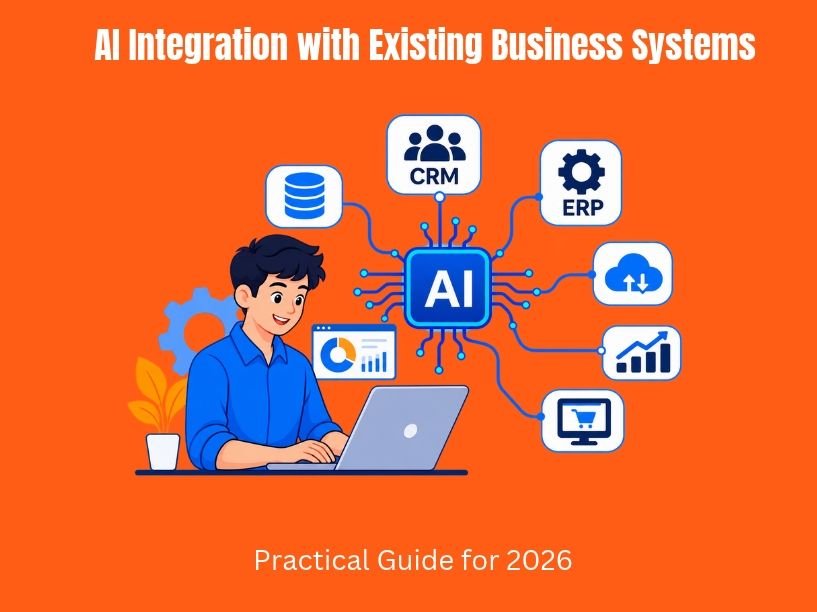
AI integration refers to embedding ai models-machine learning, natural language processing, computer vision, and generative ai-directly into the workflows, interfaces, and data pipelines of existing systems like CRM (Salesforce, Dynamics 365), ERP (SAP, Oracle), HRMS, and custom web or mobile applications.
This is fundamentally different from deploying standalone ai tools where users export data into a separate portal and switch between disconnected interfaces. When AI is integrated, it works inside existing tools, screens, and processes that teams already use daily.
Not every process benefits equally from ai adoption. Organizations that focus on specific operational problems see better AI adoption rates than those chasing broad, undefined “AI transformation.”
AI integration creates strong value when you have:
Focusing on high-value repetitive workflows aids in ai integration success. AI integration often begins with identifying high-value use cases where measurable improvement is possible.
AI integration may not be the right move when:
Quick fit-check checklist:
AI technologies plug into nearly every layer of how businesses operate. Here are the most common integration points, organized by system type:
TVL IT Solutions integrates AI with custom Node.js and Python backends as well as enterprise platforms, connecting ai solutions to the systems clients already rely on.
When ai systems are embedded into existing business operations rather than bolted on as afterthoughts, the results are measurable and compounding.
Operational efficiency: AI can automate repetitive tasks, improving efficiency across departments. AI integration can improve efficiency by automating repetitive tasks like data entry, invoice matching, and ticket routing. Deployment of AI systems allows handling of increasing workloads without proportional staffing increases-a critical advantage for scaling businesses.
Better decision-making: AI enhances decision-making by analyzing large datasets quickly, and AI enhances speed accuracy and smarter decision-making in businesses. Data-driven decision making offers faster insights than traditional methods, moving teams from gut-feel to evidence-based action. AI provides actionable insights through advanced data analytics that would take human analysts weeks to compile.
Financial impact: AI integration can lead to a 38% increase in profitability by 2035. AI integration can also reduce operational costs by 38% by 2035 through automation and optimization. Companies already see significant cost savings from supply chain optimization, reduced rework, and lower support costs. AI integration can lead to significant cost savings for businesses even in early implementation stages. AI integration can increase profitability by 38% by 2035 according to multiple industry analyses. AI applications enhance resource allocation and customer service efficiency simultaneously.
Customer experience: AI enables enhanced customer experiences through personalized engagement. Companies using AI-powered recommendations see higher sales conversion rates. AI-driven tools enhance customer service with personalized recommendations, and AI-driven systems can operate 24/7 to meet customer demand without staffing every shift. Coca-Cola uses AI to enhance customer engagement and operations, demonstrating that this approach works at massive scale.
Real-world examples worth noting:
AI integration can improve productivity by 0.8% to 1.4% annually, and those gains compound year over year as models improve and adoption deepens.
Honest assessment of risks is essential. Common AI integration challenges include poor data quality and employee adoption issues. Here are the primary obstacles:
Integration complexity with legacy systems: Older on-prem ERP without modern APIs, a custom monolith built in 2010, or multiple CRMs inherited through acquisitions all create friction. AI integration costs range from $10,000 to $500,000+ depending on scope and system complexity. Training AI models has risen 2.4x in costs since 2016, making architecture choices more consequential.
Data quality issues: Inconsistent customer data across systems, missing order history before 2020, unstructured emails and PDFs, and incomplete data all undermine model accuracy. Poor data quality limits AI effectiveness in businesses, and 25% of organizations struggle with data complexity during integration.
Security and compliance: 57% of IT professionals cite data privacy as a major inhibitor of ai projects. Sensitive data flowing into AI models requires access controls, encryption, data lineage tracking, and compliance with regulations like the EU AI Act (in force since August 2024) and GDPR.
Skill gaps and change resistance: 33% of companies cite limited AI skills as a barrier to adoption. Teams may resist AI suggestions based on fear of job loss or memories of previous failed automation projects from 2018–2021.
Investment requirements: AI integration requires significant investment in data preparation and infrastructure before any model can deliver business value. Organizations that underestimate this step consistently underperform.
Effective AI integration requires clear goals and infrastructure readiness. Here is a practical roadmap for ai business integration projects in 2026:
Over half of enterprises rely on external vendors for AI implementation. TVL IT Solutions typically starts with a 4–6 week discovery phase to map business needs, system capabilities, and data readiness before committing to a full build.
Choosing the right ai tools depends on your existing tech stack, data formats, compliance requirements, and the complexity of your use case.
Architecture considerations:
TVL IT Solutions evaluates ai algorithms, scalability, vendor lock-in risks, the existing stack (Java, .NET, Node.js, Python), and long-term maintenance burden before recommending an approach. The goal is to avoid over-engineering early pilots while building architecture that scales.
Improving data quality is crucial for successful AI implementations-more critical, in fact, than the choice of ai algorithms. High quality data is the foundation; without it, even sophisticated models produce unreliable outputs.
Key data preparation tasks:
Poor data quality limits AI effectiveness in businesses-this is not theoretical. Ensuring data quality means building a strong data foundation before deploying models, including structured data pipelines, validation rules, and ongoing data analysis workflows.
AI implementation success depends heavily on people. Process owners, frontline staff, and IT teams must trust and understand AI suggestions before they will use them consistently.
Typical resistance points:
Practical change management tactics:
42% of large enterprises are integrating AI into operations, and the companies seeing the highest returns are those where change management runs in parallel with technical implementation, not as an afterthought.
AI integration is not a set-and-forget activity. Models drift as customer behavior evolves, regulations shift, and business strategies change. Monitoring and governance are essential throughout the AI lifecycle.
Key metrics to track:
| Metric Category | Examples |
| Model performance | Accuracy, precision, recall, response latency |
| User adoption | Usage rates, override rates by human reviewers |
| Business KPIs | Conversion rate, average handle time, defect rate, customer satisfaction |
| Operational health | Pipeline uptime, data freshness, retraining frequency |
Continuous monitoring dashboards, alerting for anomalies, and scheduled model retraining with fresh data from integrated business systems keep AI effective over time. Automated quality control through AI reduces human error in processes, but only if the models themselves remain calibrated.
TVL IT Solutions helps clients design monitoring pipelines and MLOps practices-versioning, rollback, A/B testing-tailored to their existing DevOps setups, as part of its broader AI and ML development services.
Background: A mid-size e-commerce company running Magento with a separate ERP for inventory struggled with low repeat purchase rates and frequent stockouts on popular items.
AI implementation: TVL IT Solutions built a recommendation engine using collaborative filtering and integrated it via API into the existing Magento storefront and ERP inventory module. Customer data from the e commerce platform fed the model; predictions flowed back into product pages and email campaigns.
Results: Repeat purchase rate increased measurably, average order value grew, and stockout incidents dropped as AI powered demand signals informed inventory replenishment. Companies using ai powered recommendations consistently see higher sales conversion rates-this client was no exception.
Background: A SaaS platform built in Node.js and React needed to alert enterprise customers when usage patterns or spend deviated significantly from historical norms.
AI implementation: The team embedded an anomaly detection model into the existing data pipeline, triggering alerts through the platform’s notification system. No separate portal was needed-alerts appeared inside the dashboard users already checked daily.
Results: Customer satisfaction improved as clients caught billing anomalies and usage spikes early. The integration complexity was managed through microservices architecture, keeping the core SaaS product stable.
Background: A global B2B services firm used Microsoft Dynamics 365 as its primary CRM but relied on manual lead prioritization across regional sales teams.
AI implementation: TVL IT Solutions embedded a custom lead scoring model using Azure ML, connected via Dynamics APIs. The model analyzed historical conversion data, engagement signals, and firmographic attributes to score and rank leads automatically.
Results: Sales teams focused on higher-probability opportunities, reducing time spent on low-fit leads. The ai integration process preserved existing Dynamics workflows-reps did not learn a new tool. Integrating generative ai summaries of account activity added further context to each lead record.
TVL IT Solutions operates as a long-term technology partner for responsible ai integration across custom software, enterprise platforms, and B2B SaaS products.
Relevant capabilities:
TVL IT Solutions brings together data engineering, backend development, and domain expertise to integrate AI into existing systems rather than rebuilding what already works.
The companies seeing real returns in 2026 are the ones that start with a clear use case, clean data, and a partner who understands both AI and enterprise systems. If your existing business systems are ready for AI but you need a team to make the integration practical and measurable, reach out to TVL IT Solutions to explore where AI fits into how your business already operates.
AI integration means embedding AI technologies such as machine learning, natural language processing, and generative AI into existing platforms like CRM, ERP, HRMS, and custom applications.
AI can be integrated into CRM, ERP, customer support, finance and accounting, supply chain, logistics, marketing automation, HRMS, and manufacturing systems.
Key benefits include improved operational efficiency, faster decision-making, reduced operational costs, better customer experiences, and automation of repetitive tasks.
Common challenges include legacy system compatibility, poor data quality, security and compliance requirements, employee resistance, skill gaps, and infrastructure investment.
The process includes defining business goals, assessing systems and data, selecting high-impact use cases, choosing AI tools, building and testing pilots, integrating with production systems, training users, and continuously monitoring performance.
At TVL IT Solutions, we specialize in delivering scalable, secure, and custom software development services tailored to your unique business needs. Whether you’re a startup or an enterprise, our team is ready to turn your vision into reality.
Get Started Now