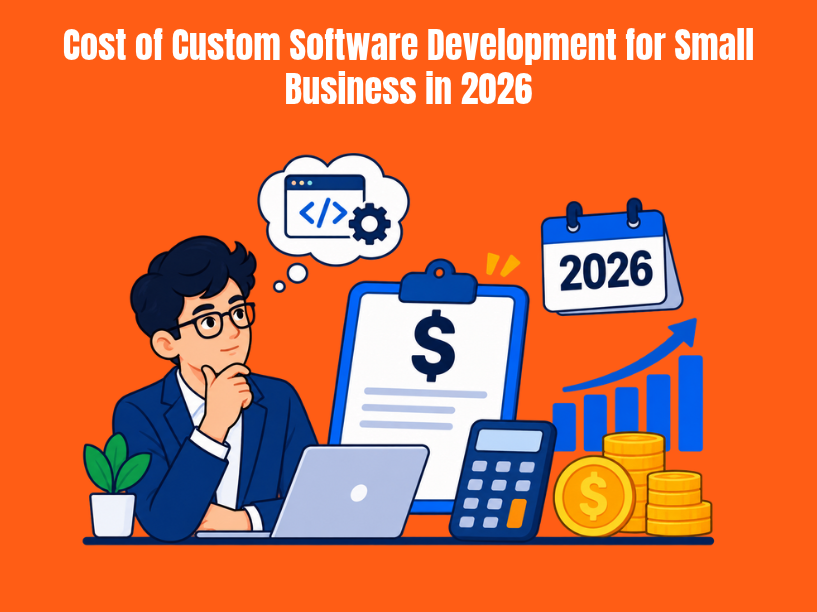

Every small business owner asking about the cost of custom software development for small business gets the same frustrating non-answer: “It depends.” This guide replaces that vague response with the specific factors, engagement models, and budgeting strategies that determine what you will actually spend. Whether you run a three-location retail chain or a field service operation with 20 technicians, the sections below will help you understand where your money goes before you request a single estimate.
There is no single flat price for custom software. The cost of custom software development depends primarily on what is being built, who builds it, and how the project is managed over time. Two projects that sound similar on the surface, such as “a booking system,” can differ by tens of thousands of dollars depending on whether the system includes mobile apps, analytics dashboards, multi-location support, or enterprise-grade security.
Custom software development for small businesses typically ranges from $30,000 to $150,000. The six factors that push that number up or down are:
TVL IT Solutions does not publish fixed price tags or canned packages. Each estimate is built after understanding the business’s workflows, growth targets, technical environment, and desired outcomes.
Consider two businesses requesting estimates in the same week: a local logistics firm needs a route-planning app with GPS tracking, offline mobile capability, and dispatch dashboards. A regional retailer with three stores needs inventory management, POS integration, analytics, and a mobile sales app. Both are “small business projects,” but the modules, integrations, and platforms involved are different, so the budgets are different.
Budgeting for a custom software project requires considering the entire lifecycle of the application. Development is only 60% to 70% of the true financial investment of a software project. Infrastructure costs, security compliance, and ongoing maintenance often add 15% to 25% of the initial build cost per year. Planning those recurring expenses is as important as budgeting the first development phase.
Custom software is a strategic investment in efficiency and growth. It replaces manual spreadsheets, reduces subscription sprawl, and delivers measurable returns (fewer errors, faster order cycles, increased revenue) over time.
Custom software development is the practice of building software around a specific business’s operations rather than asking the business to conform to a generic SaaS tool. Off the shelf software serves broad audiences; custom solutions serve yours.
Three scenarios illustrate the range:
Such software unifies web portals, mobile interfaces, and admin tools into one coherent system. Fewer disconnected tools means fewer manual data transfers and fewer errors. TVL IT Solutions focuses on tailoring backend, frontend, and mobile experiences to the processes that actually drive a client’s revenue.
Over time, developing custom software reduces dependence on multiple disconnected subscriptions and manual spreadsheets, both of which become more expensive and fragile as a business grows. If you are unsure whether your business has outgrown its current tools, these signs are a practical starting point.
Think of each factor below as a lever. Pull one toward “more,” and costs increase. Pull it toward “less,” and costs decrease. Small businesses that understand these key factors early avoid mid-project surprises.
The seven levers:
Understanding these factors before development begins helps owners set realistic expectations and prepare clearer briefs. TVL IT Solutions walks clients through each lever during a discovery workshop before committing to a build. The sections below explore each factor with small-business examples.
The same app idea can carry very different budgets depending on its purpose. A manufacturing SME digitizing paper-based quality checks needs a simple internal tool with a handful of forms and a reporting screen. A startup trying to launch that same concept as a multi-tenant SaaS on day one needs subscription billing, tenant isolation, onboarding flows, analytics dashboards, and formal security audits.
A simple internal tool is less expensive than a full business platform with user accounts and reporting. Clear business goals, such as “reduce order processing time by half” or “cut manual data entry for invoicing,” help right-size the software development process. Vague goals (“modernize operations”) lead to sprawling feature lists.
Before asking any development company for an estimate, define:
TVL IT Solutions uses goal-oriented roadmapping to align features with returns instead of building everything at once. According to research from Zentric Solutions, small-business custom software development projects often achieve payback in 6 to 14 months and generate 3 to 5 times ROI over three years when goals are well-defined and tied to growth.
“Scope” covers how many modules, user roles, workflows, and platforms the software project includes. Scope and complexity directly affects software development costs more than any other single factor.
Project size significantly influences software development costs. Here is a rough breakdown by tier:
| Project Tier | Typical Scope | Typical Range |
| Small | Single-purpose web tool, 1-2 user roles, minimal integrations | $15,000 to $25,000 |
| Mid-range | Multi-module business app, 3-5 user roles, mobile + web, payment or CRM integration | $40,000 to $150,000 |
| Large | Data-heavy platform, AI-assisted features, multiple devices, complex workflows | Exceeds $200,000 |
| Enterprise | Organization-wide systems, advanced features, strict compliance, global scale | $100,000 to $500,000 |
Custom software projects can start around $15,000 to $25,000 for small builds. Mid-range custom software typically costs between $40,000 and $150,000. Large systems often exceed $200,000 due to advanced features, and enterprise software projects can range from $100,000 to $500,000.
A concrete example: a simple booking app that sends email notifications is a small project. Add role-based permissions, automated billing, cancellation policies, push notifications across multiple devices, and analytics dashboards, and you are in mid-range territory.
Complexity increases development time and costs because every extra workflow, report, and edge case adds planning, coding, and testing effort. Integrating payment gateways or third-party APIs increases project complexity further. For small businesses, the best strategy is to define a core scope for a first release and phase complex features into later versions.
Software “size” is measured in unique screens, forms, dashboards, and user flows, not just “number of features.” A technician mobile app alone may need dozens of screens: job list, map view, offline mode, signature capture, photo upload, parts checklist. The manager dashboard adds analytic charts, report exports, and scheduling views. Each screen requires UI/UX design, frontend code, backend logic, and testing.
Mapping user journeys (from login to task completion) reveals how many screens are required. A journey like “technician receives assignment, drives to site, logs work, captures photos, submits report, triggers invoice” touches eight or more screens, each with branching logic for exceptions.
TVL IT Solutions runs user journey mapping workshops with clients to keep the number of screens aligned with real-world usage. Building screens nobody uses wastes budget. Reusing UI patterns and components (design systems, shared style guides) reduces design and development time while keeping the experience consistent across the application.
The technology stack is the combination of frontend frameworks, backend languages, databases, and cloud services that power the software solution. These choices affect both development speed and long-term infrastructure costs.
In 2026, typical stacks for small business software development projects include JavaScript or TypeScript frontends (React, Vue, Angular), backend APIs in Node.js, Python, or Java, databases like PostgreSQL or MongoDB, and containerized deployments on AWS, Azure, or Google Cloud. For mobile, cross-platform frameworks like Flutter or React Native let teams serve iOS and Android from a shared codebase.
Technology stack choice impacts both speed and maintenance costs. A stack chosen for novelty rather than team expertise leads to slower builds and harder maintenance. Cloud platforms enable pay-as-you-go hosting, but poorly optimized infrastructure produces surprise bills as traffic grows.
Consider an e-commerce brand that starts with dozens of daily orders but grows to thousands. Without scalable cloud architecture (caching, CDN, horizontal scaling, monitoring), performance degrades and infrastructure costs spike. TVL IT Solutions designs architectures to be secure, scalable, and optimized to avoid unnecessary spending.
Good UI/UX design increases adoption, reduces training needs, and prevents expensive rework after launch. Poor design leads to low adoption or costly fixes when staff refuse to use the system.
Design work spans wireframes, interactive prototypes, visual design systems, and accessibility considerations (color contrast, keyboard navigation, screen reader support). A warehouse scanning app, for instance, needs large buttons for gloved hands, one-hand use, and offline mode. A cramped, generic interface causes errors and slows operations in the field.
Designing for multiple user types (customers, managers, field staff) adds effort because each persona has different tasks and information needs. A manager reviewing daily KPIs and a technician logging a completed repair need different screen layouts, data density, and interaction patterns.
TVL IT Solutions prioritizes usability testing with real users from the client’s team during early prototyping. Testing with three to five actual users catches most usability problems before a single line of production code is written, keeping designs practical and cost-effective.
Integrations are a common hidden driver of development costs. Most small businesses already use CRM, accounting, ERP, payment gateways, or logistics platforms. Connecting the new custom software to those other systems requires API work, authentication setup, error handling, and testing.
Integrations with third-party systems can raise overall costs because each external software introduces its own quirks: rate limits, documentation gaps, authentication protocols (OAuth, API tokens), and version changes over time. Systems integrating with Microsoft Dynamics, Salesforce, or popular accounting software need careful planning around data management and synchronization schedules.
Data migration adds another layer. Cleaning legacy spreadsheets or older systems’ data, mapping fields to new structures, and validating imported records takes time. A retailer migrating 50,000 product SKUs from a legacy POS system into a new inventory platform will spend more on migration than a business starting from scratch.
TVL IT Solutions treats integration work as a distinct project phase and anticipates external software quirks that can delay timelines if discovered mid-build.
Small businesses typically choose among three approaches to build software:
In-house developers: Full control and deep product knowledge, but high overhead (salaries, benefits, equipment, management) and difficulty scaling. Recruiting experienced developers takes months.
Freelancers: Lower overhead and flexible for small tasks. But quality varies, coordination overhead grows with team size, and a single freelancer creates a single point of failure. Complex projects requiring coordinated roles (business analyst, UX designer, backend developer, frontend developer, QA engineer, DevOps) are hard to run on a purely freelance model.
Dedicated development partner: Access to a full development team with multiple specialized skills, consistent quality standards, and long-term maintainability. Team expertise directly affects project quality and budget. A project manager coordinates delivery, and the partner handles hiring, tooling, and process.
TVL IT Solutions offers offshore dedicated teams and flexible engagement models so SMEs can access a complete team without building it internally. When choosing a development partner, evaluate not just initial build capability but also capacity for ongoing support and enhancements.
Developer hourly rates vary widely by region, affecting project costs. Billable rates for software developers vary between $100 to $250+ per hour in North America to $25 to $75 per hour for offshore teams. Costs are driven by project scope, team location, and feature depth.
Specific regional ranges in 2026:
| Region | Typical Hourly Rate |
| United States | $100 to $180 |
| Western Europe | $80 to $150 |
| Eastern Europe | $30 to $70 |
| India / South Asia | $20 to $50 |
| Latin America | $30 to $60 |
Hourly rates for US developers range from $100 to $180. Offshore development rates typically range from $20 to $50 per hour in India and South Asia, and from $30 to $70 per hour in Eastern Europe. Hiring developers in Eastern Europe can lower costs compared to onshore options. Offshore developers can be found at a fraction of US costs.
Offshore development can lower costs but requires careful management. Many offshore projects fail due to poor communication, not due to lack of technical skill. Time zone differences can lead to project delays in offshore development if teams do not plan overlapping working hours, regular demo sessions, and clear documentation.
TVL IT Solutions is an India-based offshore partner with experience working with clients in North America, Europe, and APAC. The company uses transparent communication rhythms, including daily standups with timezone overlap, recorded demo sessions, and shared project boards, to address language barriers and coordination challenges.
How you structure the collaboration affects predictability and flexibility. Four common pricing models exist for software development pricing:
Fixed price: Defined scope, fixed budget. A fixed price model starts around $10,000 for simple systems. Best when requirements are clear and unlikely to change, such as an internal reporting dashboard with predefined metrics. Risk: scope creep leads to change orders.
Time and materials: The time and materials model charges for actual hours worked. Better for evolving products like a B2B SaaS where new features and integrations emerge during development. Hourly rates range from $20 to $150+ depending on region.
Dedicated team: A team (or “pod”) works exclusively on your project. Dedicated teams typically cost between $15,000 to $60,000 monthly, depending on team size and seniority mix. Ideal for long-term digital transformation where deep context matters.
Hybrid: Hybrid models combine fixed price and hourly rates for flexibility. Discovery and planning phases are fixed; build phases run on time and materials; maintenance is a separate retainer. This structure suits projects where initial requirements are uncertain.
TVL IT Solutions supports all these engagement models and works with clients to select the structure that matches their risk tolerance and change profile.
The standard software development process follows six phases: discovery, design, development, testing, deployment, and support. Each phase uses different specialists and tools, so organizing them well directly impacts overall development costs.
Skipping or compressing early stages like discovery and design usually increases total software development costs due to rework. A retail SME that refined its inventory rules during discovery avoided costly logic rewrites mid-build. The rules around purchase order thresholds and multi-location stock transfers were clarified in workshops rather than discovered as bugs during testing.
TVL IT Solutions follows an agile development process with iterative releases. Each sprint delivers working software that stakeholders can review, keeping small businesses in control of scope and budget.
Discovery is the phase where business processes, user types, data flows, and technical constraints are mapped into clear requirements. It produces process diagrams, a prioritized feature list, a risk register, and a roadmap split into initial and later releases.
A practical example: mapping the order lifecycle for an e-commerce SME, from browsing through checkout to shipping and returns, reveals which modules are essential for launch and which (like a full returns portal) can be deferred. This distinction between “must-have now” and “build later” is the single most effective cost control mechanism.
A well-run discovery phase typically takes two to four weeks for small-to-moderate software development projects and pays for itself by reducing ambiguity. Investing in solid discovery improves the accuracy of any custom software development pricing estimate that follows.
TVL IT Solutions offers structured discovery workshops, remote or onsite, as a standalone engagement before full development begins.
UI/UX designers, backend and frontend developers, and QA engineers collaborate in sprints to ship working increments. Adding more software developers without matching capacity in design or QA creates bottlenecks: untested code stacks up, and design debt accumulates.
A multi-location salon chain tested appointment flows with staff during a beta phase. Technicians and front-desk staff flagged confusing button labels and missing confirmation screens. Fixing those issues in beta cost a fraction of what production hotfixes would have required.
Quality assurance covers usability, performance, security, and compatibility testing across browsers and devices. Catching defects early costs far less than discovering them after deployment. TVL IT Solutions uses automated tests where appropriate, including unit, integration, and regression suites, to reduce manual regression effort over the product’s lifetime.
Deployment is the transition from staging to production. Infrastructure, monitoring, backup strategies, and security configurations (SSL, data encryption, access controls) must be in place before users touch the system.
Typical infrastructure elements include:
After launch, maintenance costs extend beyond bug fixes to include security patches, performance tuning, dependency updates, and minor improvements based on user feedback. Maintenance costs typically range from 15% to 25% of project value annually.
A logistics SME that added new regions and vehicles over time needed database optimizations, additional configuration screens, and infrastructure scaling. These ongoing costs were predictable because they were planned from the start.
TVL IT Solutions plans long-term ongoing maintenance with clients from the outset, helping them budget for sustainable support rather than scrambling after launch.
AI assisted development tools in 2026 include code suggestion engines, test generation, documentation support, and basic refactoring assistants. These tools accelerate repetitive tasks: generating CRUD operations, boilerplate validation code, unit tests, and API documentation.
Senior developers still design architecture, ensure security, handle software complexity complicated logic, and review AI-generated output. Machine learning models and recommendation engines within custom platforms require human expertise for training data selection, model evaluation, and deployment. AI does not replace the development team expertise needed for these decisions.
A concrete example: for a CRM module, AI tools generate forms, basic validation, and unit tests. Custom business logic, such as lead scoring rules specific to the client’s sales process, is handcrafted and reviewed by experienced developers with specialized skills.
AI assisted development can shorten timelines for certain feature sets, indirectly reducing overall development time. TVL IT Solutions uses AI-assisted development responsibly, pairing it with human oversight and strict quality standards to avoid technical debt.
Several hidden costs catch small businesses off guard:
Using off-the-shelf solutions for non-core functions (authentication, email delivery, CMS) can reduce development hours for those components. The project cost should include a contingency buffer of 10% to 20% for unavoidable surprises.
TVL IT Solutions surfaces likely hidden costs early during discovery and keeps a transparent log of change requests with their impact on timeline and budget.
These are actions you can take before and during a custom software build to improve cost efficiency:
TVL IT Solutions helps clients make these build-vs.-integrate decisions to keep development and infrastructure costs aligned with business realities.
A regional maintenance services company relied on paper-based scheduling, handwritten work orders, and manual data entry into accounting tools. Technicians called the office for assignments; dispatchers tracked jobs on whiteboards. The problems were concrete: missed work orders, delayed invoicing, no visibility into technician workload.
Discovery (2 weeks): TVL IT Solutions mapped the company’s dispatch workflow, identified five user roles, and documented 23 screens across mobile and web. The team deprioritized secondary features (offline GPS tracking, full geo-fencing) for a later release.
MVP build (10 weeks): A mobile app for technicians (job details, status updates, photo capture, digital signatures) and a manager dashboard (scheduling, assignment tracking, performance reports). AI-assisted code generation handled CRUD forms and basic validation, letting senior developers focus on dispatch logic and notification rules.
Integration (3 weeks): The new system connected to the company’s existing accounting platform for automated invoice generation.
Outcomes: Fewer missed appointments, faster invoicing cycles (days reduced from seven to two), and clearer workload planning. The phased approach kept the custom software build within the company’s budget by deferring advanced features to a second release.
A small European logistics broker managed route optimization through internal spreadsheets and a basic desktop tool. The tool worked for internal use but could not serve external clients. Between 2024 and 2026, the company partnered with TVL IT Solutions to turn it into a multi-tenant SaaS platform.
Phase 1; Fixed discovery: The team mapped the internal workflow, defined the tenant isolation model, and designed subscription tiers. This phase clarified how much the custom software cost would increase relative to the internal tool.
Phase 2; Time and material build: Multi-tenant architecture, user onboarding, analytics dashboards, subscription billing via Stripe integration, and role-based access control. The transition from single-tenant to multi-tenant required additional security layers, database isolation, and enterprise systems for monitoring.
Phase 3; Dedicated maintenance team: After launch, a small dedicated team handled bug fixes, performance tuning, and feature additions as customers provided feedback. AI-assisted development generated regression tests and documentation to keep the growing codebase manageable.
The hybrid engagement model (fixed discovery, T&M build, dedicated maintenance) supported predictable investment while allowing the product to evolve with market feedback.
TVL IT Solutions is a custom software development company based in India delivering full-stack web and mobile development, enterprise solutions (AI/ML, Microsoft Dynamics, Salesforce), and secure, scalable architecture for clients across North America, Europe, and APAC.
The company aligns development efforts with business KPIs. Features are built in order of impact on revenue or cost savings, not as a flat checklist. Reusable internal libraries, coding standards, and automated CI/CD pipelines reduce waste during development and keep long-term maintenance costs down.
Flexible engagement models (dedicated team, fixed scope, time and material, hybrid) let small businesses and B2B SaaS founders choose the structure that fits their stage. Custom software development services from TVL IT Solutions cover the full lifecycle: discovery, design, build, test, deploy, and maintain.
If you are evaluating custom software development companies for your next project, schedule a discovery session with TVL IT Solutions. Share your current systems, workflows, and priorities so the estimate reflects your actual needs, not assumptions.
Custom software development for small businesses typically ranges from $30,000 to $150,000. The final cost depends on project scope, features, integrations, technology, team structure, and ongoing support.
The main factors include business goals, feature complexity, number of screens and user journeys, integrations, technology stack, infrastructure, team composition, UI/UX design, and project timeline.
According to the article, offshore development rates in India and South Asia typically range from $20 to $50 per hour. Rates vary based on location, expertise, project requirements, and team structure.
The four common models are fixed price, time and materials, dedicated team, and hybrid. The right model depends on project scope, budget predictability, flexibility, and long-term development needs.
Annual maintenance typically ranges from 15% to 25% of the initial project value. It covers bug fixes, security patches, performance optimization, dependency updates, and ongoing improvements.
At TVL IT Solutions, we specialize in delivering scalable, secure, and custom software development services tailored to your unique business needs. Whether you’re a startup or an enterprise, our team is ready to turn your vision into reality.
Get Started Now