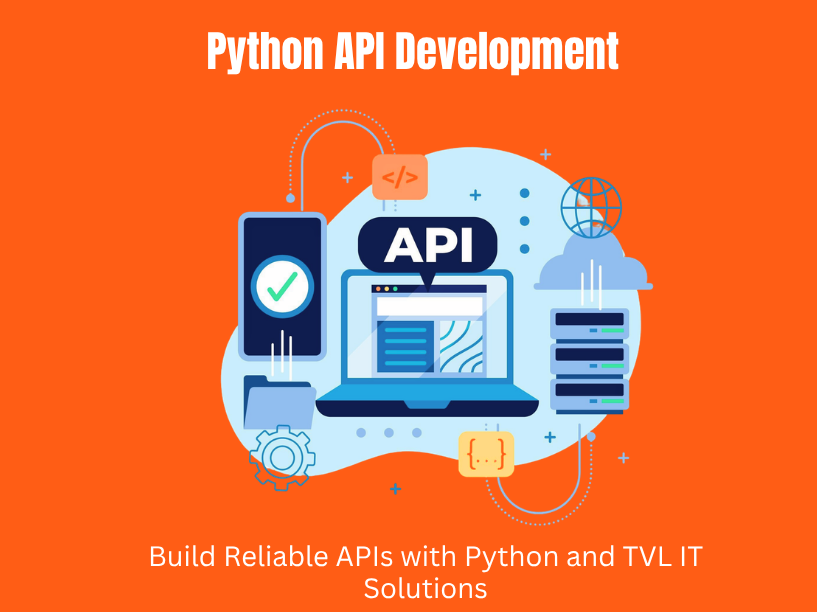

TVL IT Solutions helps startups, SMEs, and enterprises build production-grade APIs using Python. As a custom software development partner, the team delivers scalable backend services that connect mobile apps, SaaS dashboards, partner platforms, and internal tools through RESTful endpoints and json data.
This python api tutorial covers both sides of the equation: consuming third-party APIs and building your own. You will learn http methods, api status codes, api design patterns, security practices, and performance techniques. Every section references concrete frameworks (FastAPI, Flask, Django REST Framework) and key libraries like the requests module and httpx. If you are planning a web, mobile, or SaaS platform, this guide is for you.
An application programming interface is a contract for exchanging data between different software systems. APIs define how two systems communicate with each other; a client sends an http request to a server, and the server returns a response, typically in json format.
Two concrete examples: a weather API at the api endpoint /weather?city=London returns weather data like temperature and humidity. A stock API at /stocks/TSLA/intraday returns time-series quotes. Both follow a pattern: a client issues a get request, and the server sends back requested data as a json response.
Core terms to know:
REST-style apis with python dominate python web development. REST powers roughly 83% of web services globally. GraphQL allows clients to define the exact shape of returned data and has seen adoption growth in enterprise settings, but REST remains the standard for most python projects between 2024 and 2026.
At TVL IT Solutions, these APIs power mobile apps calling backend services, B2B SaaS connectors exposing partner integrations, and internal dashboards pulling from microservices.
HTTP methods describe “what you want to do.” API status codes indicate how a request was processed. Using both correctly defines reliable communication between software applications.
API requests can be made using GET, POST, PUT, and DELETE methods, plus PATCH for partial updates:
Meaningful HTTP status codes should replace generic responses like 200 OK for every outcome. Common HTTP status codes include 200, 404, and 500. Here is a practical reference:
| Code | Meaning | When to use |
| 200 | OK | A get request succeeds and returns a body |
| 201 | Created | A post request creates a resource; return Location header |
| 204 | No Content | DELETE or PUT succeeds; no body needed |
| 400 | Bad Request | Malformed JSON or missing required field |
| 401 | Unauthorized | No credentials or invalid token |
| 403 | Forbidden | Authenticated but lacking permission |
| 404 | Not Found | A 404 status code indicates the requested resource was not found |
| 409 | Conflict | Duplicate username or unique constraint violation |
| 422 | Unprocessable | Valid JSON but business rules fail (invalid dates, ranges) |
| 429 | Too Many Requests | Rate limit exceeded; include Retry-After header |
| 500 | Server Error | A 500 status code signifies a server error occurred |
A 200 status code means the request was successful. Treat response status code selection as part of your api design: consistent codes improve client error handling, observability, and debugging.
Python is the most popular programming language in 2024, and its clean syntax makes it a natural choice for consuming third-party APIs. The ecosystem offers mature tools for making api requests against any public api.
Install the requests library using pip install requests. Then add import requests at the top of your py file. The requests library handles synchronous http requests. For asynchronous requests, httpx provides both sync and async clients; use it when your application makes concurrent api calls to multiple services.
A basic example: send a get request to https://api.github.com/users/octocat using the requests library, then check the response status code and parse the json response:
Use api keys in headers or Bearer tokens for authenticated endpoints. Store secrets in environment variables; never hard-code them. Pass query parameters using a params dictionary rather than manually building query strings. This keeps code readable and avoids encoding errors.
When TVL IT Solutions integrates third-party APIs for clients, the team applies retries with exponential backoff, enforces timeouts on every single request, and logs each api call with structured metadata. If a call fails, the system returns a clear generic error message to the end user instead of exposing raw stack traces.
Three frameworks lead Python API development in 2026. According to Stack Overflow’s 2025 survey, FastAPI posted a +5-point usage jump, one of the largest among web frameworks. Django and Flask remain popular frameworks for building APIs, each filling distinct roles.
Flask is a lightweight microframework designed for quick prototyping. Install Flask using the following command: pip install flask. Define routes with @app.route. Flask is lightweight and well-documented for restful apis, which makes it a solid choice for small services and straightforward api projects.
FastAPI is an async-first, high-performance microframework for rest apis and the most starred framework on GitHub. Install fastapi with pip install fastapi. Define endpoints with @app.get or @app.post. FastAPI generates interactive documentation via OpenAPI automatically. Automatic documentation in FastAPI and Litestar enhances developer experience by letting consumers explore endpoints without reading separate docs. OpenAPI generates automatic documentation from code schemas and type definitions.
Django REST Framework is a powerful toolkit for enterprise applications with relational data. It provides serializers, ViewSets, and routers on top of Django’s ORM and admin interface.
Flask fits lightweight services and rapid prototyping. FastAPI fits greenfield microservices requiring async and high throughput. Django REST fits full-stack web applications needing ORM, admin, and built-in auth. TVL IT Solutions selects the web framework based on domain complexity, team familiarity, and scalability needs across backend web development, mobile backends, and bespoke SaaS platforms.
JSON is a lightweight data-interchange format used in APIs. APIs often return data in json format, and Python maps JSON objects to dicts and lists natively.
Python’s json module handles JSON serialization and deserialization. You can read JSON from a file using json.load in Python, and to write JSON to a file, use json.dump. JSON objects consist of key-value pairs, where keys are strings. In client code, call response.json() on a requests or httpx response to parse json data into a Python dict. On the server side, FastAPI returns dicts as JSON automatically; Flask uses jsonify.
Python API development involves designing a clear interface and validating data at every boundary. Pydantic is a data validation library using type hints in Python; FastAPI relies on it for request parsing. Marshmallow fills a similar role for Flask and Django projects.
Consider a /transactions api endpoint accepting fields like amount (positive float), currency (ISO 4217 string), occurred_at (ISO 8601 datetime), and category (enum from a fixed set). Pydantic enforces these constraints before your business logic executes.
When decoding json data fails or validation rules reject a payload, return a 400 or 422 status code with structured error details. Never send a generic error message without specifying which field failed and why. TVL IT Solutions treats schema definitions as part of long-term api design, aiding front-end integration, documentation, and automated testing across python projects and SaaS platforms.
Good api design reduces integration friction more than any single framework choice. Proper organization of code improves maintenance and allows for scalable projects.
Use plural nouns: /api/v1/customers, /api/v1/customers/{id}/orders. Avoid nesting deeper than two levels. Consistent naming lets consumers predict endpoint patterns without checking documentation for every resource.
Versioning APIs helps manage changes without breaking existing clients. URL-based versioning (/api/v1/…) remains the most common strategy because it is visible and discoverable. Header-based or media-type versioning exists but is harder for consumers to test in a browser or from the command line. TVL IT Solutions favors explicit URL versioning for long-lived B2B SaaS APIs where partners depend on stable contracts.
Three common patterns exist for pagination:
Allow filtering and sorting via query parameters: ?status=pending&created_after=2026-01-01&sort=created_at_desc. Document available parameters so consumers can retrieve data without guessing.
Wrap every response in a consistent envelope: data, meta (including pagination), and errors. This pattern lets clients parse any endpoint response with the same logic, whether the api call succeeds or fails. Avoid returning different shapes for different endpoints.
APIs expose core business data. Security-first development is non-negotiable for any serious python api deployment. A recent study found that 99% of surveyed organizations experienced API security incidents in the past year, and 22% reported data breaches via APIs.
Implementing authentication requires practices like using HTTPS and keeping secrets secure. Store tokens and keys in environment variables, not in source code.
For regulated sectors like finance or healthcare, TVL IT Solutions applies dependency scanning, role-based access control (RBAC), and architectural decoupling that separates presentation, application, and infrastructure layers. Separation of concerns keeps route handlers thin and leaves business rules isolated, which reduces the attack surface of each endpoint.
Monitoring matters too: log authentication failures, repeated 401/403 responses, and rate-limit triggers. Do not log sensitive data like tokens or passwords. This observability layer helps teams catch suspicious activity early. Read more about why businesses choose Python development services that bake security into every layer.
API performance is not only about raw server speed. Latency, concurrency, and predictable behavior under load define whether an API meets user expectations.
Asynchronous programming is essential for I/O-bound operations like database queries and external api requests. FastAPI with async endpoints plus httpx async clients allows a single worker to handle many concurrent connections during IO wait times. Regular performance evaluation is crucial for I/O-bound APIs; measure 95th-percentile response times before and after switching to async to validate improvements.
Deploy multiple Uvicorn or Gunicorn workers. Containerize APIs with Docker and orchestrate with Kubernetes for horizontal scaling. At the database layer, connection pooling prevents exhausting database connections under load. SQLAlchemy is the industry-standard ORM for managing database interactions in Python; pair it with proper indexing and pagination to avoid N+1 query patterns. Database state management can use migration tools like Alembic with an ORM to keep schemas in sync across environments. Dependency injection allows passing shared resources (database sessions, cache clients) into api endpoints cleanly.
TVL IT Solutions designs scalable backend architecture for APIs backing mobile apps, games, and B2B SaaS, with load testing and performance budgets embedded in delivery.
Reliable APIs need more than manual testing. Automated tests and observability ensure consistent behavior as software systems evolve.
Testing layers in isolation involves writing unit tests and integration tests. Unit tests validate business logic functions with no network or database calls. Integration tests hit real or staged api endpoints, verify different status codes, and assert on JSON payloads. Contract tests confirm schema compatibility between your API and its consumers (frontends, partner services).
Use pytest with framework-specific test clients: FastAPI’s TestClient, DRF’s APIClient, or Flask’s test client. Simulate http requests, check that a post request returns 201, confirm that a get request against an unknown ID returns 404, and verify that invalid payloads trigger 422.
Three pillars support production observability:
Consistent error handling and logging improve user experience and debugging. TVL IT Solutions integrates dashboards and alerts so teams spot spikes in 4xx/5xx responses, slow endpoints, or unusual api usage patterns early. Treat test suites and monitoring as core features, not optional extras bolted on at the end.
Theory is useful, but design decisions become clearer when grounded in concrete projects. Here are three examples drawn from common python applications TVL IT Solutions delivers.
A fintech startup needed a reporting platform where partners could pull transaction summaries, generate statements, and receive data in real time. TVL IT Solutions built the backend with FastAPI, PostgreSQL, and React. The API exposed versioned rest apis (/api/v1/reports, /api/v1/transactions) secured with OAuth2. Cursor-based pagination handled datasets exceeding 500,000 rows per partner. Caching reduced average endpoint latency from 320ms to under 90ms at the 95th percentile.
A logistics company required APIs to track driver locations, delivery events, and send push notifications. TVL IT Solutions chose Django REST Framework for its built-in ORM, admin panel, and auth system. The API handled basic operations like creating shipments, updating statuses, and enabling clients to retrieve data for route optimization. Schema stability and clear documentation cut third-party integrator onboarding from weeks to days. Read more about signs you need a custom Python API development company.
A game studio needed a leaderboard service handling thousands of concurrent requests from players. TVL IT Solutions built a simple api with FastAPI backed by Redis for sub-millisecond reads. The service used asynchronous endpoints to send data and receive data under heavy load without blocking. Advanced features like anti-cheat validation and rate limiting protected data integrity and prevented abuse. The API enabled developers on the game team to integrate leaderboards with a few lines of client code.
These projects share common themes: security baked in from day one, scalable architecture, and clear documentation that accelerates integration.
Organizations typically engage TVL IT Solutions when planning new APIs or modernizing legacy backends. The development process follows a structured path from discovery to production.
Discovery steps:
Collaborative design workshops:
TVL IT Solutions runs workshops where teams define data models, different http methods per resource, validation rules, and error handling strategies. These sessions produce an API specification before any code is written. This enable developers to work in parallel on frontend and backend.
Delivery approaches:
Choose from dedicated team, fixed scope, or hybrid engagement models. The focus is flexibility and long-term partnership, not rigid contracts. Learn about the benefits of hiring dedicated backend web developers for sustained projects.
Before you reach out: prepare a list of desired endpoints, integration targets (CRM, ERP, payment gateway), and the programming language preferences of your team. This makes the initial consultation concrete and productive. Install python and experiment with making api requests against a public api to sharpen your requirements.
Modern software development treats APIs as products. If your startup, SME, or enterprise needs secure, scalable python api development to underpin digital products, partner with TVL IT Solutions to turn those endpoints into working software.
Python API development involves building APIs that allow applications and software systems to communicate and exchange data using Python.
FastAPI, Flask, and Django REST Framework are popular Python frameworks for building RESTful APIs.
FastAPI supports asynchronous programming, high performance, automatic OpenAPI documentation, and type-based data validation.
Python APIs can use HTTPS, API keys, OAuth2, JWT, input validation, rate limiting, CORS controls, and secure environment variables
APIs can be scaled using asynchronous programming, caching, database optimization, connection pooling, Docker, Kubernetes, and horizontal scaling.
At TVL IT Solutions, we specialize in delivering scalable, secure, and custom software development services tailored to your unique business needs. Whether you’re a startup or an enterprise, our team is ready to turn your vision into reality.
Get Started Now