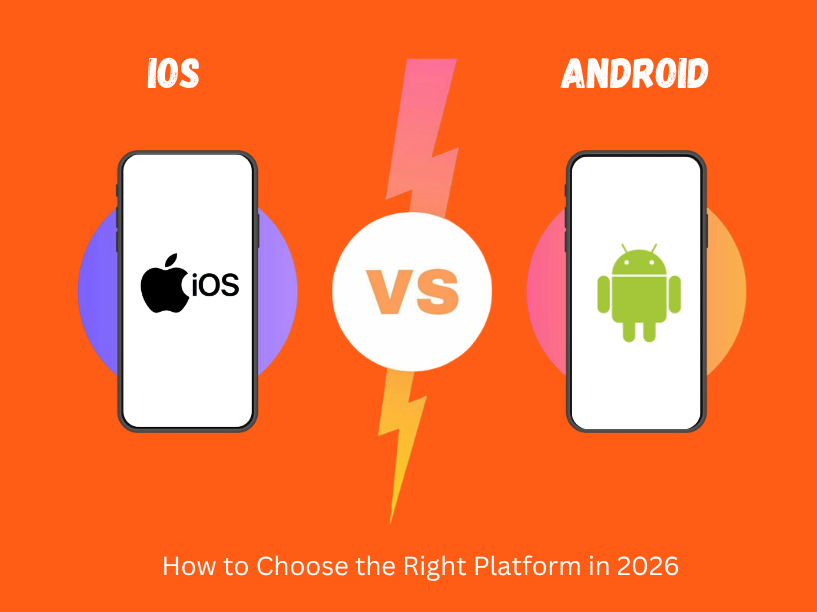
The ios vs android app development decision boils down to where your users are and how they pay. Android holds approximately 71-72% of the global smartphone market share. iOS accounts for about 28-29%. But market share alone tells half the story; the other half is revenue.
Here is how to think about it:
Key trade-offs at a glance:
TVL IT Solutions builds native ios apps, native android apps, and cross-platform apps. The recommendation always starts with the client’s business goals, target audience, and monetization plan.
The sections below break down each factor in detail.
Platform choice starts with two questions: where are your users, and how do they spend?
Android holds 71-72% of the global smartphone market share, with dominant positions in India, Brazil, Indonesia, and most of Africa. Android dominates emerging markets with over 85% market share in several of these regions. iOS accounts for about 28-29% globally but commands over 57% in the US (57.05% as of 2024) and strong positions in Canada, the UK, and Australia.
Android’s vast global market share offers a larger potential audience than iOS. But ios market share punches above its weight in revenue. iOS users represent 68.6% of global consumer app spending, despite being roughly a quarter of mobile users. iOS users spend an average of $140 annually on apps. Android users spend approximately $69 annually on apps.
This is the “volume vs value” split:
iOS users tend to sit in higher-income brackets and are less price-sensitive. Common monetization: subscriptions, paid downloads, in app purchases. Android users span a more diverse economic range. Common monetization: ads, freemium, micro-transactions, carrier billing.
Apps developed for iOS often have higher average revenue per user compared to Android. iOS users historically spend more on apps and in-app purchases than android users, and that gap persists across non-gaming categories like finance and business tools.
Mini case snapshot: A subscription-based wellness mobile application targeting North America would prioritize iOS first to capture higher lifetime value per user. An e-learning app targeting India would choose android to reach millions of price-sensitive mobile users, then add iOS later for urban high-spend segments.
The split between ios and android development goes beyond user demographics. It shapes how teams plan, build, test, and ship software.
Key technical contrasts:
iOS has a controlled and homogeneous device ecosystem. Android offers greater customizability due to its open nature but requires more defensive planning around screen sizes, hardware tiers, and os versions.
These differences translate into different timelines, QA strategies, team skills, and long-term maintenance loads. TVL IT Solutions structures android and ios development projects with separate test matrices for Android (covering device labs and OEM-specific behavior) and review-time buffers for Apple submissions.
Each of these areas is covered in depth below.
Language and tooling choices directly affect developer productivity, hiring timelines, and how maintainable your codebase remains three years after launch.
Swift 6 is the primary language for iOS development. Apple introduced Swift in 2014, and it has since become the default for new ios app development. Swift emphasizes safety and performance in iOS applications through features like strong type safety, memory safety, and built-in async/await concurrency. Objective-C still appears in older enterprise codebases and certain third-party libraries.
iOS development primarily uses Xcode as its integrated development environment. Xcode includes Interface Builder for visual layout, SwiftUI previews for rapid UI iteration, Instruments for profiling, and a built-in simulator. It is available only on macOS.
Kotlin 2.0 is the preferred language for Android development. Google endorsed Kotlin as the modern language for building android apps, and it has become the standard for new projects. Kotlin reduces boilerplate code by approximately 40% compared to Java, thanks to concise syntax and built-in null safety. Java remains relevant for existing codebases and teams with deep Java expertise.
Android Studio is the official IDE for android development. It is Google’s official IDE, built on JetBrains IntelliJ, and runs on Windows, macOS, and Linux. It includes a layout editor, Gradle build system, device profiling, and logging tools.
Xcode’s tight integration with Apple’s ecosystem and integrated tools offers predictability, though it has occasional stability quirks. Android Studio provides flexibility across operating systems and deep tooling, but Gradle build complexity and emulator performance can slow android developers during iteration cycles.
TVL IT Solutions recommends native stacks (Swift + Kotlin) for products that need premium UX, strong retention, and long-term scalability. For MVPs or fast validation where the same app ships on both platforms, cross-platform frameworks like Flutter or React Native reduce initial development effort.
Where and how your team can code is a practical constraint that gets underestimated in early project planning.
Developing for iOS typically requires a Mac to run Xcode. MacBook Pro, Mac mini, or iMac hardware is necessary to compile, sign, and simulate ios apps. Remote teams or shops running Windows or Linux must either purchase Mac hardware, rent cloud macOS instances, or set up dedicated build machines. iOS development requires a $99 annual developer fee through the Apple Developer Program for app distribution and access to advanced capabilities.
Android Studio supports Windows, macOS, and Linux systems, making setup easier for geographically distributed or multi-OS teams. Android developers can run emulators on most modern hardware and connect a wide range of physical android phones via USB debugging. Android’s Google Play developer fee is a one-time $25 payment.
iOS build pipelines need macOS runners, whether physical machines or cloud services, to compile and code-sign. Android pipelines run on Linux or Windows, making them cheaper to scale and parallelize.
TVL IT Solutions configures separate CI pipelines for each mobile platform: macOS agents handle iOS builds, provisioning, and code signing; Linux-based agents handle Android build variants. This separation keeps release cadence predictable for both platforms and avoids bottlenecks when one pipeline needs maintenance.
iOS and android users develop muscle memory around their platform’s interaction patterns. Ignoring those patterns creates friction.
iOS uses Human Interface Guidelines emphasizing clarity and depth. Content takes priority; chrome is minimal. iOS apps typically feature a tab bar for primary navigation. Standard gestures include swipe-back and edge swipes. The smallest clickable area for iOS is 44px, and safe areas guide layout around notches and home indicators.
Android follows Material Design focusing on bold colors and animations. Material You adds dynamic color theming and expressive motion. Android apps often use a navigation drawer for primary navigation, alongside bottom navigation bars and navigation rails. The smallest clickable area for Android is 48px (48dp). Android follows Google’s Material Design system for its UI frameworks, with built-in support for diverse screen sizes and aspect ratios.
Copying iOS screens directly to Android, or the reverse, creates a user interface that feels foreign to platform-native users. Navigation placement, gesture behavior, typography scales, and animation timing all differ between the two operating systems.
For consumer apps with large user bases, leaning into native patterns on each platform improves retention. For internal enterprise tools, a unified cross-platform design may be acceptable because users interact with the app less frequently and prioritize function over feel.
TVL IT Solutions adapts the same product concept into two native-feeling interfaces when building for both platforms, aligning each with the platform’s guidelines. This applies whether the team is building a startup’s first iOS app or scaling an Android product across regions.
Distribution channels and review timelines directly affect when your app reaches users and how you plan marketing pushes.
iOS apps are distributed through the App Store which has a rigorous review process. Apple reviews most submissions within 24 hours; over 90% are processed within 48 hours. Complex apps, sensitive categories, or first-time submissions can take longer. Apple’s guidelines cover content quality, privacy, and design standards. Rejections come with detailed messages, but they require planning buffer time before coordinated launches. iOS offers better app review policies ensuring high-quality apps. As a result, 82% of users trust App Store apps compared to 65% for Play Store.
Android apps are distributed primarily through the google play store which has a faster review process. Updates for established apps often go live within hours. New apps or accounts in sensitive categories may take 3-7 days. Google Play offers internal testing, closed testing, and open testing tracks for staged rollouts.
Android’s open-source nature enables distribution through third party app stores (vendor-specific stores, regional stores in China and Southeast Asia) and direct APK sideloading. Each channel expands reach but adds maintenance overhead: separate release pipelines, compatibility testing, and security considerations.
Apple requires App Tracking Transparency and privacy nutrition labels. Google Play introduced Data Safety sections with similar disclosure requirements. Product owners should factor legal and compliance review into their roadmap alongside app store submission prep.
TVL IT Solutions plans release calendars with review-time buffers for Apple and staged rollout strategies for google play, reducing launch risk for both platforms.
Per-hour development rates for iOS and Android engineers in offshore markets are often comparable. The total project effort diverges because of what each platform demands beyond writing code.
iOS projects benefit from Apple’s controlled ecosystem. Fewer device types and rapid OS adoption mean less time spent on layout variations and backward compatibility. A feature-equivalent iOS build often reaches production earlier than its Android counterpart. Android projects require additional effort for layout optimization across screen sizes, performance tuning for budget hardware, and handling OEM-specific behaviors.
Android’s fragmentation requires larger device labs or cloud testing services. Teams must verify behavior across multiple screen resolutions, RAM tiers, CPU capabilities, and manufacturer skins. iOS offers a streamlined device environment which simplifies testing and optimization. iOS testing still needs to cover older devices (iPhone SE, iPhone 12) and recent iOS versions, but the matrix is smaller.
iOS applications can be optimized more easily due to predictable hardware. iOS apps typically have a higher retention rate of 23.9% on day-1, partly because consistent performance builds user trust. iOS development generally has lower ongoing maintenance costs. Android development costs can be higher due to device fragmentation and the need to support more active os versions.
TVL IT Solutions project example: For one client, the iOS version shipped three weeks ahead of Android because Android QA uncovered layout and performance issues on budget devices. In a separate project targeting an emerging market, the Android MVP shipped first because the client prioritized user volume; iOS followed after validating monetization signals.
Monetization strategy should shape platform priority from the start, not get bolted on after development.
Platform commissions (Apple and Google both take a revenue share, with reduced rates for qualifying small businesses) affect margins from day one. Factor store fees into your financial model before writing a line of code.
TVL IT Solutions example: For a fitness app targeting the US and UK, TVL proposes a subscription model on iOS first with trial periods and IAP content unlocks. For an Indian market learning app, TVL proposes a freemium model on Android with ad support and local payment integration, keeping iOS ready for later expansion into premium user segments.
Security and performance separate apps that last from apps that get uninstalled. This matters most in finance, healthcare, and enterprise use cases.
Apple’s ecosystem benefits from tight hardware-software integration. Apple’s updates are consistent across all devices for better security, and most active users run recent iOS versions. Biometric APIs (Face ID, Touch ID) behave predictably. Apple controls the App Store review pipeline, filtering out malicious or low-quality software before it reaches users.
Android accounted for approximately 98% of mobile malware cases. Android’s open-source nature increases security risks and malware exposure. OS fragmentation means many android devices run older versions without current security patches. Android versions prior to version 13 are no longer receiving security updates in many cases. Teams building for Android need extra defensive coding: encryption at rest and in transit, secure local storage, and runtime permission checks across multiple os versions.
TVL IT Solutions applies a security-first architecture on both platforms: automated security scanning in CI, code reviews focused on data handling, and continuous performance profiling. This approach keeps enterprise-grade apps stable across yearly OS releases on both mobile platforms.
Many businesses do not want to choose between ios and android. They want both, built efficiently.
Cross-platform frameworks allow for shared codebases between iOS and Android apps. This is the core advantage.
Cross-platform works well for MVPs, early-stage products, and B2C apps that need quick validation on both platforms. Flutter and React Native both handle this well.
Native is the right call for performance-critical apps, advanced graphics (games), complex enterprise integrations (Microsoft Dynamics, Salesforce, proprietary hardware), or products where the user interface must feel indistinguishable from platform-native apps. TVL IT Solutions offers both native and cross-platform mobile software development paths depending on product requirements.
TVL IT Solutions is a custom mobile software development company based in India that delivers native iOS, native Android, and cross-platform mobile application builds for startups, SMEs, and enterprises worldwide.
If you are evaluating whether to develop apps for iOS, Android, or both, TVL IT Solutions can help you move from strategic questions to a concrete roadmap and implementation plan.
iOS vs android is a business and audience decision first, a technical one second. iOS wins where revenue per user, consistent security, and a more uniform development environment matter most. Android wins where reach, flexibility in distribution, and emerging-market penetration are the priority.
Most successful products eventually support both mobile platforms. The strategic question is sequencing: which platform earns you revenue and user feedback first?
Answer these questions before committing:
TVL IT Solutions helps companies move from these strategic questions to a concrete platform roadmap, architecture, and implementation across iOS, Android, or cross-platform stacks. Start where your users spend. Expand where your users grow.
Choose iOS first if you target high-spending users in markets like the US, UK, and Western Europe. Choose Android first if your focus is emerging markets and maximum user reach.
Costs can be similar, but Android may require more QA and maintenance because of device and OS fragmentation. The final cost depends on features, complexity, and development approach.
iOS users generally spend more on apps, subscriptions, and in-app purchases, while Android offers a larger global user base. The better platform depends on your target audience and monetization model.
Native development is ideal when you need high performance, platform-specific features, or a highly polished user experience. For faster MVP development, Flutter or React Native can be effective alternatives.
Consider your target market, user demographics, monetization strategy, budget, timeline, technical requirements, and long-term growth plans before choosing iOS, Android, or cross-platform development.
At TVL IT Solutions, we specialize in delivering scalable, secure, and custom software development services tailored to your unique business needs. Whether you’re a startup or an enterprise, our team is ready to turn your vision into reality.
Get Started Now