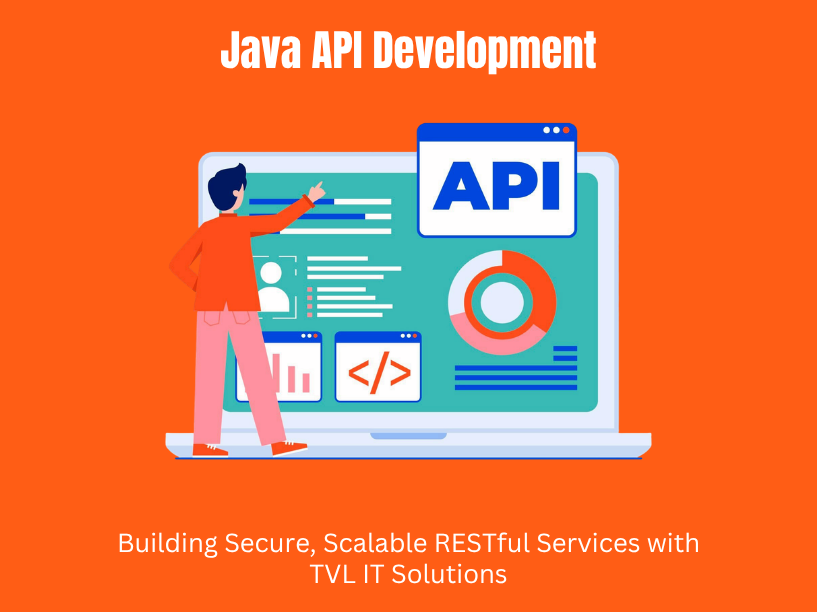

A java api, at its core, is a set of HTTP-based interfaces built with Java technologies that expose business logic as restful services consumable by any client – browsers, mobile apps, other microservices, or SaaS platforms. In 2026, RESTful APIs over HTTP remain the backbone of how modern software systems communicate. Java APIs enable communication between different software systems, and restful apis are widely used for building web services that power everything from single-page applications to complex enterprise integrations.
These rest api endpoints use standard HTTP methods – GET, POST, PUT, DELETE, PATCH – to perform crud operations on resources, allowing developers to build clean, predictable interfaces. TVL IT Solutions, an India-based custom software development company, specializes in secure, scalable java api development for startups, SMEs, and enterprises. This article covers java rest api work end-to-end: design principles, frameworks like spring boot and jax rs on Jakarta EE, testing, security, and real-world implementation patterns that drive production-grade results.
In Java, an application programming interface is the exposed set of java classes, interfaces, and methods that let software components interact. Concrete examples from the JDK include java.util.List for collection handling, java.sql.Connection for database access via JDBC, and java.net.http.HttpClient introduced in Java 11 for making outbound http request calls. Java offers over 100 APIs in its Standard Library alone, and Java APIs support various types like Web, Database, and OS APIs.
Beyond the standard library, developers rely on third-party libraries – Jackson for JSON serialization, Hibernate for ORM, cloud SDKs like AWS SDK for Java – to extend functionality. APIs simplify access to third party services in Java, whether you need to write objects to S3 or trigger serverless functions. Custom business APIs built within a project encapsulate domain logic specific to your application.
The main API categories relevant to backend projects break down as follows. Web APIs are restful apis over HTTP that expose business capabilities to clients and other services. Database APIs include JDBC, the java persistence api (JPA), and spring data jpa for object-relational mapping and data storage. OS and network APIs cover Java NIO and the HTTP client for file I/O and network calls. Cloud and SaaS SDKs – for instance, AWS SDK for Java – handle integration with external infrastructure services. REST APIs sit squarely in the web API category: they are HTTP-based, resource-oriented, and designed to handle requests from any client that speaks HTTP.
Restful apis in Java are stateless and use standard http methods to interact with resources identified by URLs. A resource like /api/v1/users or /api/v1/orders represents a domain concept, and the server returns responses in a specific format – typically JSON, occasionally xml. RESTful APIs should be stateless, containing all request information needed for the server to process each call independently, with no server-side session.
HTTP methods define actions for RESTful APIs, including GET, POST, PUT, PATCH, and DELETE. A get request to /products retrieves a list. A post request to /products creates a new resource. PUT sends a full update, PATCH a partial one, and DELETE removes the resource. GET, PUT, and DELETE are idempotent – repeating them yields the same result. POST is not. Response codes matter: 200 OK for a successful fetch data operation, 201 Created after a POST, 400 Bad Request for validation failures, 404 Not Found when a resource is absent, and 500 Internal Server Error for unhandled failures.
Consider a concrete example: a client sends GET /api/v1/users/42, and the server responds with status 200 OK and a JSON body: {“id”:42,”name”:”Alice”,”email”:”alice@example.com”}. In production, Java REST APIs run over HTTPS behind load balancers, API gateways (such as Kong or AWS API Gateway), or service meshes like Istio in microservice environments – forming a client server architecture that scales horizontally.
API design should ensure meaningful endpoint names and consistent formats across requests and responses. Before writing any java code, identify domain resources – User, Order, Invoice, GameSession – and map each to resource URIs and JSON schemas. This contract-first approach, often using OpenAPI, prevents drift between what the API promises and what the implementation delivers.
Restful api development follows specific design practices. Use plural, resource-based paths: /users, /orders/{id}. Support filtering, pagination, and sorting via query parameters, for instance /orders?status=PAID&page=1&size=20&sort=-createdDate. Using pagination is important to prevent returning unbounded database collections in responses. Apply consistent versioning patterns such as /api/v1 in the path for public APIs.
Map crud operations to http methods explicitly. Prefer PUT for full updates where the client sends the complete resource, and PATCH for partial updates. PUT and DELETE must be idempotent. Use separate request and response models – a UserDto at the API boundary versus a UserEntity in persistence – to decouple the external contract from internal code and database schema. This separation means your api endpoint contracts remain stable even when the database evolves.
For mobile and SaaS scenarios, minimize payload size by avoiding deeply nested data unless clients request it. Consider rate limits from day one, compression, and support for HTTP/2. Java APIs should prioritize RESTful design principles and security measures from the earliest design phase, ensuring a uniform interface that clients can rely on.
The two dominant ecosystems for restful api development in Java are spring boot and Jakarta EE with jax rs. Spring Boot simplifies REST API development with minimal configuration and auto configuration, making it the preferred choice for teams that want velocity. Use Spring Boot’s @RestController for clear api endpoints, and annotations like @GetMapping, @PostMapping, @PutMapping, and @DeleteMapping to map http methods to controller logic. Spring data jpa integrates seamlessly with databases for crud operations, and spring data jpa integrates easily with restful services through repository abstractions that handle pagination, sorting, and querying. The spring framework powers approximately 66% of cloud-native Java applications according to recent developer surveys.
Jakarta EE provides JAX-RS for building restful web services using a standards-based approach. JAX-RS is a Java standard for building restful web services, and jax rs uses annotations like @GET and @POST for api development, along with @Path, @PUT, and @DELETE. It runs on application servers like WildFly and Payara, or on lightweight runtimes such as Quarkus and Helidon. Jakarta EE adoption reached approximately 58% in 2025, running neck-and-neck with Spring in certain measurements.
TVL IT Solutions recommends spring boot for greenfield microservices, startup products, and APIs backing mobile apps – scenarios where speed and dependency injection flexibility matter most. For enterprises with existing application servers, standardized governance requirements, or legacy java ee investments, Jakarta EE offers vendor-neutral consistency. Both ecosystems use Maven or Gradle as build tools, and projects typically start from Spring Initializr or Maven archetypes to generate a jar file or deployable artifact. The java virtual machine underpins all of these, running java applications reliably across platforms with built in support for concurrency, memory management, and security.
Developing a high-performing Java API requires solid architectural principles. Here is the typical implementation flow TVL IT Solutions follows, applicable regardless of whether you choose Spring Boot or Jakarta EE.
First, define the domain model. For a “Task Management” API, this means creating java classes like Task with fields such as id, title, description, status, and dueDate. Think of this as the blueprint: something like import java.time.LocalDate at the top of your entity file.
Next, build the persistence layer. JPA entities annotated with @Entity map to database tables. Repositories or DAOs – using spring data jpa or generic JPA – handle data access. You can implement pagination and sorting using Spring Data JPA’s Pageable parameter, allowing developers to fetch data in bounded, efficient chunks.
The service layer encapsulates business logic. Methods like createTask(), getTasks(), updateTaskStatus(), and deleteTask() enforce rules – for instance, only certain status transitions are allowed, or only the task owner can delete. A minimal entry point class might include public static void main(String[] args) to bootstrap the application.
Finally, the controller layer exposes rest endpoints. A TaskController annotated with @RestController maps HTTP methods to service calls. A method signature like return responseentity.ok(taskService.getTasks(page, size)) handles a GET, while createTask(@RequestBody TaskDto dto) handles a POST. Validation annotations (@NotNull, @Size) on DTOs catch bad input and return 400 responses with structured error details.
TVL IT Solutions organizes Java API projects in layered architectures – controller, service, repository – to support long-term maintainability and team scaling across dedicated or hybrid engagement models.
Automated testing is necessary for comprehensive API quality assurance – it is non-negotiable for production systems. Testing APIs with JUnit and Mockito ensures expected functionality at the unit level: mock dependencies, verify service logic, and test edge cases like null inputs or unauthorized access. Testing RESTful APIs is crucial for ensuring expected functionality across the full stack, so integration tests using Spring’s MockMvc simulate real api calls against controller endpoints, while Testcontainers spin up dockerized databases for realistic data storage verification.
Structure tests around typical REST scenarios: happy-path GET/POST/PUT/DELETE, validation failures returning 400 responses, and concurrency edge cases like updating an already-deleted resource. Cover both the browser-facing and service-to-service flows.
Document APIs using tools like Swagger for better usability. API documentation should include endpoint descriptions and authentication requirements. Using Springdoc OpenAPI, annotate controllers with @Operation and @Schema to auto-generate interactive swagger ui documentation that frontend, mobile, and partner teams can use as a living reference. Keep docs versioned with the codebase.
Structured logging helps with observability and identifying performance issues. Log HTTP requests and return responses with redaction of sensitive fields like tokens or passwords. Monitoring and logging are crucial for observing API performance in production – collect request rates, latency percentiles, and error counts using tools like Micrometer feeding into Prometheus. For distributed systems, OpenTelemetry provides tracing across microservices.
TVL IT Solutions integrates testing, documentation generation, and security scanning into CI/CD pipelines, so every Java API change is validated before deployment – a practice that plays a crucial role in maintaining production reliability.
Security practices should be built into the API from the beginning, not bolted on after launch. Research indicates approximately 99% of organizations experienced API security incidents in the past year, with roughly 22% suffering actual data breaches through APIs. For authentication and authorization, use OAuth 2.1, OpenID Connect, or JWT bearer tokens. Spring Security or Jakarta Security enables role-based access control (RBAC), and security should apply the principle of least privilege to restrict resource access to only what each user or service needs.
Transport security should enforce TLS encryption to protect data in transit – enforce HTTPS everywhere, including internal service communications. Input validation is essential to prevent SQL injection and XSS attacks: validate and sanitize every parameter and request body. Implement rate limiting and throttling at the API gateway or filter level. Add HTTP security headers like Content-Security-Policy and Strict-Transport-Security. Handle secrets – database passwords, API keys – through environment variables or secret managers, never hardcoded in internal code or committed to Git.
On the performance side, use HTTP cache headers (ETag, Cache-Control) and server-side caches like Caffeine or Redis for expensive operations. HikariCP is a high-performance connection pool commonly used in java applications for efficient database access. Database indexing can improve performance by reducing query times, and asynchronous request handling suits long-running operations. For secure, high-performance Java web services, TVL IT Solutions has hardened multi-tenant SaaS APIs using Spring Security combined with JWT for tenant isolation, centralized logging across tenants, and per-tenant rate limits – all without exposing or sharing any confidential client data.
TVL IT Solutions applies these principles across diverse api development engagements. Here are three representative examples.
A startup needed a RESTful API for a mobile fitness app. TVL IT Solutions built it with Spring Boot, exposing /api/v1/workouts and /api/v1/sessions as rest endpoints consumed by Android and iOS clients. Authentication used JWT, personalized data was delivered via JSON, and the API supported offline-friendly patterns with pagination and lightweight payloads.
An SME required an internal REST API to unify data from Salesforce and Microsoft Dynamics. TVL IT Solutions developed Java connectors with scheduled sync endpoints, allowing developers on the client side to fetch data from a single coherent API rather than juggling two platforms. The web services layer handled data transformation and exposed combined dashboards.
A gaming company needed backend APIs for multiplayer matchmaking and in-game purchases. Java microservices orchestrated matchmaking logic, billing, and inventory management, with APIs serving both browser and mobile clients. Event streams handled real-time features alongside the RESTful layer.
TVL IT Solutions’ process follows a clear arc: discovery of business requirements and integration points, API contract design (OpenAPI-first where suitable), implementation with secure, scalable architecture, and iterative delivery with automated testing and monitoring. Their offshore, dedicated-team and hybrid engagement models support long-term API evolution, and these APIs in Java are often part of broader custom software development initiatives that include web frontends, mobile apps, or AI/ML-powered features.
From understanding core API concepts and RESTful principles to designing resource-oriented URLs, choosing between Spring Boot and Jakarta EE, implementing layered architectures, and hardening APIs with security and observability – the journey to a production-ready Java REST API demands a deep understanding of both the tools and the discipline. Every decision, from DTO separation to connection pooling, shapes whether your API will scale gracefully or buckle under load.
Well-designed Java APIs support scalable architecture, security-first development, and smooth integration across web, mobile, and enterprise systems. They build scalable foundations that adapt as your product grows. TVL IT Solutions serves as a long-term engineering partner for custom Java API development, digital transformation, and B2B SaaS backends – bringing the frameworks, testing rigor, and software development practices covered in this article to every engagement.
If you are evaluating your API strategy, consider auditing existing APIs for REST compliance, security gaps, and performance bottlenecks. Look at consolidating legacy SOAP or ad-hoc integrations into coherent restful web services. And when the scope demands experienced hands, engage a team that treats API development as an engineering discipline, not a checkbox.
Java API development involves building HTTP-based interfaces with Java that expose business logic as RESTful services for web, mobile, SaaS, and enterprise applications.
Spring Boot and Jakarta EE with JAX-RS are the two major frameworks discussed for building Java RESTful APIs.
Java REST APIs can use OAuth 2.1, OpenID Connect, JWT, role-based access control, HTTPS, input validation, rate limiting, and secure secret management.
JUnit and Mockito can be used for unit testing, while MockMvc and Testcontainers support integration testing and realistic database validation.
A layered architecture, resource-oriented API design, pagination, caching, database optimization, automated testing, monitoring, documentation, and security practices help create scalable Java APIs.
At TVL IT Solutions, we specialize in delivering scalable, secure, and custom software development services tailored to your unique business needs. Whether you’re a startup or an enterprise, our team is ready to turn your vision into reality.
Get Started Now